Promethium
Lanthanide · Period 6 · f-block
The lanthanide with no stable isotopes, found in fission waste
- Atomic mass
- 145 u
- State at 25 °C
- Solid
- Electronegativity
- 1.13
- Melting point
- 1,041.9 °C
- Boiling point
- 2,999.9 °C
- Configuration
- [Xe] 4f5 6s2
Nucleus drawn at reduced count for clarity. Drag to rotate.
Promethium, explained
Video lesson in production
Bhavya’s explainer for this element will play here.
Overview
Promethium is the only lanthanide with no stable isotope, and one of just two elements lighter than bismuth (with technetium) that are entirely radioactive. The reason is nuclear rather than chemical: by the Mattauch isobar rule, its neighbours neodymium and samarium already hold stable isotopes at every mass number promethium could use, so any promethium nucleus eventually beta-decays into one of them. The longest-lived isotope, promethium-145, has a half-life of only 17.7 years, so any promethium present when the Earth formed vanished long ago.
Chemically, promethium behaves like a typical lanthanide. Its configuration is [Xe]4f5 6s2, and it gives up the two 6s electrons and one 4f electron to form the Pm3+ ion, whose salts are pink to rose coloured. Most of what chemists know comes from tracer-scale work on promethium-147, a fission product extracted from spent nuclear fuel. Its weak beta radiation, which carries no strong gamma emission, made it useful in luminous paints and miniature nuclear batteries, where it replaced the far more hazardous radium.
Discovery
Element 61 was claimed several times in the 1920s, as 'illinium' in Illinois and 'florentium' in Florence, but neither claim held up. It was finally identified in 1945 by Jacob Marinsky, Lawrence Glendenin and Charles Coryell at Clinton Laboratories (now Oak Ridge National Laboratory), who separated it from uranium fission products using ion-exchange chromatography. The discovery was announced in 1947. Coryell's wife, Grace Mary Coryell, suggested the name after Prometheus, the Titan who stole fire from the gods.
- Where it’s found
- Only trace amounts occur naturally in uranium ores; usable quantities are extracted from spent nuclear fuel or made by neutron irradiation of neodymium.
- What it’s used for
- Nuclear (beta-voltaic) batteries
- Luminous paint
- Industrial thickness gauges
- Research tracer
- In living things
- None. It is radioactive, and absorbed promethium tends to deposit in bone, where its radiation can damage tissue.
- Safety
- Radioactive; all isotopes must be handled in shielded facilities, and inhaled or ingested material is the main hazard.
How it compares
Where Promethium sits among all 118 elements on the trends that shape the table.
- Electronegativity1.13Pauling
#83 of 100 elements with data
- Ionization energy540kJ/mol
#89 of 104 elements with data
- Atomic radius185pm
#11 of 95 elements with data
- Electron affinity12.4kJ/mol
#81 of 109 elements with data
- Density7.26g/cm³
#60 of 114 elements with data
- Melting point1,320K
#47 of 110 elements with data
- Density
- 7.26 g/cm³
- Atomic radius
- 185 pm
- Covalent radius
- 173 pm
- Molar heat
- —
- Appearance
- metallic
- Discovered by
- Chien Shiung Wu
Inside the atom
61 electrons arranged in 6 shells: 2 · 8 · 18 · 23 · 8 · 2.
Orbital diagram
1s2 2s2 2p6 3s2 3p6 4s2 3d10 4p6 5s2 4d10 5p6 6s2 4f5 · shorthand [Xe] 4f5 6s2
- 1s2
- 2s2
- 2p6
- 3s2
- 3p6
- 4s2
- 3d10
- 4p6
- 5s2
- 4d10
- 5p6
- 6s2
- 4f5
Each box is an orbital holding up to two electrons of opposite spin. Highlighted subshells hold the valence electrons that decide how Promethium bonds.
Ionization energies
Signature reactions
The chemistry Promethium is known for.
Nuclear · Beta decay
Formation from neodymium-147
Neodymium-146 captures a neutron to become neodymium-147, which beta-decays with an 11-day half-life into promethium-147. This route and fission of uranium-235 supply the world's promethium.
Conditions: neodymium-146 irradiated with neutrons in a reactor
Nuclear · Beta decay
Decay of promethium-147
A neutron in the nucleus turns into a proton, emitting an electron and an antineutrino and leaving stable samarium-147. These low-energy electrons are what light up phosphors in promethium paint and generate current in beta-voltaic cells.
Conditions: spontaneous, half-life 2.62 years
Acid–base
Dissolving promethium oxide
Like other lanthanide oxides, Pm2O3 is basic and dissolves in acid to give a solution of pink Pm3+ ions. Separating promethium from its neighbours then relies on ion-exchange columns, the same technique used in its discovery.
Conditions: dilute acid, shielded hot cell
Where you’ll meet it

Oak Ridge National Laboratory
Promethium was first identified here in 1945, when the site was still called Clinton Laboratories.
Photo: Wikimedia Commons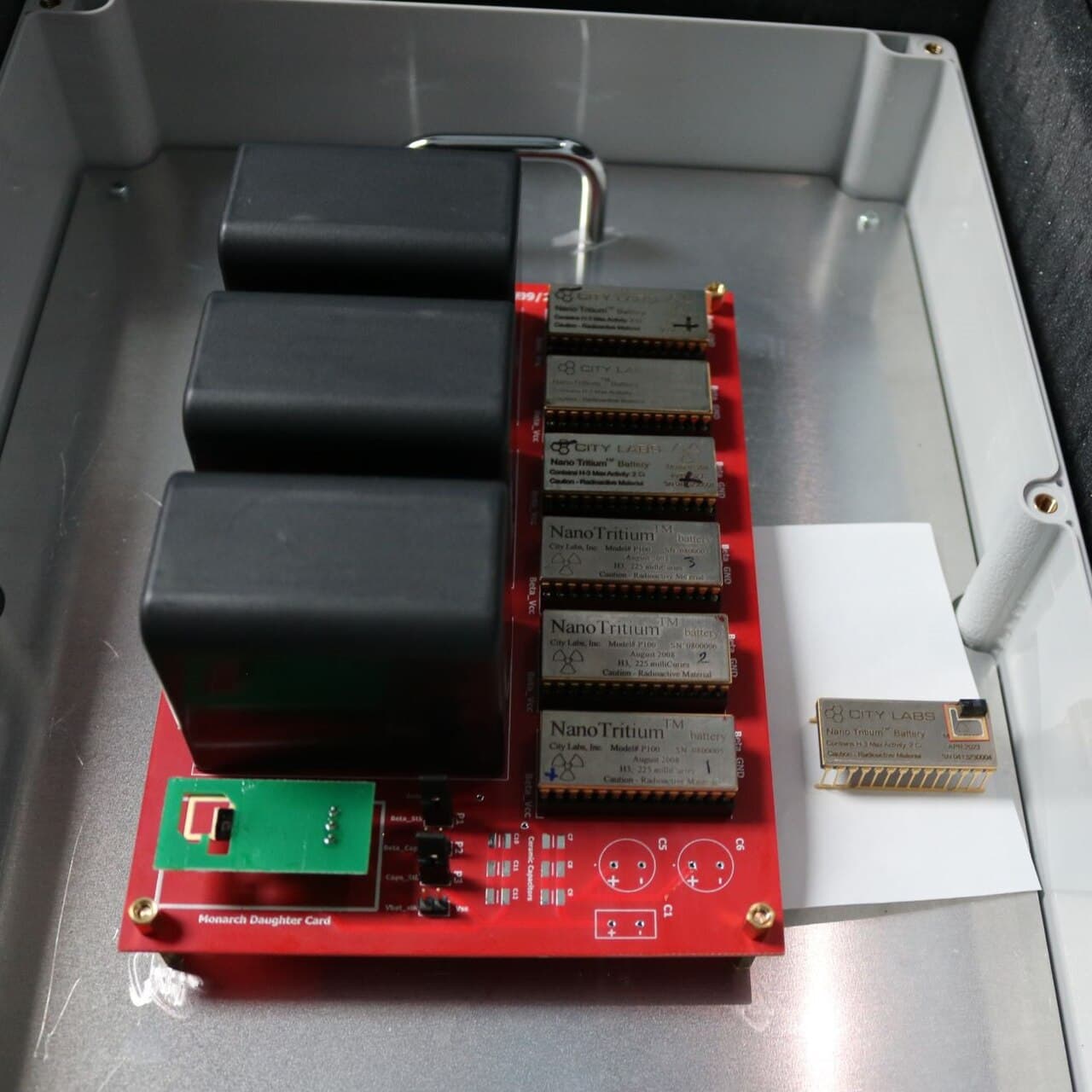
Atomic battery
Promethium-147 was one of the first isotopes used to turn beta radiation directly into electricity in compact batteries.
Photo: Wikimedia Commons
Radioluminescence
Promethium-147 replaced radium in self-luminous paints, where its beta particles make a phosphor glow without any external power.
Photo: Wikimedia Commons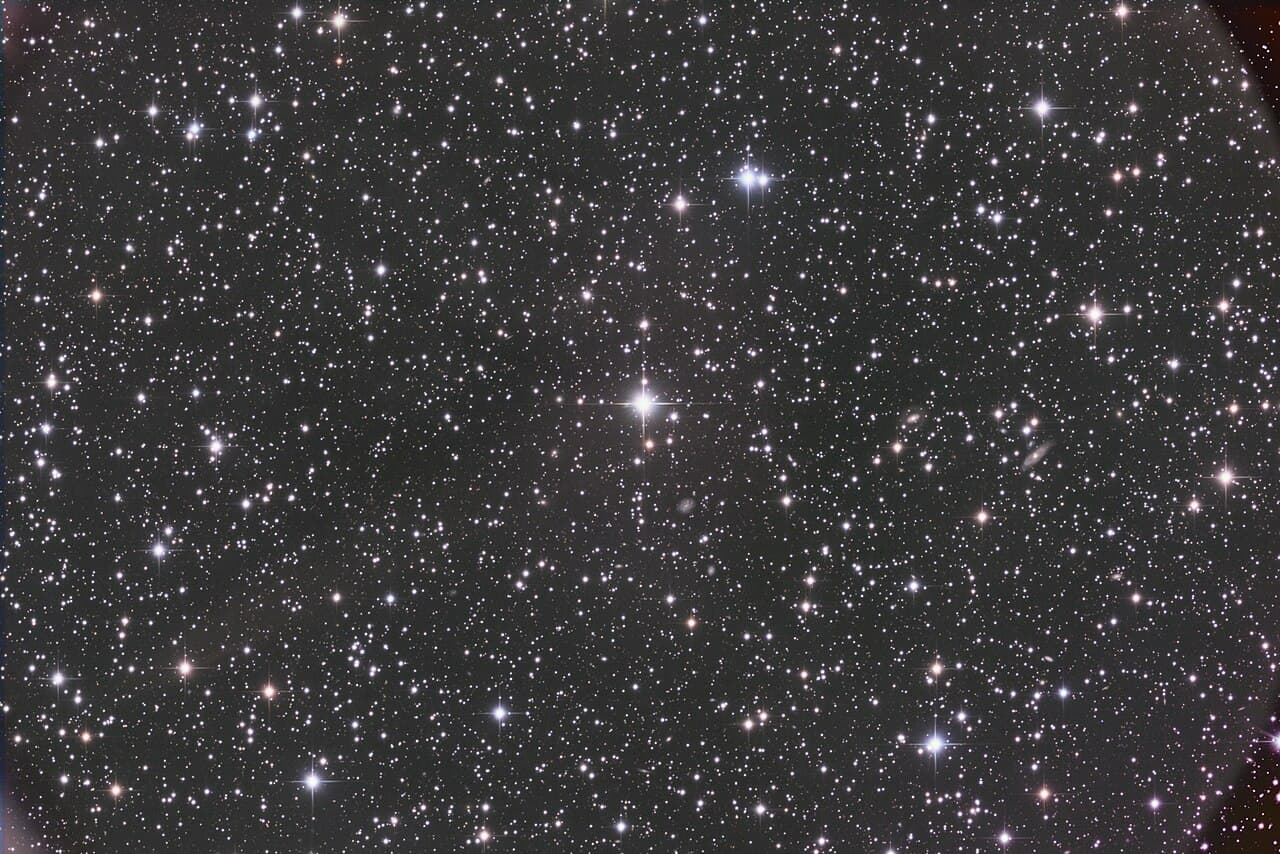
Przybylski's Star
This peculiar star's spectrum has been reported to contain promethium lines, a puzzle since the element is so short-lived.
Photo: Wikimedia Commons


Research
No research on Promethium yet
When Bhavya publishes a project that studies Promethium, it will be linked here.