Cerium
Lanthanide · Period 6 · f-block
The most common rare earth, from lighter sparks to polished glass
- Atomic mass
- 140.116 u
- State at 25 °C
- Solid
- Electronegativity
- 1.12
- Melting point
- 794.9 °C
- Boiling point
- 3,442.9 °C
- Configuration
- [Xe] 4f1 5d1 6s2
Nucleus drawn at reduced count for clarity. Drag to rotate.
Cerium, explained
Video lesson in production
Bhavya’s explainer for this element will play here.
Overview
Cerium is a soft, ductile, iron-grey lanthanide and the most abundant of the rare earth elements, about as common in the crust as copper. Its configuration is [Xe] 4f1 5d1 6s2. Like the other lanthanides it readily forms Ce^3+, but it is unique in also having a stable +4 state: losing a fourth electron empties the 4f subshell and leaves the xenon configuration. Ce^4+ is a strong oxidizing agent, used in titrations and organic synthesis, and the ease of switching between +3 and +4 underlies most of cerium's practical uses.
Cerium dioxide is the most effective compound known for polishing glass: it reacts chemically with the glass surface while grinding it, giving optical lenses and phone screens their flawless finish. In catalytic converters, ceria acts as an oxygen buffer, releasing oxygen when exhaust is fuel-rich and absorbing it when lean. Cerium metal is pyrophoric: scraping it sheds tiny particles that ignite in air. Mixed with iron and other lanthanides as ferrocerium, it produces the sparks in lighters and fire starters. Cerium oxide also absorbs ultraviolet light and decolourises glass.
Discovery
In 1803 Jöns Jacob Berzelius and Wilhelm Hisinger in Sweden, and independently Martin Heinrich Klaproth in Germany, found a new earth in a heavy mineral from Bastnäs, Sweden, now called cerite. Berzelius and Hisinger named the element after the dwarf planet Ceres, discovered two years earlier, which itself was named after the Roman goddess of agriculture. The metal was first isolated in 1875 by William Hillebrand and Thomas Norton.
- Where it’s found
- Cerium makes up about 60 parts per million of the crust and is extracted from bastnäsite and monazite, mainly in China.
- What it’s used for
- Glass polishing powder
- Catalytic converters
- Lighter flints (ferrocerium)
- UV-absorbing glass
- Self-cleaning ovens
- Steel and aluminium alloys
- In living things
- Cerium has no role in humans and has low toxicity. Like lanthanum, it can serve as a cofactor in methanol dehydrogenase enzymes of some bacteria.
- Safety
- Cerium metal shavings and powder can ignite spontaneously in air, so it is stored under oil or argon; cerium compounds have low toxicity.
How it compares
Where Cerium sits among all 118 elements on the trends that shape the table.
- Electronegativity1.12Pauling
#86 of 100 elements with data
- Ionization energy534kJ/mol
#91 of 104 elements with data
- Atomic radius185pm
#11 of 95 elements with data
- Electron affinity55kJ/mol
#45 of 109 elements with data
- Density6.77g/cm³
#67 of 114 elements with data
- Melting point1,070K
#63 of 110 elements with data
- Density
- 6.77 g/cm³
- Atomic radius
- 185 pm
- Covalent radius
- 163 pm
- Molar heat
- 26.94 J/(mol·K)
- Appearance
- silvery white
- Discovered by
- Martin Heinrich Klaproth
Inside the atom
58 electrons arranged in 6 shells: 2 · 8 · 18 · 19 · 9 · 2.
Orbital diagram
1s2 2s2 2p6 3s2 3p6 4s2 3d10 4p6 5s2 4d10 5p6 6s2 5d1 4f1 · shorthand [Xe] 4f1 5d1 6s2
- 1s2
- 2s2
- 2p6
- 3s2
- 3p6
- 4s2
- 3d10
- 4p6
- 5s2
- 4d10
- 5p6
- 6s2
- 5d1
- 4f1
Each box is an orbital holding up to two electrons of opposite spin. Highlighted subshells hold the valence electrons that decide how Cerium bonds.
Ionization energies
Signature reactions
The chemistry Cerium is known for.
Redox · Combustion
Sparking in air
Particles scraped from cerium or ferrocerium are hot enough to ignite, burning brilliantly to form cerium dioxide. The glowing fragments are what light a lighter's fuel.
Conditions: fine particles in air, initiated by friction
Redox · Reversible
Oxygen storage in catalytic converters
When exhaust is short of oxygen, ceria gives up some of its lattice oxygen; when oxygen is in excess, Ce2O3 takes it back. This buffering keeps the precious metal catalyst working efficiently.
Conditions: hot exhaust, 300–900 °C
Redox · Analysis
Cerimetric titration
Yellow-orange cerium(IV) oxidizes iron(II) and becomes colourless cerium(III). Analysts use this one-electron transfer to measure iron and other reducing agents precisely.
Conditions: acidic aqueous solution
Where you’ll meet it
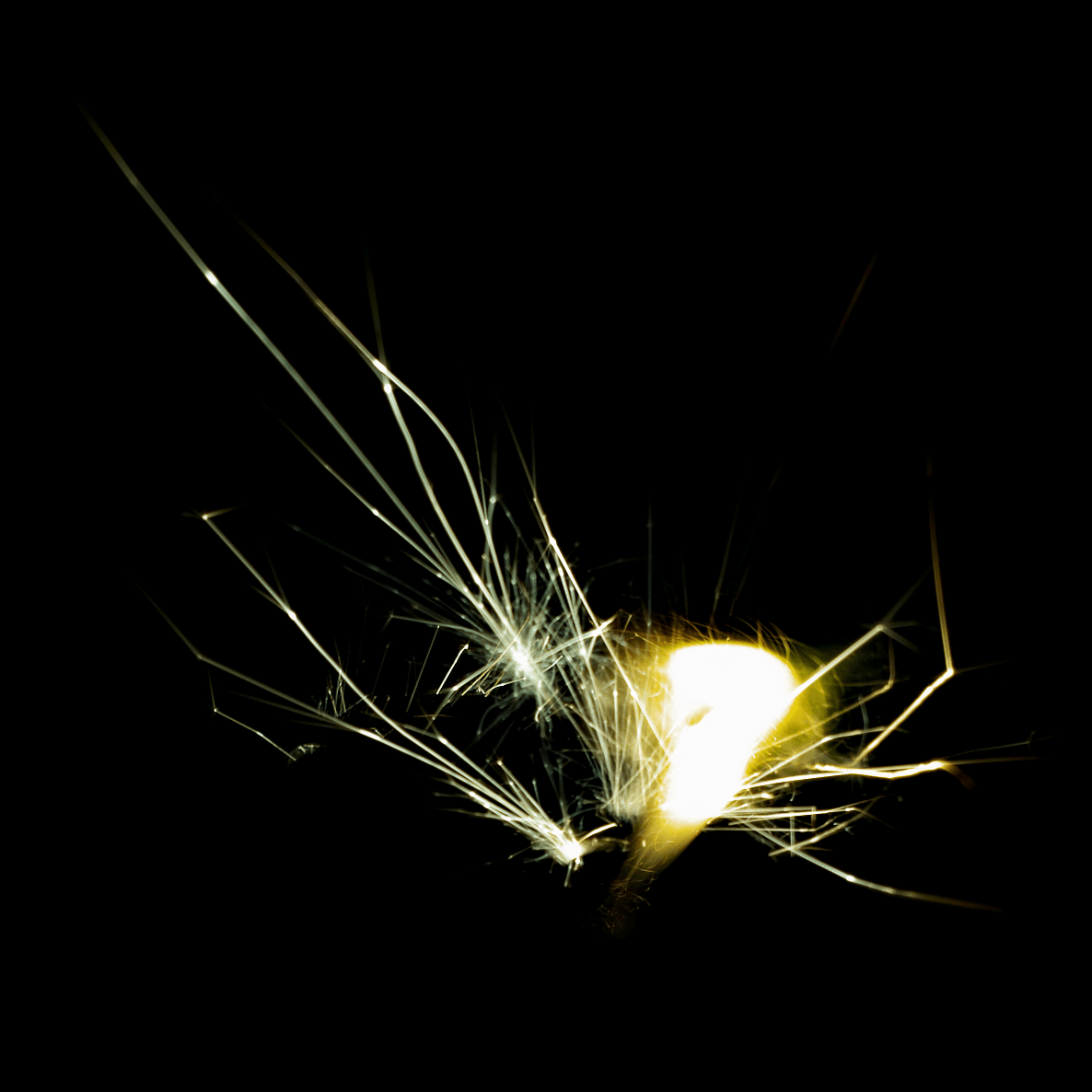
Ferrocerium
Ferrocerium rods throw hot sparks because cerium ignites when scraped.
Photo: Wikimedia Commons


Research
No research on Cerium yet
When Bhavya publishes a project that studies Cerium, it will be linked here.