Gadolinium
Lanthanide · Period 6 · f-block
Magnetic at room temperature and the metal behind MRI contrast
- Atomic mass
- 157.253 u
- State at 25 °C
- Solid
- Electronegativity
- 1.2
- Melting point
- 1,311.9 °C
- Boiling point
- 2,999.9 °C
- Configuration
- [Xe] 4f7 5d1 6s2
Nucleus drawn at reduced count for clarity. Drag to rotate.
Gadolinium, explained
Video lesson in production
Bhavya’s explainer for this element will play here.
Overview
Gadolinium sits in the middle of the lanthanide row with the configuration [Xe]4f7 5d1 6s2. Losing three electrons gives Gd3+, which keeps a half-filled 4f shell with seven unpaired electrons, the largest number any ion can have. That gives gadolinium an unusually large magnetic moment. The metal is ferromagnetic below about 20 °C, close to room temperature, so a piece of gadolinium cooled in a fridge will stick to a magnet and then let go as it warms up.
In the clinic, those seven unpaired electrons speed up the relaxation of nearby water protons, which brightens tissues in magnetic resonance imaging. Free Gd3+ is toxic because it is about the same size as Ca2+ and interferes with calcium-dependent processes, so it is always given tightly wrapped in a chelating molecule. Gadolinium-157 also captures slow neutrons more strongly than any other stable nuclide, making the element valuable for reactor control and neutron detection.
Discovery
Swiss chemist Jean Charles Galissard de Marignac detected the spectral lines of a new element in 1880 in samples derived from the minerals gadolinite and samarskite. In 1886 Paul-Émile Lecoq de Boisbaudran isolated its oxide and named it gadolinium after gadolinite, which itself honours the Finnish chemist Johan Gadolin, a pioneer of rare-earth research. Pure metallic gadolinium was first prepared in 1935 by Félix Trombe.
- Where it’s found
- About 6 parts per million of Earth's crust, extracted mainly from monazite and bastnäsite.
- What it’s used for
- MRI contrast agents
- Reactor control and shielding
- Magnetic refrigeration research
- X-ray intensifying screens
- Neutron radiography
- In living things
- No natural biological role. Free Gd3+ is toxic, and small amounts from contrast agents can remain in the brain and bones, so agents are given only when needed.
- Safety
- Bulk metal is fairly stable; fine powder can ignite, and soluble gadolinium salts should not be ingested.
How it compares
Where Gadolinium sits among all 118 elements on the trends that shape the table.
- Electronegativity1.2Pauling
#79 of 100 elements with data
- Ionization energy593kJ/mol
#70 of 104 elements with data
- Atomic radius180pm
#17 of 95 elements with data
- Electron affinity13.2kJ/mol
#80 of 109 elements with data
- Density7.9g/cm³
#55 of 114 elements with data
- Melting point1,590K
#38 of 110 elements with data
- Density
- 7.9 g/cm³
- Atomic radius
- 180 pm
- Covalent radius
- 169 pm
- Molar heat
- 37.03 J/(mol·K)
- Appearance
- silvery white
- Discovered by
- Jean Charles Galissard de Marignac
Inside the atom
64 electrons arranged in 6 shells: 2 · 8 · 18 · 25 · 9 · 2.
Orbital diagram
1s2 2s2 2p6 3s2 3p6 4s2 3d10 4p6 5s2 4d10 5p6 6s2 4f7 5d1 · shorthand [Xe] 4f7 5d1 6s2
- 1s2
- 2s2
- 2p6
- 3s2
- 3p6
- 4s2
- 3d10
- 4p6
- 5s2
- 4d10
- 5p6
- 6s2
- 4f7
- 5d1
Each box is an orbital holding up to two electrons of opposite spin. Highlighted subshells hold the valence electrons that decide how Gadolinium bonds.
Ionization energies
Signature reactions
The chemistry Gadolinium is known for.
Redox · Single displacement
Reaction with water
Gadolinium slowly reduces water, giving off hydrogen and forming white gadolinium hydroxide. The reaction is gentler than for europium because gadolinium's metallic bonding uses three electrons.
Conditions: slow in cold water, faster when hot
Redox · Combustion
Oxidation in air
The metal tarnishes slowly at room temperature and burns when heated, forming white gadolinium oxide. The oxide flakes off and does not protect the metal underneath.
Conditions: slow in moist air, rapid above 150 °C
Redox · Metal extraction
Calciothermic reduction
Calcium, a stronger reducing agent, strips fluorine from gadolinium fluoride to give molten gadolinium metal and a calcium fluoride slag. Most heavy lanthanide metals are produced this way.
Conditions: about 1450 °C, argon atmosphere, tantalum crucible
Where you’ll meet it

Magnetic resonance imaging
Gadolinium-based agents are injected in a large share of MRI scans to sharpen contrast between tissues.
Photo: Wikimedia Commons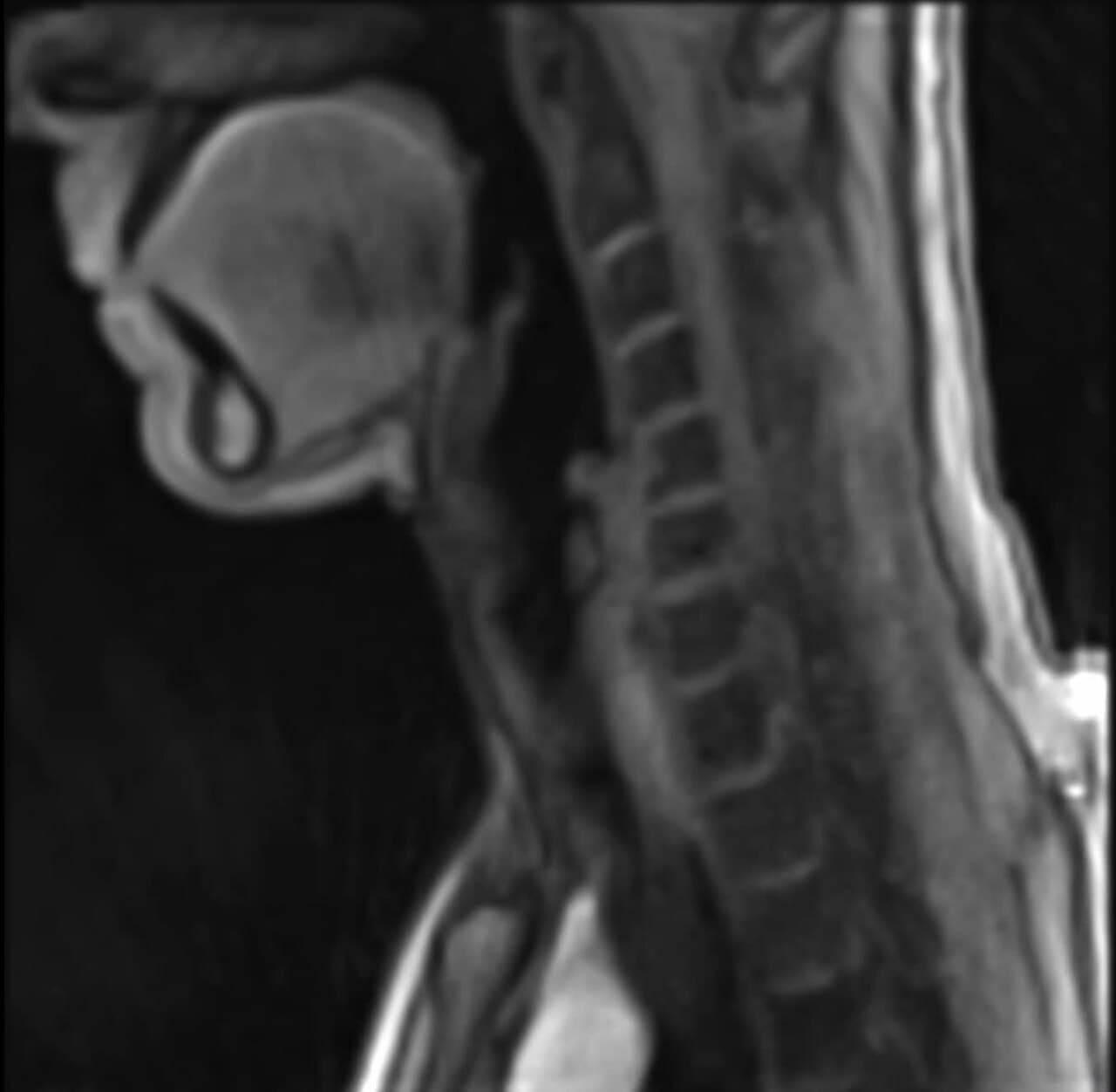
MRI contrast agent
Most MRI contrast agents are gadolinium chelates that shorten the relaxation time of water protons.
Photo: Wikimedia Commons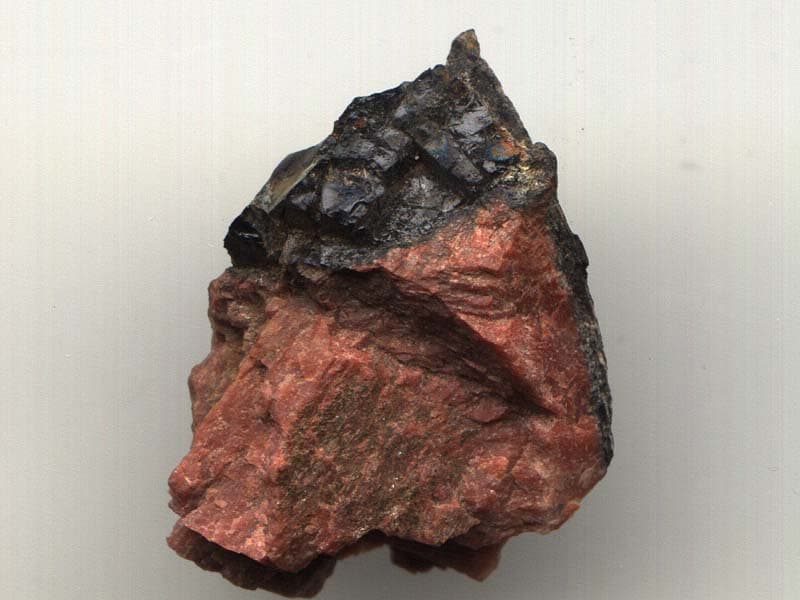
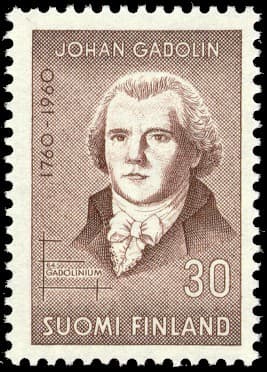
Johan Gadolin
The Finnish chemist honoured by gadolinite, and through it by the element.
Photo: Wikimedia Commons


Research
No research on Gadolinium yet
When Bhavya publishes a project that studies Gadolinium, it will be linked here.