Europium
Lanthanide · Period 6 · f-block
The red glow in old TV screens and the glow on euro notes
- Atomic mass
- 151.964 u
- State at 25 °C
- Solid
- Electronegativity
- 1.2
- Melting point
- 825.9 °C
- Boiling point
- 1,528.9 °C
- Configuration
- [Xe] 4f7 6s2
Nucleus drawn at reduced count for clarity. Drag to rotate.
Europium, explained
Video lesson in production
Bhavya’s explainer for this element will play here.
Overview
Europium has the configuration [Xe]4f7 6s2, and its half-filled 4f shell explains most of its character. Because 4f7 is especially stable, europium readily stops at the Eu2+ ion after losing only its two 6s electrons, behaving more like calcium or strontium than like a typical lanthanide. Only two electrons enter its metallic bonding instead of three, so the metal is the least dense lanthanide, melts at a low 822 °C, and is the most reactive of the rare earths: it tarnishes within hours in air and must be stored under oil or argon.
Europium's ions are famous emitters of light. Eu3+ gives a sharp, saturated red line near 612 nanometres, while Eu2+ produces broad blue to green emission depending on its host crystal. In both cases the 4f electrons are shielded by outer shells, so their energy levels shift little from host to host. Phosphors such as yttrium oxide doped with europium supplied the red in colour televisions and fluorescent lamps, and Eu2+ is the activator in glow-in-the-dark strontium aluminate.
Discovery
Europium's spectral lines were noticed in samarium samples during the 1880s and 1890s, but French chemist Eugène-Anatole Demarçay was the first to separate it convincingly, isolating it in 1901 after painstaking fractional crystallisation of samarium magnesium nitrate. He named it after the continent of Europe. Pure europium metal was not produced until 1937, and large-scale separation became practical only in the 1950s with ion-exchange methods.
- Where it’s found
- About 2 parts per million of Earth's crust, obtained mainly from bastnäsite and monazite, where it is concentrated by reduction to Eu2+.
- What it’s used for
- Red television and LED phosphors
- Anti-counterfeiting inks
- Glow-in-the-dark pigments
- Fluorescent lamps
- Reactor control rods
- In living things
- No biological role. Europium compounds are of low toxicity, though fine metal dust is a fire and irritation hazard.
- Safety
- The metal reacts with air and water and can ignite as a powder; store it under mineral oil or inert gas.
How it compares
Where Europium sits among all 118 elements on the trends that shape the table.
- Electronegativity1.2Pauling
#79 of 100 elements with data
- Ionization energy547kJ/mol
#87 of 104 elements with data
- Atomic radius185pm
#11 of 95 elements with data
- Electron affinity11.2kJ/mol
#82 of 109 elements with data
- Density5.26g/cm³
#79 of 114 elements with data
- Melting point1,100K
#60 of 110 elements with data
- Density
- 5.26 g/cm³
- Atomic radius
- 185 pm
- Covalent radius
- 168 pm
- Molar heat
- 27.66 J/(mol·K)
- Appearance
- —
- Discovered by
- Eugène-Anatole Demarçay
Inside the atom
63 electrons arranged in 6 shells: 2 · 8 · 18 · 25 · 8 · 2.
Orbital diagram
1s2 2s2 2p6 3s2 3p6 4s2 3d10 4p6 5s2 4d10 5p6 6s2 4f7 · shorthand [Xe] 4f7 6s2
- 1s2
- 2s2
- 2p6
- 3s2
- 3p6
- 4s2
- 3d10
- 4p6
- 5s2
- 4d10
- 5p6
- 6s2
- 4f7
Each box is an orbital holding up to two electrons of opposite spin. Highlighted subshells hold the valence electrons that decide how Europium bonds.
Ionization energies
Signature reactions
The chemistry Europium is known for.
Redox · Single displacement
Dissolving in dilute sulfuric acid
Europium dissolves quickly with vigorous fizzing as hydrogen is released, forming a nearly colourless solution of Eu3+. The speed of the reaction reflects europium's position as the most reactive lanthanide.
Conditions: dilute acid, room temperature
Redox · Separation chemistry
Reduction of Eu3+ by zinc
Zinc reduces Eu3+ to Eu2+, something it cannot do for the neighbouring lanthanides. The Eu2+ can then be precipitated as insoluble EuSO4, which is how europium is pulled out of a mixture of chemically similar rare earths.
Conditions: acidic solution passed over zinc
Redox · Combustion
Burning in air
Heated europium burns to white europium(III) oxide. This oxide is the starting material for the red phosphors used in displays and lamps.
Conditions: ignites at about 150–180 °C
Where you’ll meet it

Euro banknotes
Europium fluorescence is used in the hidden UV-glowing security features of euro notes.
Photo: Wikimedia Commons
Strontium aluminate
Doped with europium and dysprosium, this pigment glows for hours after the lights go out.
Photo: Wikimedia Commons
Color television
Europium-doped red phosphors, introduced in the mid-1960s, made the red on colour TV screens much brighter.
Photo: Wikimedia Commons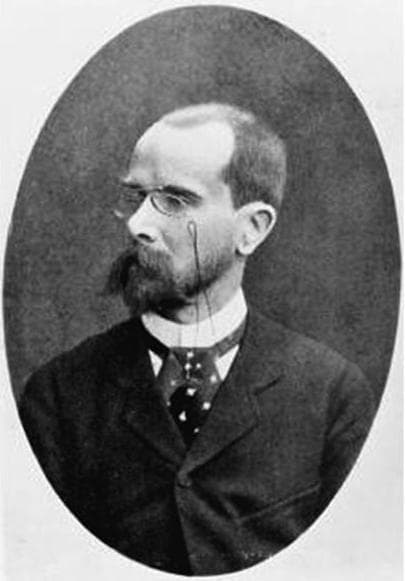
Eugène-Anatole Demarçay
The French chemist who isolated europium in 1901 and named it after Europe.
Photo: Wikimedia Commons


Research
No research on Europium yet
When Bhavya publishes a project that studies Europium, it will be linked here.