Neodymium
Lanthanide · Period 6 · f-block
The rare earth inside the world's strongest permanent magnets
- Atomic mass
- 144.242 u
- State at 25 °C
- Solid
- Electronegativity
- 1.14
- Melting point
- 1,023.9 °C
- Boiling point
- 3,073.9 °C
- Configuration
- [Xe] 4f4 6s2
Nucleus drawn at reduced count for clarity. Drag to rotate.
Neodymium, explained
Video lesson in production
Bhavya’s explainer for this element will play here.
Overview
Neodymium is a silvery lanthanide with the configuration [Xe] 4f4 6s2. Its Nd^3+ ions have three unpaired 4f electrons, and because these electrons are shielded deep inside the atom, they keep their magnetic moments when the atom is bonded in a solid. That is the key to neodymium's fame. In the compound Nd2Fe14B, neodymium locks the magnetic moments of iron atoms into one preferred direction, producing magnets that resist demagnetization and store more magnetic energy than any other permanent magnet material.
Neodymium-iron-boron magnets, invented in 1982–84, made small, powerful motors possible. They are found in electric vehicle motors, direct-drive wind turbines, hard drives, earbuds and phone vibration motors. The same sharp 4f transitions that give neodymium salts a lilac colour also make Nd^3+ an excellent laser ion: Nd:YAG and Nd-glass lasers emit infrared light at about 1,064 nm, used for cutting, eye surgery and fusion research. Neodymium glass looks lavender in daylight but blue under fluorescent light. Despite its 'rare earth' label, neodymium is more abundant in the crust than cobalt or lead.
Discovery
Neodymium was separated in 1885 by Carl Auer von Welsbach in Vienna, who split didymium, previously considered a single element, into two. One fraction gave green salts (praseodymium) and the other pink-violet salts, which he named neodymium, the 'new twin'. Pure neodymium metal was first produced in 1925. The modern magnet was developed independently in the early 1980s by Masato Sagawa at Sumitomo Special Metals and by John Croat's group at General Motors.
- Where it’s found
- Neodymium makes up about 40 parts per million of the crust and is mined from bastnäsite and monazite, with China producing most of the world's supply.
- What it’s used for
- Permanent magnets
- Electric vehicle motors
- Wind turbine generators
- Nd:YAG lasers
- Headphones and speakers
- Coloured and filter glass
- In living things
- Neodymium has no biological role in humans and has low toxicity, though its dust irritates the lungs and eyes.
- Safety
- Neodymium magnets are strong enough to pinch skin and shatter if they snap together, and they can be dangerous if swallowed; the metal powder is flammable.
How it compares
Where Neodymium sits among all 118 elements on the trends that shape the table.
- Electronegativity1.14Pauling
#82 of 100 elements with data
- Ionization energy533kJ/mol
#92 of 104 elements with data
- Atomic radius185pm
#11 of 95 elements with data
- Electron affinity185kJ/mol
#11 of 109 elements with data
- Density7.01g/cm³
#65 of 114 elements with data
- Melting point1,300K
#48 of 110 elements with data
- Density
- 7.01 g/cm³
- Atomic radius
- 185 pm
- Covalent radius
- 174 pm
- Molar heat
- 27.45 J/(mol·K)
- Appearance
- silvery white
- Discovered by
- Carl Auer von Welsbach
Inside the atom
60 electrons arranged in 6 shells: 2 · 8 · 18 · 22 · 8 · 2.
Orbital diagram
1s2 2s2 2p6 3s2 3p6 4s2 3d10 4p6 5s2 4d10 5p6 6s2 4f4 · shorthand [Xe] 4f4 6s2
- 1s2
- 2s2
- 2p6
- 3s2
- 3p6
- 4s2
- 3d10
- 4p6
- 5s2
- 4d10
- 5p6
- 6s2
- 4f4
Each box is an orbital holding up to two electrons of opposite spin. Highlighted subshells hold the valence electrons that decide how Neodymium bonds.
Ionization energies
Signature reactions
The chemistry Neodymium is known for.
Redox · Oxidation
Tarnishing in air
Neodymium oxidizes in moist air, forming a flaking oxide layer. Neodymium magnets are therefore plated with nickel or coated in epoxy to protect them.
Conditions: room temperature, faster when heated
Acid–base · Hydrofluorination
Making neodymium fluoride
Hydrogen fluoride converts neodymium oxide into anhydrous neodymium fluoride. The fluoride is the feed for producing neodymium metal by reduction or molten-salt electrolysis.
Conditions: anhydrous HF, about 600 °C
Redox · Metal extraction
Calciothermic reduction
Calcium, a stronger reducing agent, takes fluorine from neodymium fluoride, leaving molten neodymium metal under a calcium fluoride slag.
Conditions: argon atmosphere, above 1,000 °C
Where you’ll meet it

Neodymium magnet
Nd-Fe-B magnets are the strongest permanent magnets available.
Photo: Wikimedia Commons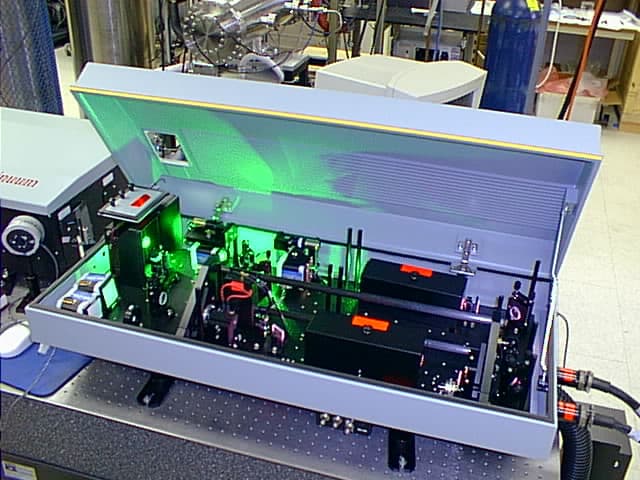
Nd:YAG laser
Nd:YAG lasers use neodymium ions in a garnet crystal to produce infrared light.
Photo: Wikimedia Commons
Headphones
Many headphones use small, powerful neodymium magnets in their drivers.
Photo: Wikimedia Commons
Wind turbine
Direct-drive wind turbines use neodymium magnets in their generators.
Photo: Wikimedia Commons


Research
No research on Neodymium yet
When Bhavya publishes a project that studies Neodymium, it will be linked here.