Potassium
Alkali metal · Period 4 · Group 1 · s-block
The explosive alkali metal hiding in every banana
- Atomic mass
- 39.098 u
- State at 25 °C
- Solid
- Electronegativity
- 0.82
- Melting point
- 63.6 °C
- Boiling point
- 758.9 °C
- Configuration
- [Ar] 4s1
Potassium, explained
Overview
Potassium ([Ar]4s1) has one valence electron in its fourth shell, farther from the nucleus and better shielded than sodium's. Removing it takes only 419 kJ/mol, so potassium is more reactive than sodium: dropped into water, it releases hydrogen fast enough to ignite it with a lilac flame. The metal is soft, waxy and lighter than water, with a density of 0.86 g/cm3, and it tarnishes within seconds in air. The large K+ ion forms mostly soluble salts, which is why potassium is found in brines and evaporite deposits.
Every living cell keeps a high concentration of potassium inside, about 140 millimolar, and pumps sodium out; the resulting gradient sets the electrical potential of cell membranes and makes nerve and heart signals possible. Plants need potassium in large amounts, so most mined potassium becomes potash fertilizer. About 0.012% of natural potassium is the radioactive isotope potassium-40 (half-life 1.25 billion years), which makes potassium the largest source of natural radioactivity inside the human body and the basis of potassium-argon dating.
Discovery
On 6 October 1807 Humphry Davy, at the Royal Institution in London, passed a current from a powerful voltaic battery through slightly moist molten potash (potassium hydroxide). Tiny globules of metal formed and burst into flame, the first metal ever isolated by electrolysis. He named it after potash, the alkali obtained by soaking plant ashes in pots. The symbol K comes from the Latin kalium, derived from the Arabic al-qali, plant ashes.
- Where it’s found
- Potassium makes up about 2% of the crust; it is mined from potash deposits of sylvite and carnallite, mainly in Canada, Russia and Belarus, and the metal is made by reducing molten potassium chloride with sodium.
- What it’s used for
- Potash fertilizers
- Soft soaps
- Salt substitutes
- Fireworks and gunpowder
- Specialty glass
- Medical electrolyte solutions
- In living things
- Potassium is essential: it is the main positive ion inside cells, maintaining membrane potential for nerve, muscle and heart function. Both too little and too much potassium in the blood can cause dangerous heart rhythms.
- Safety
- Potassium metal reacts violently with water and ignites the hydrogen released; it is stored under mineral oil. Old potassium can develop a crust of superoxide that may explode when cut or handled.
How it compares
Where Potassium sits among all 118 elements on the trends that shape the table.
- Electronegativity0.82Pauling
#97 of 100 elements with data
- Ionization energy419kJ/mol
#101 of 104 elements with data
- Atomic radius220pm
#3 of 95 elements with data
- Electron affinity48.4kJ/mol
#53 of 109 elements with data
- Density0.862g/cm³
#102 of 114 elements with data
- Melting point337K
#91 of 110 elements with data
- Density
- 0.862 g/cm³
- Atomic radius
- 220 pm
- Covalent radius
- 196 pm
- Molar heat
- 29.6 J/(mol·K)
- Appearance
- silvery gray
- Discovered by
- Humphry Davy
Inside the atom
19 electrons arranged in 4 shells: 2 · 8 · 8 · 1.
Orbital diagram
1s2 2s2 2p6 3s2 3p6 4s1 · shorthand [Ar] 4s1
- 1s2
- 2s2
- 2p6
- 3s2
- 3p6
- 4s1
Each box is an orbital holding up to two electrons of opposite spin. Highlighted subshells hold the valence electrons that decide how Potassium bonds.
Ionization energies
Signature reactions
The chemistry Potassium is known for.
Redox · Single displacement
Potassium with water
Potassium skims across water and the hydrogen it releases catches fire immediately, burning with a lilac flame; the metal often spits or explodes at the end. The reaction is more violent than sodium's because potassium's outer electron is held less tightly. The resulting solution is strongly alkaline potassium hydroxide.
Conditions: room temperature
Redox · Synthesis
Formation of potassium superoxide
Burning potassium forms yellow potassium superoxide rather than a simple oxide, because the large K+ ion stabilizes the large O2- ion. Potassium superoxide releases oxygen when it absorbs moisture and carbon dioxide. It has been used in rebreathers and in spacecraft life-support systems.
Conditions: burning in air or oxygen
Redox · Equilibrium
Industrial production of potassium
Sodium vapour passed through molten potassium chloride produces potassium vapour. The equilibrium does not favour potassium, but because potassium is more volatile, it is continuously distilled off, driving the reaction forward. This is a neat application of Le Chatelier's principle.
Conditions: about 850 °C
Where you’ll meet it

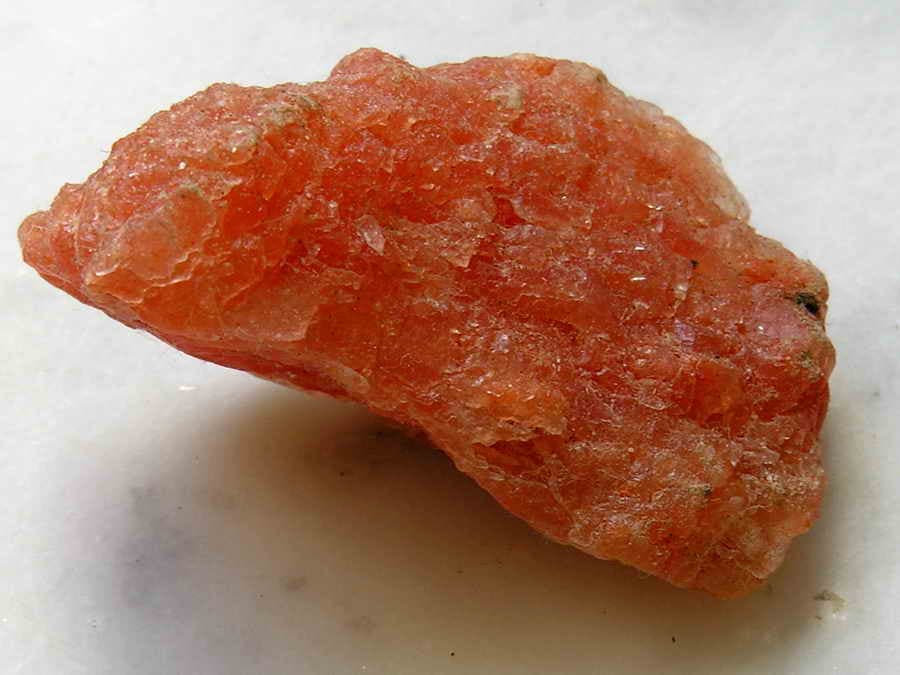
Sylvite
Sylvite, potassium chloride, is the main ore mined for potash fertilizer.
Photo: Wikimedia Commons
Potash
Potash, mined from ancient evaporated seas, supplies the potassium in fertilizers.
Photo: Wikimedia Commons


Research
No research on Potassium yet
When Bhavya publishes a project that studies Potassium, it will be linked here.