Argon
Noble gas · Period 3 · Group 18 · p-block
The lazy gas that fills one percent of every breath
- Atomic mass
- 39.948 u
- State at 25 °C
- Gas
- Electronegativity
- —
- Melting point
- -189.3 °C
- Boiling point
- -185.8 °C
- Configuration
- [Ne] 3s2 3p6
Argon, explained
Overview
Argon has a full outer shell ([Ne]3s2 3p6), and removing an electron takes 1521 kJ/mol, so it shows almost no chemical reactivity. No stable argon compound exists at ordinary temperatures; the only known neutral compound, HArF, survives only below about 27 K. Argon is a colourless, odourless gas that boils at -186 °C. It is denser than air, about 1.4 times, and it conducts heat poorly, properties that make it useful as an inert blanket and an insulating fill.
Argon makes up 0.93% of Earth's atmosphere, more than 20 times the amount of carbon dioxide, making it by far the most common noble gas on Earth. Nearly all of it is argon-40, produced over billions of years by the radioactive decay of potassium-40 in rocks; the same decay is used to date volcanic rocks. Because it is cheap and inert, argon shields hot metal from oxygen during welding, protects molten steel and growing silicon crystals, and fills incandescent bulbs and double-glazed windows. In a discharge tube it glows violet-blue.
Discovery
In 1892 Lord Rayleigh noticed that nitrogen extracted from air was about 0.5% denser than nitrogen made from ammonia. Working with William Ramsay, he removed the nitrogen from air by passing it over hot magnesium and in 1894 isolated a small residue of a previously unknown gas. They named it argon, from the Greek argos, meaning lazy or idle, because it would not react. Both received Nobel Prizes in 1904, Rayleigh in physics and Ramsay in chemistry.
- Where it’s found
- Argon makes up 0.93% of the atmosphere and is obtained by fractional distillation of liquid air.
- What it’s used for
- Welding shielding gas
- Steel refining
- Incandescent and fluorescent lamps
- Window insulation
- Silicon crystal growth
- Wine preservation
- In living things
- Argon has no biological role and is non-toxic.
- Safety
- Argon is non-toxic, but because it is heavier than air it can pool in low or enclosed spaces and cause asphyxiation without warning. Liquid argon causes cold burns.
How it compares
Where Argon sits among all 118 elements on the trends that shape the table.
- ElectronegativityNo data
Not measured for this element
- Ionization energy1,520kJ/mol
#4 of 104 elements with data
- Atomic radius71pm
#90 of 95 elements with data
- Electron affinity-96kJ/mol
#104 of 109 elements with data
- Density0.002g/cm³
#108 of 114 elements with data
- Melting point83.8K
#104 of 110 elements with data
- Density
- 1.78 g/L
- Atomic radius
- 71 pm
- Covalent radius
- 96 pm
- Molar heat
- —
- Appearance
- colorless gas exhibiting a lilac/violet glow when placed in a high voltage electric field
- Discovered by
- Lord Rayleigh
Inside the atom
18 electrons arranged in 3 shells: 2 · 8 · 8.
Orbital diagram
1s2 2s2 2p6 3s2 3p6 · shorthand [Ne] 3s2 3p6
- 1s2
- 2s2
- 2p6
- 3s2
- 3p6
Each box is an orbital holding up to two electrons of opposite spin. Highlighted subshells hold the valence electrons that decide how Argon bonds.
Ionization energies
Signature reactions
The chemistry Argon is known for.
Nuclear · Electron capture
Electron capture by potassium-40
About 11% of decaying potassium-40 nuclei capture an inner electron, turning a proton into a neutron and producing argon-40. The argon gets trapped in crystallizing minerals, so measuring the ratio of argon-40 to potassium-40 dates volcanic rocks. Over Earth's history, this decay produced nearly all atmospheric argon.
Conditions: spontaneous, half-life 1.25 billion years
Photochemical · Matrix isolation
Formation of argon fluorohydride
Ultraviolet light breaks HF molecules frozen in solid argon, and the hydrogen and fluorine atoms then bond to an argon atom. Researchers in Helsinki identified HArF in 2000 by its infrared spectrum. It decomposes when warmed above about 27 K, confirming argon's extreme reluctance to bond.
Conditions: UV photolysis of HF in solid argon, below 27 K
Physical · Plasma
Ionization in a welding arc
In TIG welding, the electric arc ionizes argon shielding gas into a conducting plasma that carries current to the workpiece. Because argon does not react with the molten metal, the weld is protected from oxidation. Its moderate ionization energy makes the arc easy to start and stable.
Conditions: electric arc, several thousand °C
Where you’ll meet it

Incandescent light bulb
Argon fills most incandescent bulbs, slowing evaporation of the hot tungsten filament.
Photo: Wikimedia Commons
Gas tungsten arc welding
TIG welders shield the weld pool with a stream of argon to keep oxygen away.
Photo: Wikimedia Commons
Plasma globe
Plasma globes are filled with low-pressure noble gas mixtures, often including argon.
Photo: Wikimedia Commons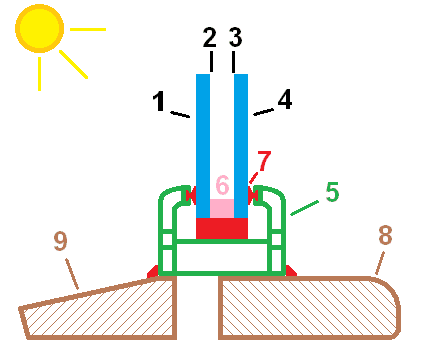
Insulated glazing
Argon between double-glazed panes conducts heat less well than air, improving insulation.
Photo: Wikimedia Commons


Research
No research on Argon yet
When Bhavya publishes a project that studies Argon, it will be linked here.