Lithium
Alkali metal · Period 2 · Group 1 · s-block
The lightest metal, powering the portable world
- Atomic mass
- 6.94 u
- State at 25 °C
- Solid
- Electronegativity
- 0.98
- Melting point
- 180.5 °C
- Boiling point
- 1,329.9 °C
- Configuration
- [He] 2s1
Lithium, explained
Overview
Lithium is the lightest metal, with a density of 0.534 g/cm3, so it floats on water and even on oil. Its electron configuration, [He]2s1, puts a single valence electron outside a compact core, and lithium gives it up readily to form Li+. Yet because Li+ is so small, it concentrates its charge intensely and polarizes neighbouring ions, so lithium behaves less like sodium and more like magnesium. It reacts with water more gently than the heavier alkali metals and is the only one that combines directly with nitrogen at room temperature.
The same small, light ion makes lithium ideal for batteries. Lithium has the most negative standard electrode potential of any element (-3.04 V), so cells built around it deliver high voltage per gram, and Li+ shuttles easily between a graphite anode and a metal oxide cathode during charging and discharging. Most lithium comes from brines pumped into evaporation ponds in the salt flats of Chile, Argentina and Bolivia, or from spodumene ore mined in Australia. Since 1949, lithium carbonate has also been a standard treatment for bipolar disorder.
Discovery
In 1817 Johan August Arfwedson, working in Jöns Jacob Berzelius's laboratory in Stockholm, found a new alkali in the mineral petalite from the island of Utö. Berzelius named it from the Greek lithos, stone, because it was discovered in a mineral rather than in plant ash like sodium and potassium. William Thomas Brande isolated a tiny amount of the metal by electrolysis in 1821, and Robert Bunsen and Augustus Matthiessen produced it in bulk in 1855 by electrolysing molten lithium chloride.
- Where it’s found
- Lithium is never found free; it is extracted from salt-flat brines in South America's Lithium Triangle and from the mineral spodumene mined mainly in Australia.
- What it’s used for
- Rechargeable batteries
- Mood-stabilizing medication
- Heat-resistant glass ceramics
- Lubricating greases
- Aerospace aluminium alloys
- In living things
- Lithium has no known essential role in the body. Lithium salts are an effective psychiatric drug, but the gap between a therapeutic and a toxic dose is narrow, so blood levels must be monitored.
- Safety
- Lithium metal reacts with water to release flammable hydrogen and corrosive lithium hydroxide, so it is stored under oil or argon. Damaged lithium-ion batteries can undergo thermal runaway and burn fiercely.
How it compares
Where Lithium sits among all 118 elements on the trends that shape the table.
- Electronegativity0.98Pauling
#92 of 100 elements with data
- Ionization energy520kJ/mol
#95 of 104 elements with data
- Atomic radius145pm
#46 of 95 elements with data
- Electron affinity59.6kJ/mol
#44 of 109 elements with data
- Density0.534g/cm³
#103 of 114 elements with data
- Melting point454K
#85 of 110 elements with data
- Density
- 0.534 g/cm³
- Atomic radius
- 145 pm
- Covalent radius
- 133 pm
- Molar heat
- 24.86 J/(mol·K)
- Appearance
- silvery-white
- Discovered by
- Johan August Arfwedson
Inside the atom
3 electrons arranged in 2 shells: 2 · 1.
Orbital diagram
1s2 2s1 · shorthand [He] 2s1
- 1s2
- 2s1
Each box is an orbital holding up to two electrons of opposite spin. Highlighted subshells hold the valence electrons that decide how Lithium bonds.
Ionization energies
Signature reactions
The chemistry Lithium is known for.
Redox · Single displacement
Lithium with water
A piece of lithium fizzes steadily as it skates across water, releasing hydrogen and leaving an alkaline solution. Unlike sodium or potassium, it rarely melts or ignites. The milder reaction reflects lithium's tightly held electron and the slow kinetics at its surface.
Conditions: room temperature
Redox · Synthesis
Formation of lithium nitride
Lithium is the only alkali metal that reacts directly with nitrogen gas, slowly forming a reddish-brown nitride. The reaction is driven by the very high lattice energy of a solid built from small Li+ ions and highly charged N3- ions. It is why lithium tarnishes even in dry air.
Conditions: room temperature, slow
Redox · Electrochemical
Lithium-ion cell discharge
During discharge, lithium stored between graphite layers gives up electrons to the external circuit while Li+ ions travel through the electrolyte into the cobalt oxide cathode. Charging reverses the process. This chemistry, developed by John Goodenough, Stanley Whittingham and Akira Yoshino, earned the 2019 Nobel Prize in Chemistry.
Conditions: battery discharge
Where you’ll meet it

Lithium-ion battery
Phones, laptops and electric cars all run on cells that move lithium ions back and forth between electrodes.
Photo: Wikimedia Commons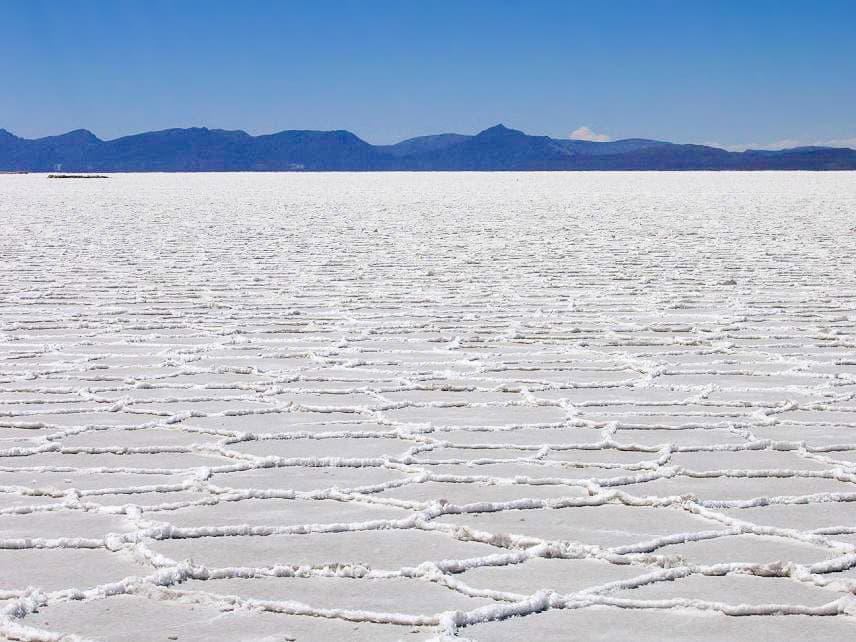
Salar de Uyuni
Bolivia's vast salt flat sits above brine that holds one of the largest lithium resources on Earth.
Photo: Wikimedia Commons
Tesla Model S
Each Model S battery pack contains thousands of lithium-ion cells.
Photo: Wikimedia Commons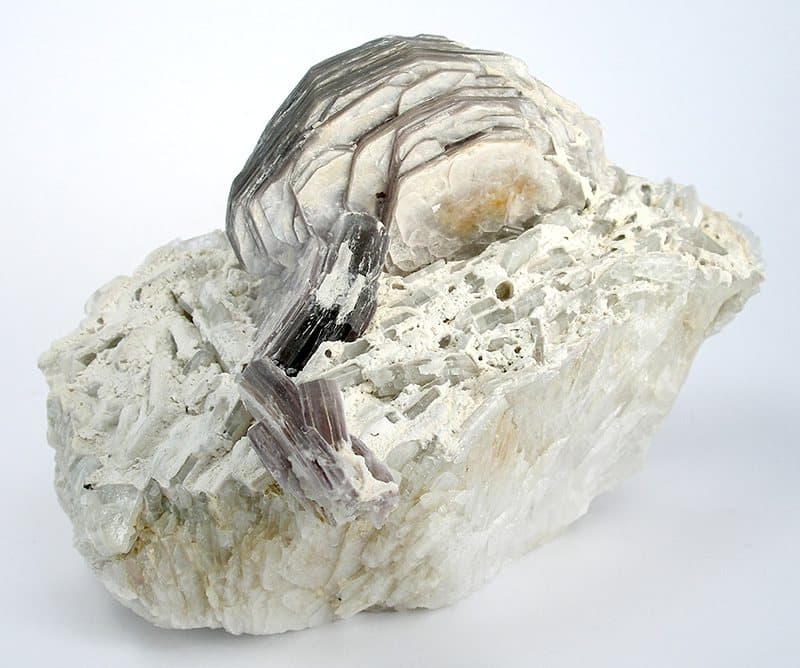
Lepidolite
This lilac mica is one of the lithium-bearing minerals in which the element occurs naturally.
Photo: Wikimedia Commons


Research
No research on Lithium yet
When Bhavya publishes a project that studies Lithium, it will be linked here.