Calcium
Alkaline earth metal · Period 4 · Group 2 · s-block
The builder of bones, shells and white cliffs
- Atomic mass
- 40.078 u
- State at 25 °C
- Solid
- Electronegativity
- 1
- Melting point
- 841.9 °C
- Boiling point
- 1,483.9 °C
- Configuration
- [Ar] 4s2
Calcium, explained
Overview
Calcium ([Ar]4s2) readily gives up its two outer electrons to form Ca2+. As an alkaline earth metal, it is less reactive than potassium next door, because it has a higher nuclear charge and must lose two electrons, but it still reacts steadily with water. The Ca2+ ion forms poorly soluble salts with carbonate, phosphate and sulfate, so calcium readily precipitates as solid minerals. Those minerals, limestone, marble, gypsum and apatite, make calcium the fifth most abundant element in Earth's crust, at about 4% by mass.
Much of the world's limestone was made by living things: corals, shellfish and microscopic plankton extract calcium and carbonate from seawater to build shells and skeletons. Heating limestone produces lime, the basis of mortar and cement, and cement production alone accounts for roughly 8% of global CO2 emissions. The human body contains about 1 kg of calcium, 99% of it in bones and teeth as hydroxyapatite. The remaining 1% is vital: brief rises in Ca2+ concentration inside cells trigger muscle contraction, the release of neurotransmitters and blood clotting.
Discovery
Lime (calcium oxide) was used in mortar and plaster by ancient Egyptians and Romans, but calcium metal was not isolated until 1808. That year Humphry Davy electrolysed a mixture of moist lime and mercuric oxide, producing a calcium amalgam, and then distilled off the mercury to leave the metal. He named it from the Latin calx (genitive calcis), meaning lime.
- Where it’s found
- Calcium is the fifth most abundant element in the crust, found in limestone, chalk, marble, gypsum and fluorite; the metal is made by reducing lime with aluminium in a vacuum.
- What it’s used for
- Cement and concrete
- Steel refining
- Agricultural lime
- Plaster and drywall
- Dietary supplements
- Chalk and fillers
- In living things
- Calcium is essential: it forms the mineral of bones and teeth and serves as a chemical signal that triggers muscle contraction, nerve transmission and blood clotting. Shells, corals and eggshells are also built from calcium carbonate.
- Safety
- Calcium metal reacts with water to release hydrogen and form corrosive calcium hydroxide. Quicklime reacts violently with water, generating enough heat to cause burns and severe eye damage.
How it compares
Where Calcium sits among all 118 elements on the trends that shape the table.
- Electronegativity1Pauling
#91 of 100 elements with data
- Ionization energy590kJ/mol
#71 of 104 elements with data
- Atomic radius180pm
#17 of 95 elements with data
- Electron affinity2.37kJ/mol
#89 of 109 elements with data
- Density1.55g/cm³
#99 of 114 elements with data
- Melting point1,120K
#57 of 110 elements with data
- Density
- 1.55 g/cm³
- Atomic radius
- 180 pm
- Covalent radius
- 171 pm
- Molar heat
- 25.929 J/(mol·K)
- Appearance
- —
- Discovered by
- Humphry Davy
Inside the atom
20 electrons arranged in 4 shells: 2 · 8 · 8 · 2.
Orbital diagram
1s2 2s2 2p6 3s2 3p6 4s2 · shorthand [Ar] 4s2
- 1s2
- 2s2
- 2p6
- 3s2
- 3p6
- 4s2
Each box is an orbital holding up to two electrons of opposite spin. Highlighted subshells hold the valence electrons that decide how Calcium bonds.
Ionization energies
Signature reactions
The chemistry Calcium is known for.
Decomposition · Industrial
Thermal decomposition of limestone
Heating limestone drives off carbon dioxide and leaves quicklime, calcium oxide. This is the first step in making lime and cement, and it is why cement production releases so much CO2 even before any fuel is burned. The process has been carried out in kilns for thousands of years.
Conditions: lime kiln, about 900 °C
Synthesis · Exothermic
Slaking of quicklime
Adding water to quicklime produces slaked lime with a hiss and a burst of steam, as the reaction releases about 65 kJ per mole. Slaked lime is used in mortar, plaster, water treatment and to reduce soil acidity. Mixed with sand, it slowly reabsorbs CO2 from the air and hardens back into calcium carbonate.
Conditions: room temperature
Acid-base · Equilibrium
Dissolving limestone to form caves
Slightly acidic rainwater dissolves limestone as soluble calcium hydrogencarbonate, carving caves over thousands of years. When the water drips into a cave and loses CO2, the equilibrium shifts back and calcium carbonate is deposited, building stalactites and stalagmites. The same reaction produces hard water and the scale inside kettles.
Conditions: rainwater containing dissolved CO2
Where you’ll meet it

White Cliffs of Dover
These chalk cliffs are made of calcium carbonate from countless microscopic algae.
Photo: Wikimedia Commons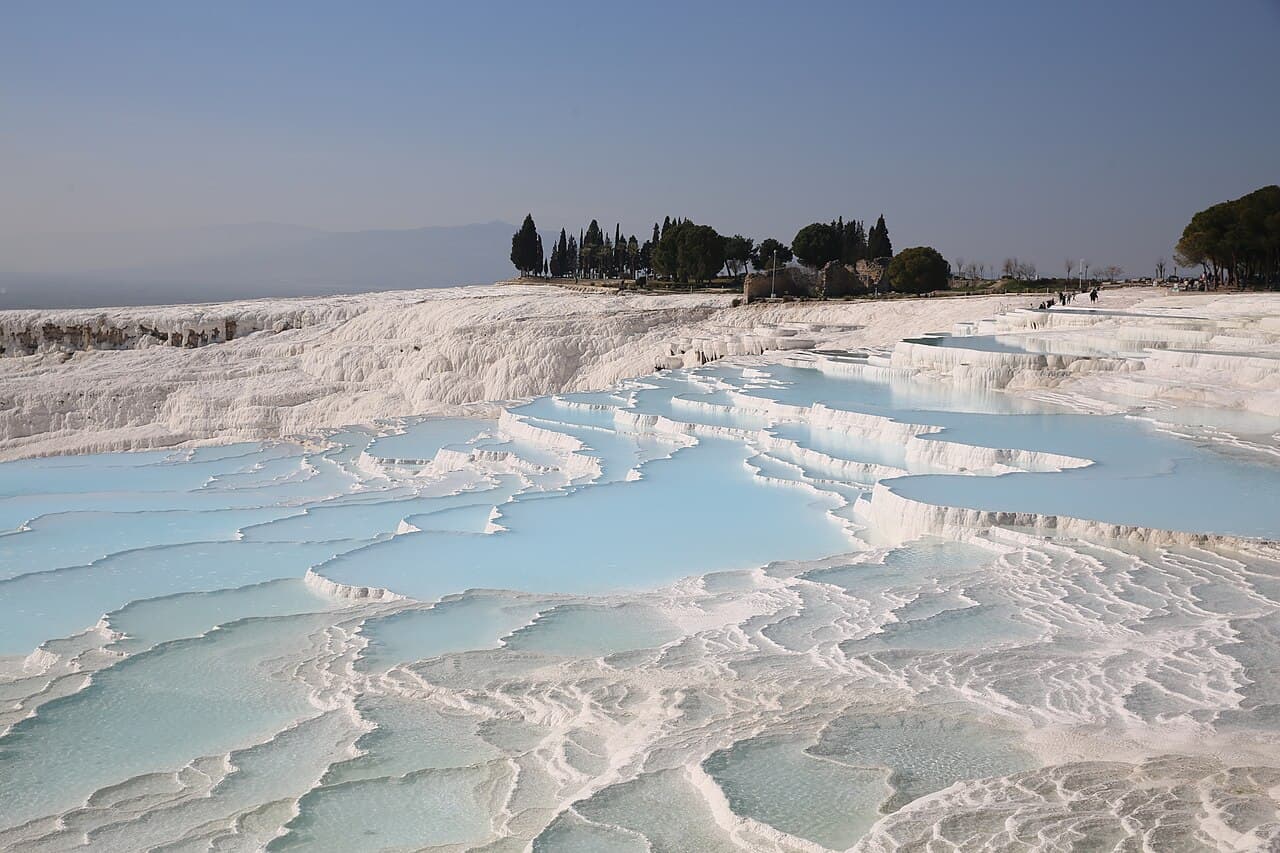
Pamukkale
Calcium-rich hot springs in Turkey have built white terraces of travertine, a form of calcium carbonate.
Photo: Wikimedia Commons
Taj Mahal
The Taj Mahal is clad in white marble, a metamorphic rock of calcium carbonate.
Photo: Wikimedia Commons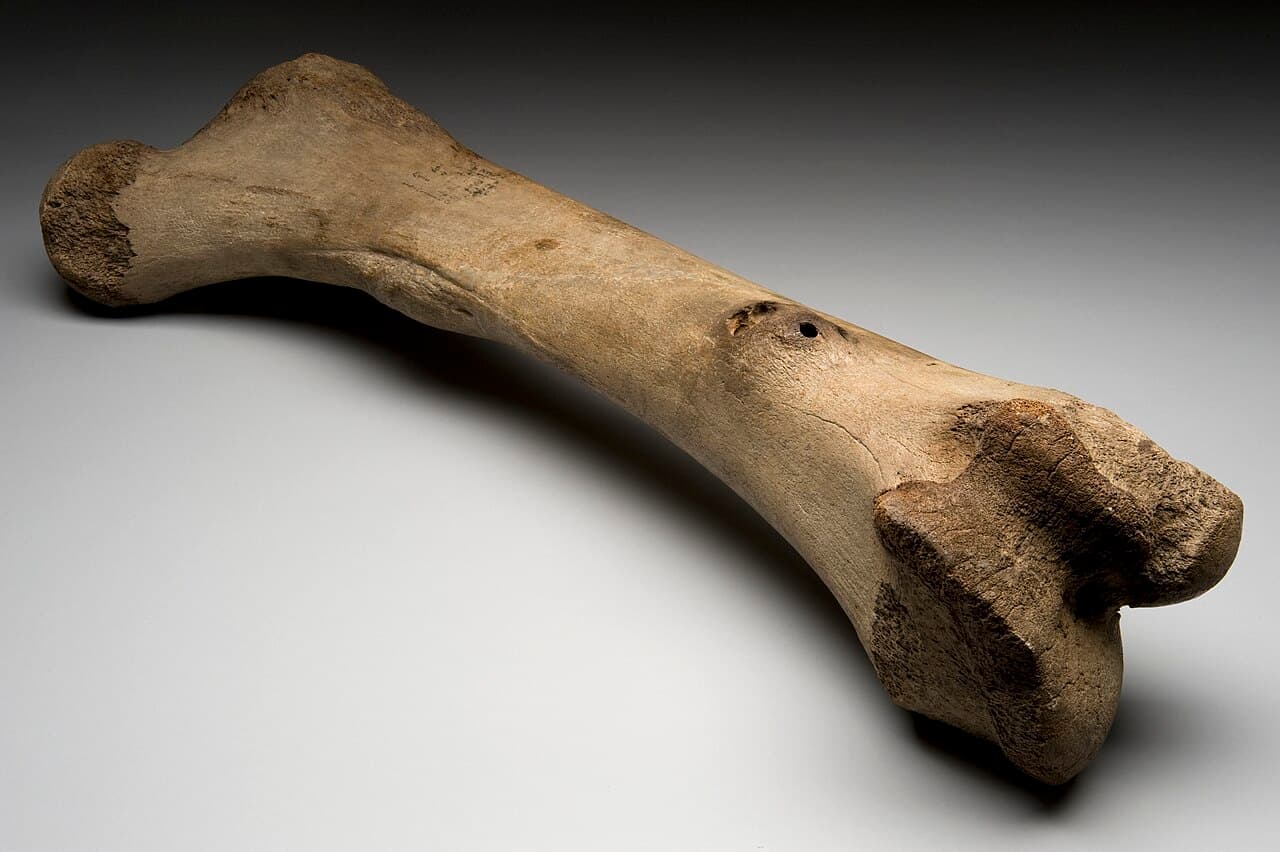
Bone
Bones get their hardness from hydroxyapatite, a calcium phosphate mineral.
Photo: Wikimedia Commons


Research
No research on Calcium yet
When Bhavya publishes a project that studies Calcium, it will be linked here.