Cesium
Alkali metal · Period 6 · Group 1 · s-block
The softest, most reactive metal, and the keeper of the second
- Atomic mass
- 132.905 u
- State at 25 °C
- Solid
- Electronegativity
- 0.79
- Melting point
- 28.6 °C
- Boiling point
- 670.9 °C
- Configuration
- [Xe] 6s1
Nucleus drawn at reduced count for clarity. Drag to rotate.
Cesium, explained
Video lesson in production
Bhavya’s explainer for this element will play here.
Overview
Caesium (spelled cesium in American English) is a soft, pale-gold alkali metal in group 1, with the configuration [Xe] 6s1. Its single outer electron sits in a large, well-shielded orbital far from the nucleus, so it is removed more easily than from any other stable element. That makes caesium the most electropositive stable metal and the most violently reactive with water. It melts at 28.5 °C, so it turns liquid on a warm day. Along with gold and copper, it is one of the few metals with a distinctly coloured, non-silvery lustre.
Caesium has only one stable isotope, caesium-133, and the energy gap between two arrangements of its outer electron spin defines time itself. Since 1967 the SI second has been defined as exactly 9,192,631,770 oscillations of the radiation from this hyperfine transition, measured by caesium atomic clocks. Such clocks underpin GPS, which relies on time signals accurate to billionths of a second. Caesium formate brines, dense but non-toxic, are used as drilling fluids in high-pressure oil and gas wells. The fission product caesium-137 is a long-lived contaminant from nuclear accidents and also a source for cancer radiotherapy.
Discovery
In 1860 Robert Bunsen and Gustav Kirchhoff in Heidelberg evaporated 40 tonnes of mineral water from Dürkheim and examined the residue with their newly invented flame spectroscope. They saw two bright blue lines that belonged to no known element, making caesium the first element discovered by spectroscopy. They named it from the Latin caesius, meaning 'sky blue'. Carl Setterberg first isolated the metal in 1882 by electrolysing molten caesium cyanide.
- Where it’s found
- Caesium makes up about 3 parts per million of the crust and is obtained mainly from the mineral pollucite, found in granite pegmatites.
- What it’s used for
- Atomic clocks
- Oil and gas drilling fluids
- Photoelectric cells
- Radiotherapy (Cs-137)
- Industrial density gauges
- Organic synthesis catalysts
- In living things
- Caesium has no biological role. The body treats it like potassium, so it spreads through soft tissue, which is why radioactive caesium-137 is a health concern after nuclear accidents.
- Safety
- Caesium metal ignites in air and reacts explosively with water, so it is stored in sealed glass ampoules under argon; caesium-137 is a dangerous radiation source, as shown by the 1987 Goiânia accident in Brazil.
How it compares
Where Cesium sits among all 118 elements on the trends that shape the table.
- Electronegativity0.79Pauling
#99 of 100 elements with data
- Ionization energy376kJ/mol
#104 of 104 elements with data
- Atomic radius260pm
#1 of 95 elements with data
- Electron affinity45.5kJ/mol
#57 of 109 elements with data
- Density1.93g/cm³
#93 of 114 elements with data
- Melting point302K
#95 of 110 elements with data
- Density
- 1.93 g/cm³
- Atomic radius
- 260 pm
- Covalent radius
- 232 pm
- Molar heat
- 32.21 J/(mol·K)
- Appearance
- silvery gold
- Discovered by
- Robert Bunsen
Inside the atom
55 electrons arranged in 6 shells: 2 · 8 · 18 · 18 · 8 · 1.
Orbital diagram
1s2 2s2 2p6 3s2 3p6 4s2 3d10 4p6 5s2 4d10 5p6 6s1 · shorthand [Xe] 6s1
- 1s2
- 2s2
- 2p6
- 3s2
- 3p6
- 4s2
- 3d10
- 4p6
- 5s2
- 4d10
- 5p6
- 6s1
Each box is an orbital holding up to two electrons of opposite spin. Highlighted subshells hold the valence electrons that decide how Cesium bonds.
Ionization energies
Signature reactions
The chemistry Cesium is known for.
Redox · Single displacement
Reaction with water
Caesium reacts with water explosively, shattering glass containers as the hydrogen ignites. The product, caesium hydroxide, is among the strongest bases known.
Conditions: room temperature, even with ice
Redox · Combustion
Forming the superoxide
Caesium burns to form orange caesium superoxide, CsO2, rather than a simple oxide. Large alkali metal cations like Cs^+ stabilize the large superoxide ion, O2^−.
Conditions: burning in excess oxygen
Acid–base · Neutralization
Making caesium formate
Caesium hydroxide neutralizes formic acid to give caesium formate. Its concentrated solution has a density of about 2.3 g/cm³, heavy enough to hold back high-pressure gas in deep wells without solid additives.
Conditions: aqueous, room temperature
Where you’ll meet it

Global Positioning System
GPS satellites carry atomic clocks, and the system's time is traced to caesium standards.
Photo: Wikimedia Commons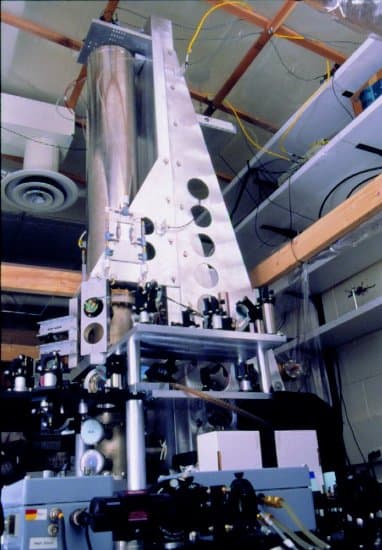
NIST-F1
NIST-F1, a caesium fountain clock, served as the primary time standard of the United States.
Photo: Wikimedia Commons

Oil well
Dense caesium formate brine is used to control pressure while drilling deep, high-pressure oil and gas wells.
Photo: Wikimedia Commons


Research
No research on Cesium yet
When Bhavya publishes a project that studies Cesium, it will be linked here.