Francium
Alkali metal · Period 7 · Group 1 · s-block
The last element found in nature, vanishing in about 22 minutes
- Atomic mass
- 223 u
- State at 25 °C
- Solid
- Electronegativity
- 0.79
- Melting point
- 26.9 °C
- Boiling point
- 676.9 °C
- Configuration
- [Rn] 7s1
Nucleus drawn at reduced count for clarity. Drag to rotate.
Francium, explained
Video lesson in production
Bhavya’s explainer for this element will play here.
Overview
Francium is the heaviest alkali metal in group 1, below lithium, sodium, potassium, rubidium and caesium. Like them it has a single outer electron, 7s1, which it gives up easily to form the Fr+ ion. Simple trends would make it the most reactive metal of all, but relativistic effects pull its 7s electron slightly closer to the heavy nucleus. As a result, francium's ionisation energy (4.07 eV) is a little higher than caesium's (3.89 eV), so caesium is probably the more reactive of the two.
No one has ever seen a piece of francium. Its longest-lived isotope, francium-223, has a half-life of only 22 minutes, and any visible amount would vaporise itself with the heat of its own decay. Experiments instead trap a few hundred thousand atoms at a time with lasers and magnetic fields. Tracer studies show francium behaves like caesium in solution, forming soluble salts and coprecipitating with caesium perchlorate. Physicists use trapped francium atoms to test subtle predictions about the weak nuclear force.
Discovery
In 1939 Marguerite Perey, a former assistant of Marie Curie at the Radium Institute in Paris, noticed unexpected beta radiation while purifying actinium-227. She showed that about 1% of actinium atoms decay by emitting an alpha particle, forming element 87. She named it francium after France. Perey later became the first woman elected to the French Academy of Sciences, as a corresponding member in 1962.
- Where it’s found
- Francium-223 forms fleetingly in uranium ores from the decay of actinium-227, and research samples are made in accelerators by fusing gold with oxygen or by spallating uranium.
- What it’s used for
- Atomic physics research
- Tests of the weak force
- Spectroscopy studies
- Laser-trapping experiments
- In living things
- Francium has no biological role; it would behave like potassium or caesium in the body but is too scarce and short-lived to matter.
- Safety
- Only made a few atoms at a time; its intense radioactivity is the only real hazard. There is no practical exposure risk outside specialist laboratories.
How it compares
Where Francium sits among all 118 elements on the trends that shape the table.
- Electronegativity0.79Pauling
#99 of 100 elements with data
- Ionization energy380kJ/mol
#103 of 104 elements with data
- Atomic radiusNo data
Not measured for this element
- Electron affinity46.9kJ/mol
#54 of 109 elements with data
- Density1.87g/cm³
#94 of 114 elements with data
- Melting point300K
#96 of 110 elements with data
- Density
- 1.87 g/cm³
- Atomic radius
- —
- Covalent radius
- —
- Molar heat
- —
- Appearance
- —
- Discovered by
- Marguerite Perey
Inside the atom
87 electrons arranged in 7 shells: 2 · 8 · 18 · 32 · 18 · 8 · 1.
Orbital diagram
1s2 2s2 2p6 3s2 3p6 4s2 3d10 4p6 5s2 4d10 5p6 6s2 4f14 5d10 6p6 7s1 · shorthand [Rn] 7s1
- 1s2
- 2s2
- 2p6
- 3s2
- 3p6
- 4s2
- 3d10
- 4p6
- 5s2
- 4d10
- 5p6
- 6s2
- 4f14
- 5d10
- 6p6
- 7s1
Each box is an orbital holding up to two electrons of opposite spin. Highlighted subshells hold the valence electrons that decide how Francium bonds.
Signature reactions
The chemistry Francium is known for.
Nuclear · Alpha decay
Perey's decay branch
A small fraction of actinium-227 nuclei emit an alpha particle instead of the usual beta particle, producing francium-223. This branch is how Marguerite Perey discovered the element in 1939.
Conditions: spontaneous; 1.38% of Ac-227 decays
Nuclear · Heavy-ion fusion
Making francium-210 by fusion
A beam of oxygen-18 nuclei fuses with gold, and the compound nucleus sheds five neutrons. Stony Brook physicists used this reaction to load francium atoms into a magneto-optical trap.
Conditions: oxygen-18 beam on hot gold target
Nuclear · Beta decay
Beta decay of francium-223
A neutron in the francium nucleus becomes a proton, emitting an electron and an antineutrino and leaving radium-223. This rapid decay is why francium never builds up in nature.
Conditions: spontaneous; half-life 22 minutes
Where you’ll meet it

Marguerite Perey
Marguerite Perey discovered francium in 1939 and named it after her country.
Photo: Wikimedia Commons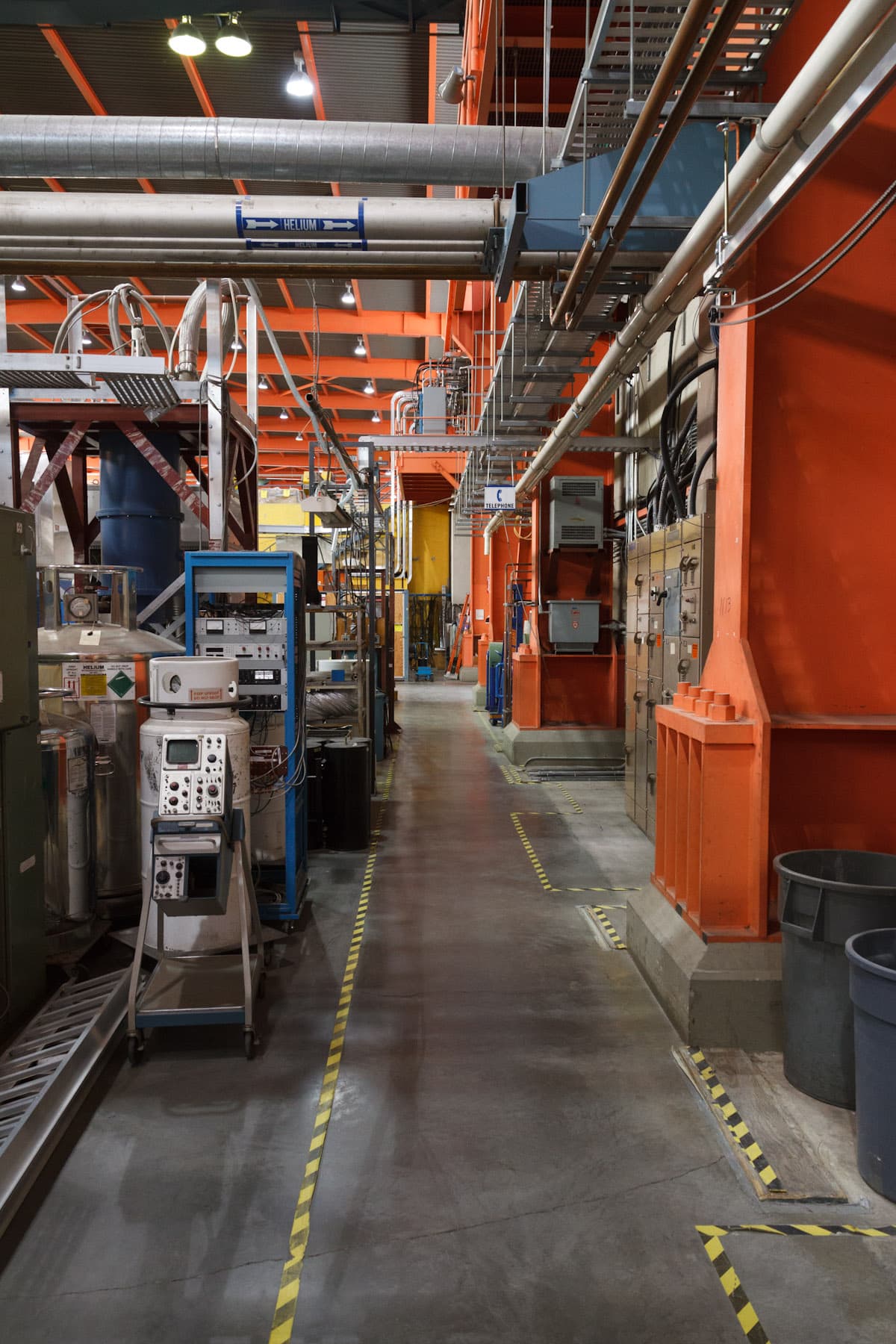
TRIUMF
Canada's TRIUMF laboratory produces francium beams for trapped-atom physics experiments.
Photo: Wikimedia Commons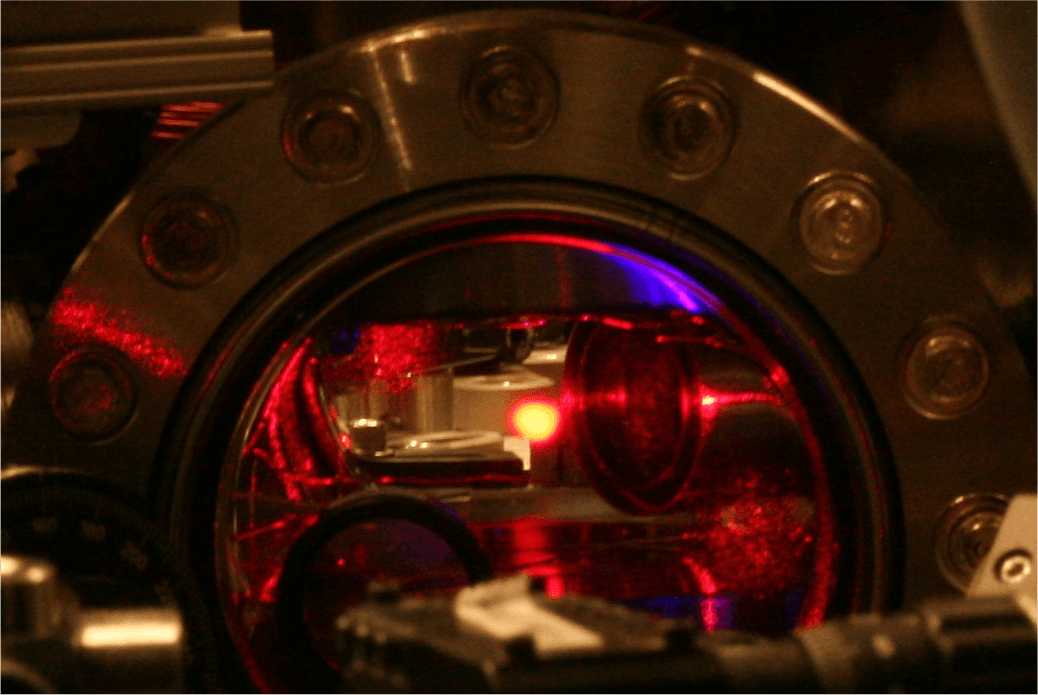
Laser cooling
Laser cooling and magneto-optical traps let physicists hold and study clouds of francium atoms.
Photo: Wikimedia Commons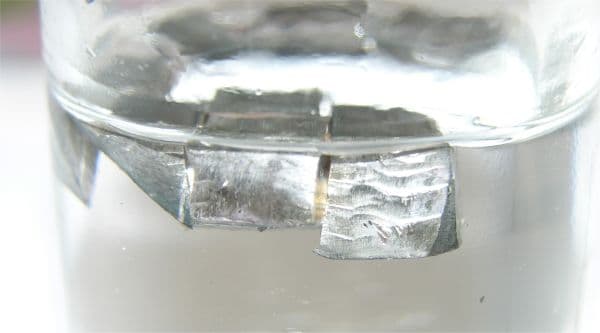
Alkali metal
Francium is the heaviest member of the alkali metals, the reactive family that begins with lithium.
Photo: Wikimedia Commons


Research
No research on Francium yet
When Bhavya publishes a project that studies Francium, it will be linked here.