Rubidium
Alkali metal · Period 5 · Group 1 · s-block
The soft, fiery alkali metal that keeps time for GPS
- Atomic mass
- 85.468 u
- State at 25 °C
- Solid
- Electronegativity
- 0.82
- Melting point
- 39.3 °C
- Boiling point
- 687.9 °C
- Configuration
- [Kr] 5s1
Rubidium, explained
Video lesson in production
Bhavya’s explainer for this element will play here.
Overview
Rubidium is an alkali metal with a single electron outside a krypton core ([Kr]5s1). That electron sits far from the nucleus and is well shielded, so it takes only 4.18 electronvolts to remove it, less than for any lighter alkali metal. As a result rubidium is extremely reactive: it ignites spontaneously in air and reacts explosively with water. The metal is soft and silvery-white and melts at just 39.3 °C, barely above body temperature. Its compounds contain the Rb+ ion, which behaves much like K+.
Rubidium makes up about 90 ppm of the crust, more than copper, yet it forms no minerals of its own, hiding instead in potassium minerals such as lepidolite. Its electrons have a hyperfine transition at a precisely fixed frequency of about 6.8 GHz, which is the basis of rubidium atomic clocks in GPS satellites and telecommunications networks. Rubidium atoms are easy to cool with lasers, so they became the workhorse of ultracold physics; the first Bose–Einstein condensate in 1995 was made from rubidium-87.
Discovery
Robert Bunsen and Gustav Kirchhoff discovered rubidium in 1861 at Heidelberg, using the flame spectroscope they had invented a year earlier. Analyzing the mineral lepidolite, they saw two deep red spectral lines no one had recorded before, and named the element after the Latin rubidus, deep red. Bunsen later prepared the metal by heating a rubidium compound with carbon.
- Where it’s found
- Rubidium is widely dispersed in potassium-bearing minerals and is recovered mainly from lepidolite and pollucite, usually alongside lithium or caesium production.
- What it’s used for
- Atomic clocks
- Laser-cooling research
- Rock dating (Rb–Sr)
- Photocells
- Heart imaging (Rb-82 PET)
- Specialty glass
- In living things
- Rubidium has no known biological role. The body handles Rb+ much like K+, and its compounds are only mildly toxic.
- Safety
- Rubidium metal ignites spontaneously in air and reacts violently with water, so it is stored under dry mineral oil or sealed in glass ampoules under argon.
How it compares
Where Rubidium sits among all 118 elements on the trends that shape the table.
- Electronegativity0.82Pauling
#97 of 100 elements with data
- Ionization energy403kJ/mol
#102 of 104 elements with data
- Atomic radius235pm
#2 of 95 elements with data
- Electron affinity46.9kJ/mol
#55 of 109 elements with data
- Density1.53g/cm³
#100 of 114 elements with data
- Melting point312K
#93 of 110 elements with data
- Density
- 1.53 g/cm³
- Atomic radius
- 235 pm
- Covalent radius
- 210 pm
- Molar heat
- 31.06 J/(mol·K)
- Appearance
- grey white
- Discovered by
- Robert Bunsen
Inside the atom
37 electrons arranged in 5 shells: 2 · 8 · 18 · 8 · 1.
Orbital diagram
1s2 2s2 2p6 3s2 3p6 4s2 3d10 4p6 5s1 · shorthand [Kr] 5s1
- 1s2
- 2s2
- 2p6
- 3s2
- 3p6
- 4s2
- 3d10
- 4p6
- 5s1
Each box is an orbital holding up to two electrons of opposite spin. Highlighted subshells hold the valence electrons that decide how Rubidium bonds.
Ionization energies
Signature reactions
The chemistry Rubidium is known for.
Redox · Single displacement
Rubidium and water
Rubidium reacts with water so fast that the hydrogen released usually ignites explosively, more violently than with potassium. The resulting solution of rubidium hydroxide is strongly alkaline.
Conditions: room temperature, violently exothermic
Redox · Combustion
Burning to the superoxide
Unlike lithium, which forms an ordinary oxide, rubidium burns to an orange superoxide containing the O2− ion. The large Rb+ ion is needed to stabilize the large superoxide anion in a crystal.
Conditions: burning in excess oxygen
Nuclear · Beta decay
Beta decay of rubidium-87
A neutron in rubidium-87 turns into a proton, emitting an electron and an antineutrino and leaving strontium-87. Measuring the ratio of the two isotopes in minerals gives the rubidium–strontium age of rocks, including meteorites and Moon samples.
Conditions: half-life about 49 billion years
Where you’ll meet it
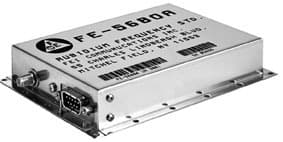
Rubidium standard
A rubidium frequency standard locks an oscillator to a hyperfine transition of rubidium-87 atoms near 6.8 GHz.
Photo: Wikimedia Commons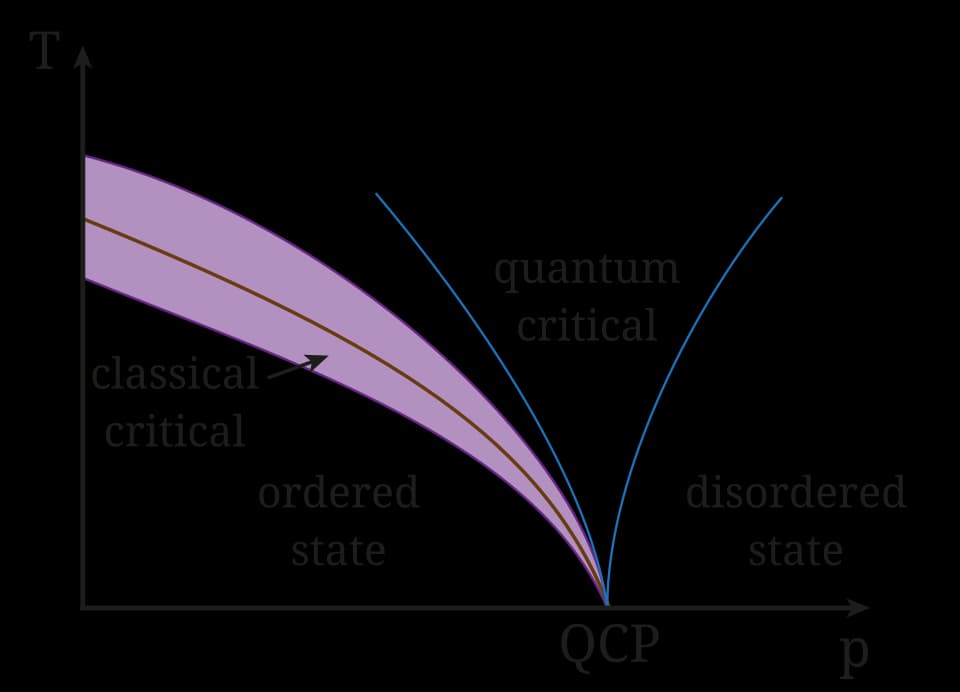
Bose–Einstein condensate
The first Bose–Einstein condensate was made in 1995 from laser-cooled rubidium-87 atoms.
Photo: Wikimedia Commons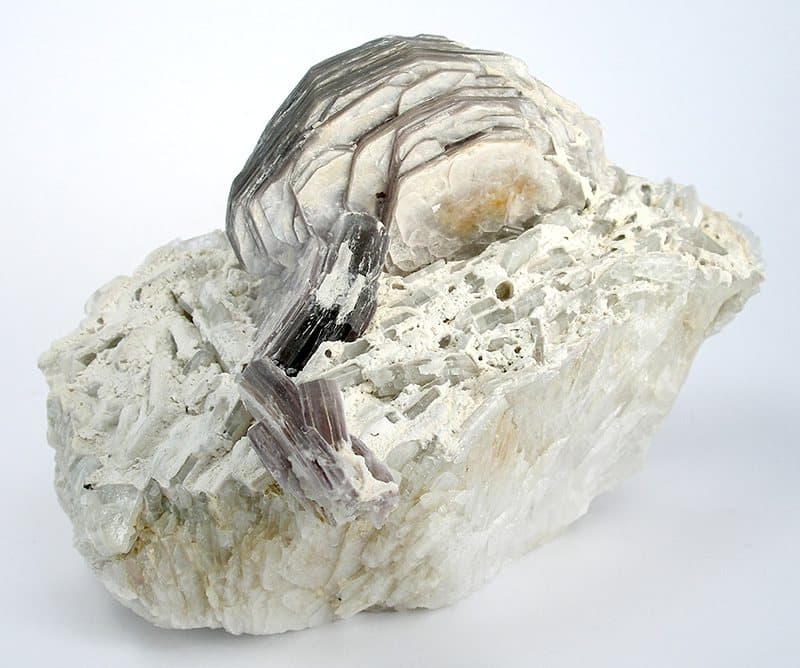
Lepidolite
Lavender lepidolite mica is the mineral in which rubidium was discovered and remains a source of it.
Photo: Wikimedia Commons
Global Positioning System
GPS satellites carry rubidium and caesium clocks so that receivers can calculate position from signal timing.
Photo: Wikimedia Commons


Research
No research on Rubidium yet
When Bhavya publishes a project that studies Rubidium, it will be linked here.