Krypton
Noble gas · Period 4 · Group 18 · p-block
The hidden noble gas that once defined the metre
- Atomic mass
- 83.798 u
- State at 25 °C
- Gas
- Electronegativity
- 3
- Melting point
- -157.4 °C
- Boiling point
- -153.2 °C
- Configuration
- [Ar] 3d10 4s2 4p6
Krypton, explained
Video lesson in production
Bhavya’s explainer for this element will play here.
Overview
Krypton is a noble gas with a completely filled outer shell ([Ar]3d10 4s2 4p6), so it has almost no tendency to gain, lose or share electrons. It is not completely inert, however. Krypton atoms are larger than argon atoms, so their outer electrons sit farther from the nucleus and are held less tightly. Fluorine, the most powerful oxidizer, can pull them into a bond: krypton difluoride, KrF2, first made in 1963, is a colorless solid that decomposes slowly even at room temperature and is one of the strongest oxidizing agents known.
Krypton makes up only about 1 part per million of air and is obtained by fractional distillation of liquefied air, which makes it expensive. It is used where its high density and low heat conductivity help, as in the insulating gap of high-performance windows, and in bright flash lamps and some lighting. Krypton fluoride excimer lasers emit ultraviolet light at 248 nm, used to make computer chips. Krypton is also the propellant in the Hall-effect thrusters of many of SpaceX's Starlink satellites.
Discovery
On 30 May 1898, William Ramsay and Morris Travers at University College London let a sample of liquefied air almost completely evaporate and examined the small residue with a spectroscope. They saw bright yellow and green lines belonging to no known element. They named the gas krypton, from the Greek kryptos, hidden. Within weeks the same technique revealed neon and xenon.
- Where it’s found
- Krypton forms about 1.1 parts per million of Earth's atmosphere and is separated as a by-product of producing oxygen and nitrogen from liquefied air.
- What it’s used for
- Insulated window glazing
- Photographic flash lamps
- Excimer lasers for chipmaking
- Satellite ion thrusters
- Specialty lighting
- In living things
- Krypton has no biological role. It is nontoxic, though it has anesthetic effects at high pressure.
- Safety
- Krypton is nontoxic but can displace oxygen and cause suffocation in enclosed spaces. It is stored as a compressed gas in cylinders.
How it compares
Where Krypton sits among all 118 elements on the trends that shape the table.
- Electronegativity3Pauling
#5 of 100 elements with data
- Ionization energy1,350kJ/mol
#6 of 104 elements with data
- Atomic radius88pm
#88 of 95 elements with data
- Electron affinity-96kJ/mol
#104 of 109 elements with data
- Density0.004g/cm³
#106 of 114 elements with data
- Melting point116K
#103 of 110 elements with data
- Density
- 3.75 g/L
- Atomic radius
- 88 pm
- Covalent radius
- 117 pm
- Molar heat
- —
- Appearance
- colorless gas, exhibiting a whitish glow in a high electric field
- Discovered by
- William Ramsay
Inside the atom
36 electrons arranged in 4 shells: 2 · 8 · 18 · 8.
Orbital diagram
1s2 2s2 2p6 3s2 3p6 4s2 3d10 4p6 · shorthand [Ar] 3d10 4s2 4p6
- 1s2
- 2s2
- 2p6
- 3s2
- 3p6
- 4s2
- 3d10
- 4p6
Each box is an orbital holding up to two electrons of opposite spin. Highlighted subshells hold the valence electrons that decide how Krypton bonds.
Ionization energies
Signature reactions
The chemistry Krypton is known for.
Redox · Synthesis
Synthesis of krypton difluoride
Krypton and fluorine combine only when energy is supplied to break fluorine molecules into atoms, and only at very low temperatures, where the fragile product survives. KrF2 is one of very few known krypton compounds.
Conditions: electric discharge or UV light, about −196 °C
Redox · Fluorination
Oxidation of gold by krypton difluoride
Krypton difluoride oxidizes gold to its +5 oxidation state, a feat beyond almost every other reagent. The product, a salt of the KrF+ cation, shows how reactive this rare noble-gas compound is.
Conditions: anhydrous hydrogen fluoride solvent or gas phase
Where you’ll meet it

Flashtube
Krypton and xenon flashtubes produce intense, brief flashes for photography and for pumping lasers.
Photo: Wikimedia Commons
Hall-effect thruster
Hall-effect thrusters accelerate ionized krypton or xenon to propel satellites.
Photo: Wikimedia Commons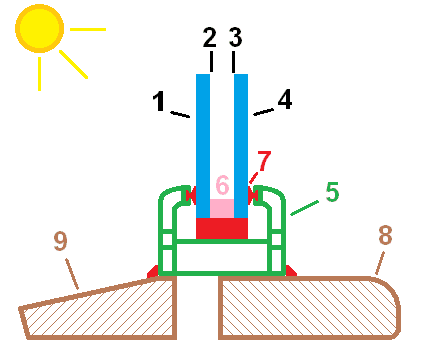
Insulated glazing
Krypton fills the narrow gaps of high-performance double and triple glazing, slowing heat loss better than air or argon.
Photo: Wikimedia Commons
Excimer laser
Krypton fluoride excimer lasers produce deep-ultraviolet light for photolithography and eye surgery research.
Photo: Wikimedia Commons


Research
No research on Krypton yet
When Bhavya publishes a project that studies Krypton, it will be linked here.