Oganesson
Noble gas (predicted) · Period 7 · Group 18 · p-block
The heaviest element known, and a noble gas that may not act like one
- Atomic mass
- 294 u
- State at 25 °C
- Solid
- Electronegativity
- —
- Melting point
- —
- Boiling point
- 76.9 °Cpredicted
- Configuration
- *[Rn] 5f14 6d10 7s2 7p6
Nucleus drawn at reduced count for clarity. Drag to rotate.
Oganesson, explained
Video lesson in production
Bhavya’s explainer for this element will play here.
Overview
Oganesson has the highest atomic number and atomic mass of any known element and sits at the bottom of group 18, below radon. Its predicted configuration, 7s2 7p6, has filled shells like the other noble gases. But relativistic effects are so strong in oganesson that calculations predict it will not behave like one: it should be polarizable enough to form bonds readily, and it may be a solid, possibly a semiconductor, at room temperature.
Calculations even suggest its electron shells are smeared out, without the distinct shell structure seen in lighter atoms, and that it may have a positive electron affinity, meaning it could accept an electron. None of this can be tested soon. Only about five atoms have ever been detected, and oganesson-294 has a half-life of under a millisecond, so everything about its chemistry is a prediction.
Discovery
A Dubna team led by Yuri Oganessian, with Lawrence Livermore National Laboratory, bombarded californium-249 with calcium-48 and detected one atom in 2002 and two more in 2005, announcing the discovery in 2006. An earlier 1999 Berkeley claim was retracted in 2001 after the data were found to be fabricated. IUPAC credited Dubna-Livermore in 2015, and oganesson was approved in 2016, the second element named after a living person.
- Where it’s found
- Oganesson does not occur in nature; it is made by bombarding californium-249 with calcium-48 ions.
- What it’s used for
- Testing relativistic quantum chemistry
- Nuclear structure research
- Probing limits of the periodic table
- Decay-chain identification
- In living things
- Oganesson has no biological role; it is radioactive and only a handful of atoms have ever existed.
- Safety
- Radioactive and only about five atoms have ever been detected; each decayed within about a millisecond.
How it compares
Where Oganesson sits among all 118 elements on the trends that shape the table.
- ElectronegativityNo data
Not measured for this element
- Ionization energyNo data
Not measured for this element
- Atomic radiusNo data
Not measured for this element
- Electron affinity5.4kJ/mol
#87 of 109 elements with data · predicted
- Density4.95g/cm³
#80 of 114 elements with data · predicted
- Melting pointNo data
Not measured for this element
- Density
- 4.95 g/cm³
- Atomic radius
- —
- Covalent radius
- —
- Molar heat
- —
- Appearance
- —
- Discovered by
- Joint Institute for Nuclear Research
Inside the atom
118 electrons arranged in 7 shells: 2 · 8 · 18 · 32 · 32 · 18 · 8.
Orbital diagram
1s2 2s2 2p6 3s2 3p6 4s2 3d10 4p6 5s2 4d10 5p6 6s2 4f14 5d10 6p6 7s2 5f14 6d10 7p6 · shorthand *[Rn] 5f14 6d10 7s2 7p6
- 1s2
- 2s2
- 2p6
- 3s2
- 3p6
- 4s2
- 3d10
- 4p6
- 5s2
- 4d10
- 5p6
- 6s2
- 4f14
- 5d10
- 6p6
- 7s2
- 5f14
- 6d10
- 7p6
Each box is an orbital holding up to two electrons of opposite spin. Highlighted subshells hold the valence electrons that decide how Oganesson bonds.
Signature reactions
How the first atoms were made, and how they fall apart.
Nuclear · Hot fusion
Dubna synthesis
Calcium-48 fuses with californium-249 and three neutrons evaporate. The cross-section is about half a picobarn, so months of bombardment yield only one or two atoms.
Conditions: calcium-48 beam on californium-249, Dubna U400 cyclotron, 2002-2005
Nuclear · Alpha decay
Alpha decay of oganesson-294
Oganesson-294 emits an alpha particle to become livermorium-290, which decays in turn to flerovium-286 and then fissions. Matching this chain to known livermorium and flerovium decays identified element 118.
Conditions: spontaneous, half-life about 0.7 milliseconds
Nuclear · Cold fusion (retracted)
Retracted Berkeley claim
Berkeley announced element 118 from this reaction in 1999, but other labs could not reproduce it and Berkeley itself found no events on reanalysis. The paper was retracted in 2001 after investigators concluded the data had been fabricated by one researcher.
Conditions: krypton-86 beam on lead-208, Berkeley, 1999
Where you’ll meet it
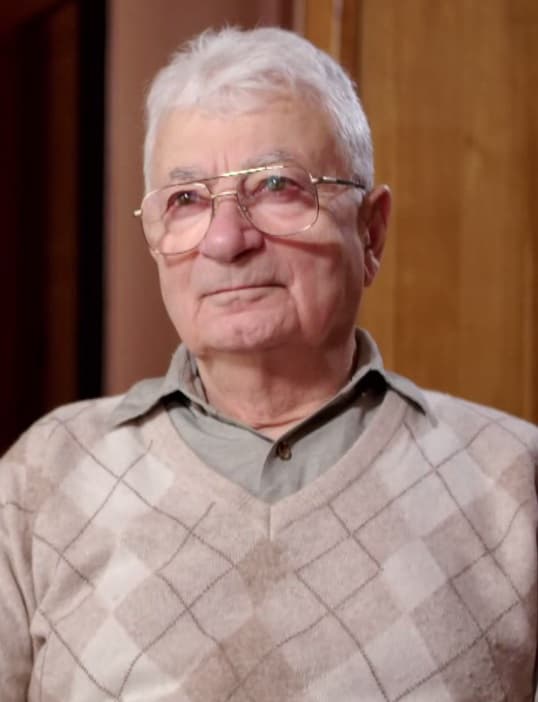
Yuri Oganessian
The Armenian-Russian physicist who led the discovery of elements 114 to 118 is honored by element 118.
Photo: Wikimedia Commons
Noble gas
Oganesson ends group 18, though calculations suggest it would not behave like the lighter noble gases.
Photo: Wikimedia Commons
Radon
Radon, directly above oganesson, is the heaviest noble gas whose properties have been measured.
Photo: Wikimedia Commons
Joint Institute for Nuclear Research
Oganesson was made at the Flerov Laboratory in Dubna, which Oganessian long directed.
Photo: Wikimedia Commons


Research
No research on Oganesson yet
When Bhavya publishes a project that studies Oganesson, it will be linked here.