Radon
Noble gas · Period 6 · Group 18 · p-block
The invisible radioactive gas that seeps up from the ground
- Atomic mass
- 222 u
- State at 25 °C
- Gas
- Electronegativity
- 2.2
- Melting point
- -71.1 °C
- Boiling point
- -61.6 °C
- Configuration
- [Xe] 4f14 5d10 6s2 6p6
Nucleus drawn at reduced count for clarity. Drag to rotate.
Radon, explained
Video lesson in production
Bhavya’s explainer for this element will play here.
Overview
Radon is the heaviest noble gas in group 18, below helium, neon, argon, krypton and xenon. Its full 6s2 6p6 shell makes it chemically unreactive, but because its outer electrons are far from the nucleus and well shielded, it has the lowest ionisation energy of the stable-shell gases and can be forced to react with fluorine. At about 9.7 grams per litre it is the densest gas at room conditions, around eight times denser than air, and it collects in low, poorly ventilated spaces such as basements.
All radon isotopes are radioactive. Radon-222, with a half-life of 3.8 days, forms continuously as radium-226 decays in rocks and soils containing uranium. Being a gas, it escapes from mineral grains, rises through cracks and enters buildings. Radon itself is breathed out again, but its short-lived decay products, polonium-218 and polonium-214, are solid metals that lodge in the lungs and emit alpha particles. That makes radon the second leading cause of lung cancer after smoking.
Discovery
In 1899 Ernest Rutherford and Robert Owens noticed a radioactive 'emanation' given off by thorium, and in 1900 Friedrich Ernst Dorn reported a similar gas from radium. William Ramsay and Robert Whytlaw-Gray isolated it in 1910, measured its density and showed it was the heaviest noble gas, calling it niton. The name radon, from radium, was adopted in 1923.
- Where it’s found
- Radon is produced continuously by radium decay in uranium-bearing rocks such as granite and shale, and escapes into soil gas, groundwater and the air.
- What it’s used for
- Groundwater tracing
- Earthquake research
- Early radiotherapy (historical)
- Geological surveys
- In living things
- Radon has no biological role; inhaled radon and its decay products are a major natural cause of lung cancer.
- Safety
- Radioactive and invisible; homes can be tested cheaply and fixed with sealing and ventilation. The US action level is 4 picocuries per litre (148 Bq/m3) of indoor air.
How it compares
Where Radon sits among all 118 elements on the trends that shape the table.
- Electronegativity2.2Pauling
#16 of 100 elements with data
- Ionization energy1,040kJ/mol
#13 of 104 elements with data
- Atomic radius120pm
#77 of 95 elements with data
- Electron affinity-68kJ/mol
#101 of 109 elements with data
- Density0.01g/cm³
#104 of 114 elements with data
- Melting point202K
#100 of 110 elements with data
- Density
- 9.73 g/L
- Atomic radius
- 120 pm
- Covalent radius
- 142 pm
- Molar heat
- —
- Appearance
- colorless gas, occasionally glows green or red in discharge tubes
- Discovered by
- Friedrich Ernst Dorn
Inside the atom
86 electrons arranged in 6 shells: 2 · 8 · 18 · 32 · 18 · 8.
Orbital diagram
1s2 2s2 2p6 3s2 3p6 4s2 3d10 4p6 5s2 4d10 5p6 6s2 4f14 5d10 6p6 · shorthand [Xe] 4f14 5d10 6s2 6p6
- 1s2
- 2s2
- 2p6
- 3s2
- 3p6
- 4s2
- 3d10
- 4p6
- 5s2
- 4d10
- 5p6
- 6s2
- 4f14
- 5d10
- 6p6
Each box is an orbital holding up to two electrons of opposite spin. Highlighted subshells hold the valence electrons that decide how Radon bonds.
Signature reactions
The chemistry Radon is known for.
Nuclear · Alpha decay
Birth of radon from radium
Radium-226 in rocks emits an alpha particle and becomes radon-222 gas. This is the main source of the radon that enters homes.
Conditions: spontaneous; half-life 1,600 years
Nuclear · Alpha decay
Decay of radon-222
Radon-222 emits an alpha particle to form polonium-218, a solid metal atom. Polonium-218 and its successors stick to dust and lung tissue, delivering most of radon's radiation dose.
Conditions: spontaneous; half-life 3.82 days
Synthesis · Noble gas chemistry
Making radon difluoride
In 1962, shortly after the first xenon compounds were made, chemists at Argonne showed that radon reacts with fluorine to form a non-volatile fluoride. Only trace amounts have ever been made because of radon's intense radioactivity.
Conditions: heating with fluorine, around 400 °C
Where you’ll meet it

Granite
Granite contains traces of uranium whose decay releases radon into the surrounding soil and air.
Photo: Wikimedia Commons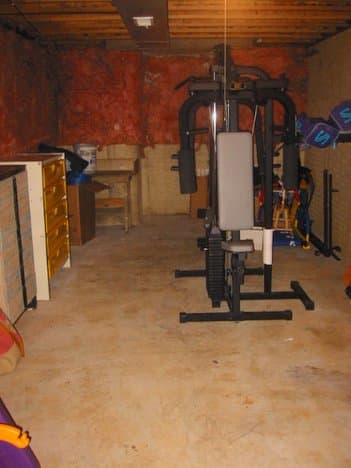
Basement
Dense radon gas tends to build up in basements, where testing is recommended.
Photo: Wikimedia Commons
Geiger counter
Radiation detectors like the Geiger counter help reveal radon and its decay products.
Photo: Wikimedia Commons
Bad Gastein
The Austrian spa town of Bad Gastein offers treatments in radon-rich tunnels and springs.
Photo: Wikimedia Commons


Research
No research on Radon yet
When Bhavya publishes a project that studies Radon, it will be linked here.