Radium
Alkaline earth metal · Period 7 · Group 2 · s-block
The glowing element of the Curies — and of the Radium Girls
- Atomic mass
- 226 u
- State at 25 °C
- Solid
- Electronegativity
- 0.9
- Melting point
- 959.9 °C
- Boiling point
- 1,736.9 °C
- Configuration
- [Rn] 7s2
Nucleus drawn at reduced count for clarity. Drag to rotate.
Radium, explained
Video lesson in production
Bhavya’s explainer for this element will play here.
Overview
Radium is the heaviest alkaline earth metal in group 2, below beryllium, magnesium, calcium, strontium and barium. With two outer electrons (7s2), it readily forms the Ra2+ ion and closely resembles barium: it reacts vigorously with water, and its sulfate is extremely insoluble. Freshly prepared radium metal is bright white but blackens in air, probably forming a nitride. Its salts glow faintly blue in the dark because their radiation excites the surrounding air and material.
Every radium isotope is radioactive. The most common, radium-226, has a half-life of 1,600 years and is part of the uranium-238 decay chain, so it is found wherever uranium is. In the body, Ra2+ behaves like calcium and lodges in bones, where its alpha radiation damages marrow and causes bone cancers. Medicine now exploits that same bone-seeking property: radium-223, with an 11-day half-life, is given to treat prostate cancer that has spread to the skeleton.
Discovery
Marie and Pierre Curie, with Gustave Bémont, announced radium in December 1898 after finding a highly radioactive barium-like fraction in pitchblende. The name comes from the Latin radius, meaning 'ray'. By 1902 Marie Curie had extracted about 0.1 g of radium chloride from tonnes of ore residue, and in 1910 she and André-Louis Debierne isolated the metal by electrolysis. She received the 1911 Nobel Prize in Chemistry for this work.
- Where it’s found
- Radium occurs in uranium ores at about one part in three million relative to uranium and is extracted from uranium processing residues, though little is now produced.
- What it’s used for
- Prostate cancer therapy (Ra-223)
- Luminous paint (historical)
- Early cancer radiotherapy
- Neutron sources (historical)
- In living things
- Radium has no biological role; it mimics calcium and concentrates in bone, where it causes anaemia and bone cancer.
- Safety
- Strongly radioactive and a bone-seeker; it also produces radon gas as it decays. Old radium-painted dials and instruments should be handled carefully and not opened.
How it compares
Where Radium sits among all 118 elements on the trends that shape the table.
- Electronegativity0.9Pauling
#95 of 100 elements with data
- Ionization energy509kJ/mol
#96 of 104 elements with data
- Atomic radius215pm
#4 of 95 elements with data
- Electron affinity9.65kJ/mol
#84 of 109 elements with data
- Density5.5g/cm³
#77 of 114 elements with data
- Melting point1,230K
#51 of 110 elements with data
- Density
- 5.5 g/cm³
- Atomic radius
- 215 pm
- Covalent radius
- 201 pm
- Molar heat
- —
- Appearance
- silvery white metallic
- Discovered by
- Pierre Curie
Inside the atom
88 electrons arranged in 7 shells: 2 · 8 · 18 · 32 · 18 · 8 · 2.
Orbital diagram
1s2 2s2 2p6 3s2 3p6 4s2 3d10 4p6 5s2 4d10 5p6 6s2 4f14 5d10 6p6 7s2 · shorthand [Rn] 7s2
- 1s2
- 2s2
- 2p6
- 3s2
- 3p6
- 4s2
- 3d10
- 4p6
- 5s2
- 4d10
- 5p6
- 6s2
- 4f14
- 5d10
- 6p6
- 7s2
Each box is an orbital holding up to two electrons of opposite spin. Highlighted subshells hold the valence electrons that decide how Radium bonds.
Ionization energies
Signature reactions
The chemistry Radium is known for.
Redox · Single displacement
Reaction with water
Radium reacts vigorously with water, releasing hydrogen and forming radium hydroxide, the most basic of the alkaline earth hydroxides. The reaction is like barium's but even more vigorous.
Conditions: room temperature
Precipitation
Precipitating radium sulfate
Radium sulfate is the least soluble sulfate known and comes down together with barium sulfate. The Curies used this barium-like behaviour to concentrate radium from pitchblende.
Conditions: aqueous solution, often with barium carrier
Nuclear · Alpha decay
Alpha decay of radium-226
Radium-226 emits an alpha particle and becomes radon-222 gas. This is why stored radium sources slowly release radioactive radon.
Conditions: spontaneous; half-life 1,600 years
Where you’ll meet it

Radium Girls
The Radium Girls painted watch dials with radium paint and suffered severe radiation poisoning.
Photo: Wikimedia Commons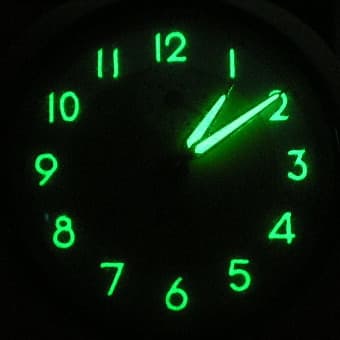
Radium dial
Radium dials glowed because radium's radiation excited zinc sulfide in the paint.
Photo: Wikimedia Commons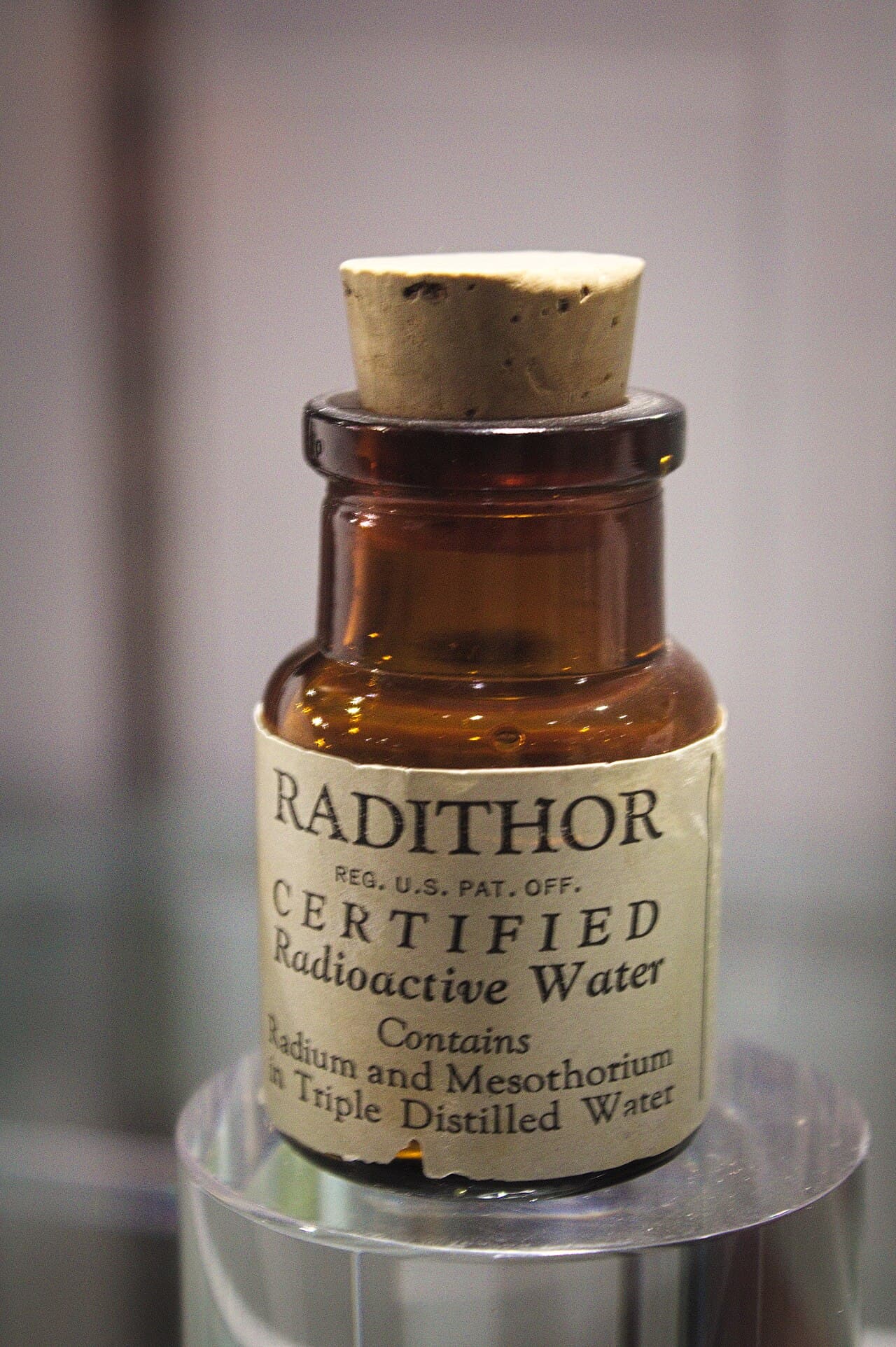
Radithor
Radithor was a 1920s patent medicine containing dissolved radium, sold as an energy tonic.
Photo: Wikimedia Commons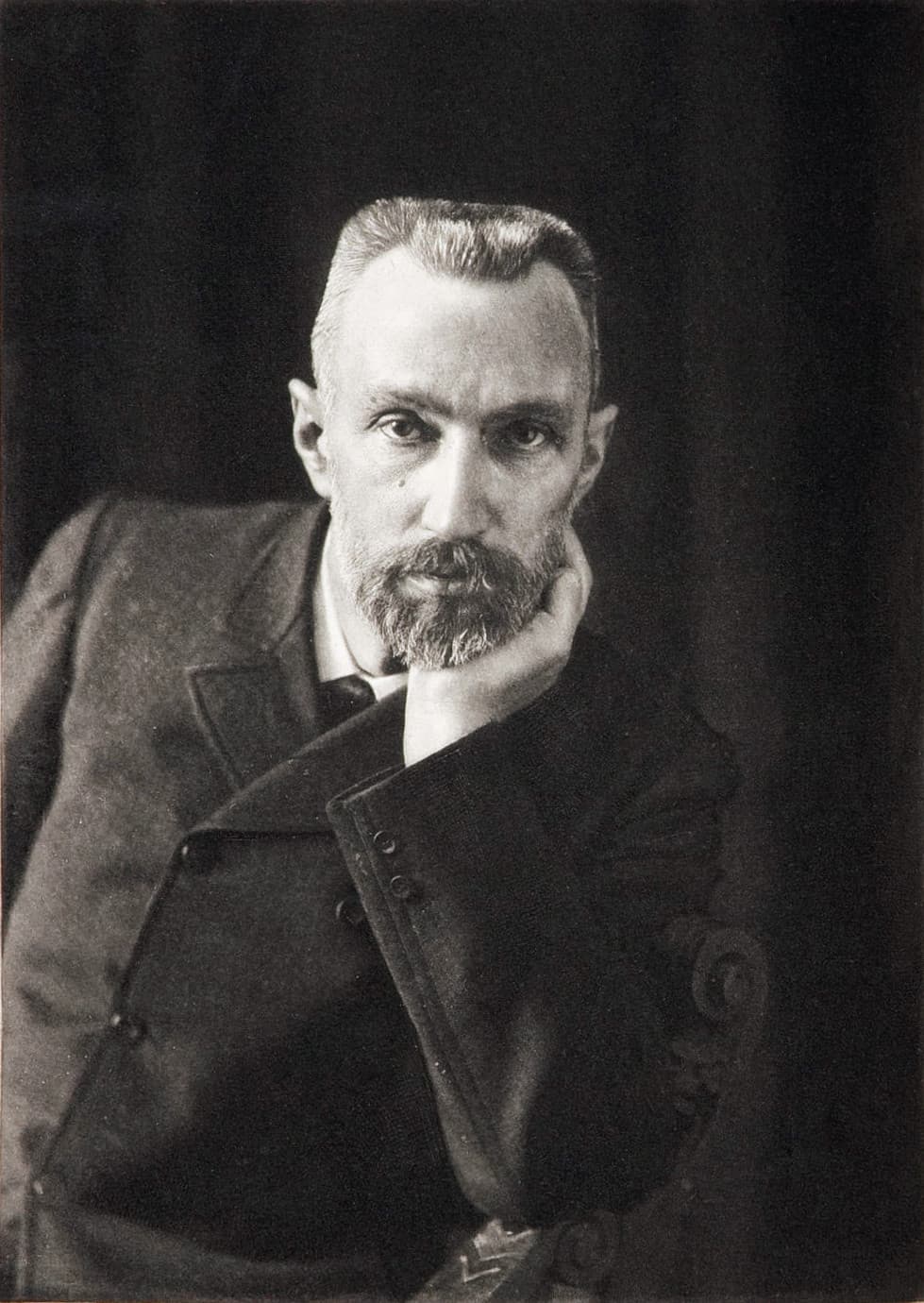
Pierre Curie
Pierre Curie co-discovered radium with Marie Curie and measured the heat it gives off.
Photo: Wikimedia Commons


Research
No research on Radium yet
When Bhavya publishes a project that studies Radium, it will be linked here.