Barium
Alkaline earth metal · Period 6 · Group 2 · s-block
The heavy element behind green fireworks and X-ray milkshakes
- Atomic mass
- 137.328 u
- State at 25 °C
- Solid
- Electronegativity
- 0.89
- Melting point
- 726.9 °C
- Boiling point
- 1,844.9 °C
- Configuration
- [Xe] 6s2
Nucleus drawn at reduced count for clarity. Drag to rotate.
Barium, explained
Video lesson in production
Bhavya’s explainer for this element will play here.
Overview
Barium is a soft, silvery alkaline earth metal in group 2, below strontium and above radium. Its configuration, [Xe] 6s2, gives two easily lost outer electrons, so barium forms Ba^2+ ions in almost all its compounds. Going down group 2 the outer electrons are farther from the nucleus and easier to remove, which makes barium more reactive than calcium or strontium: it tarnishes quickly in air, reacts vigorously with water, and is stored under oil. The name reflects the density of its minerals, especially baryte, barium sulfate, which is unusually heavy for a pale, non-metallic-looking stone.
Barium's compounds range from harmless to deadly depending on solubility. Barium sulfate is so insoluble that it passes through the gut untouched, and because barium's 56 electrons absorb X-rays strongly, a 'barium meal' outlines the oesophagus, stomach and intestines on X-ray images. Soluble barium salts, by contrast, are poisonous because Ba^2+ blocks potassium channels in muscle and nerve cells. Most baryte is ground up and added to drilling mud to weigh it down. Barium compounds also colour fireworks green, form permanent ferrite magnets, and appear in the high-temperature superconductor YBCO.
Discovery
In the early 1600s, Vincenzo Casciarolo, a shoemaker and alchemist in Bologna, found that heated pebbles of baryte glowed in the dark after exposure to light; these became famous as 'Bologna stones'. In 1772 Carl Wilhelm Scheele recognised a new earth, baryta (barium oxide), in baryte. Humphry Davy isolated barium metal in 1808 by electrolysis of molten barium hydroxide, using the new electric battery. The name comes from the Greek barys, meaning 'heavy'.
- Where it’s found
- Barium makes up about 0.04% of the crust, mostly as baryte (BaSO4) and witherite (BaCO3); China and India are the largest baryte producers.
- What it’s used for
- Oil-well drilling mud
- X-ray contrast meals
- Green fireworks
- Ferrite magnets
- White pigment and paper coating
- Vacuum tube getters
- In living things
- Barium has no biological role in humans, and soluble barium compounds are toxic, causing muscle weakness and dangerous drops in blood potassium. Some desmid algae deposit barium sulfate crystals in their cells.
- Safety
- Barium metal reacts with water and air and is stored under oil; soluble salts such as barium chloride and barium carbonate are poisonous if swallowed, while barium sulfate is safe for medical use.
How it compares
Where Barium sits among all 118 elements on the trends that shape the table.
- Electronegativity0.89Pauling
#96 of 100 elements with data
- Ionization energy503kJ/mol
#97 of 104 elements with data
- Atomic radius215pm
#4 of 95 elements with data
- Electron affinity14kJ/mol
#79 of 109 elements with data
- Density3.51g/cm³
#85 of 114 elements with data
- Melting point1,000K
#65 of 110 elements with data
- Density
- 3.51 g/cm³
- Atomic radius
- 215 pm
- Covalent radius
- 196 pm
- Molar heat
- 28.07 J/(mol·K)
- Appearance
- —
- Discovered by
- Carl Wilhelm Scheele
Inside the atom
56 electrons arranged in 6 shells: 2 · 8 · 18 · 18 · 8 · 2.
Orbital diagram
1s2 2s2 2p6 3s2 3p6 4s2 3d10 4p6 5s2 4d10 5p6 6s2 · shorthand [Xe] 6s2
- 1s2
- 2s2
- 2p6
- 3s2
- 3p6
- 4s2
- 3d10
- 4p6
- 5s2
- 4d10
- 5p6
- 6s2
Each box is an orbital holding up to two electrons of opposite spin. Highlighted subshells hold the valence electrons that decide how Barium bonds.
Ionization energies
Signature reactions
The chemistry Barium is known for.
Precipitation
Sulfate precipitation
Barium and sulfate ions combine into a dense white precipitate that is almost completely insoluble. Chemists use it to test for sulfate ions, and its insolubility is why barium sulfate is safe to swallow.
Conditions: aqueous, room temperature
Redox · Single displacement
Reaction with water
Barium fizzes vigorously in water, releasing hydrogen and forming strongly alkaline barium hydroxide. The reaction is faster than with calcium, reflecting barium's lower ionization energy.
Conditions: room temperature
Redox · Ore processing
Carbothermic reduction of baryte
Heating baryte with coke converts insoluble barium sulfate into water-soluble barium sulfide, known as 'black ash'. From it, manufacturers make nearly all other barium chemicals.
Conditions: kiln, about 1,000 °C
Where you’ll meet it

Baryte
Baryte, the dense mineral barium sulfate, is the main source of barium.
Photo: Wikimedia Commons
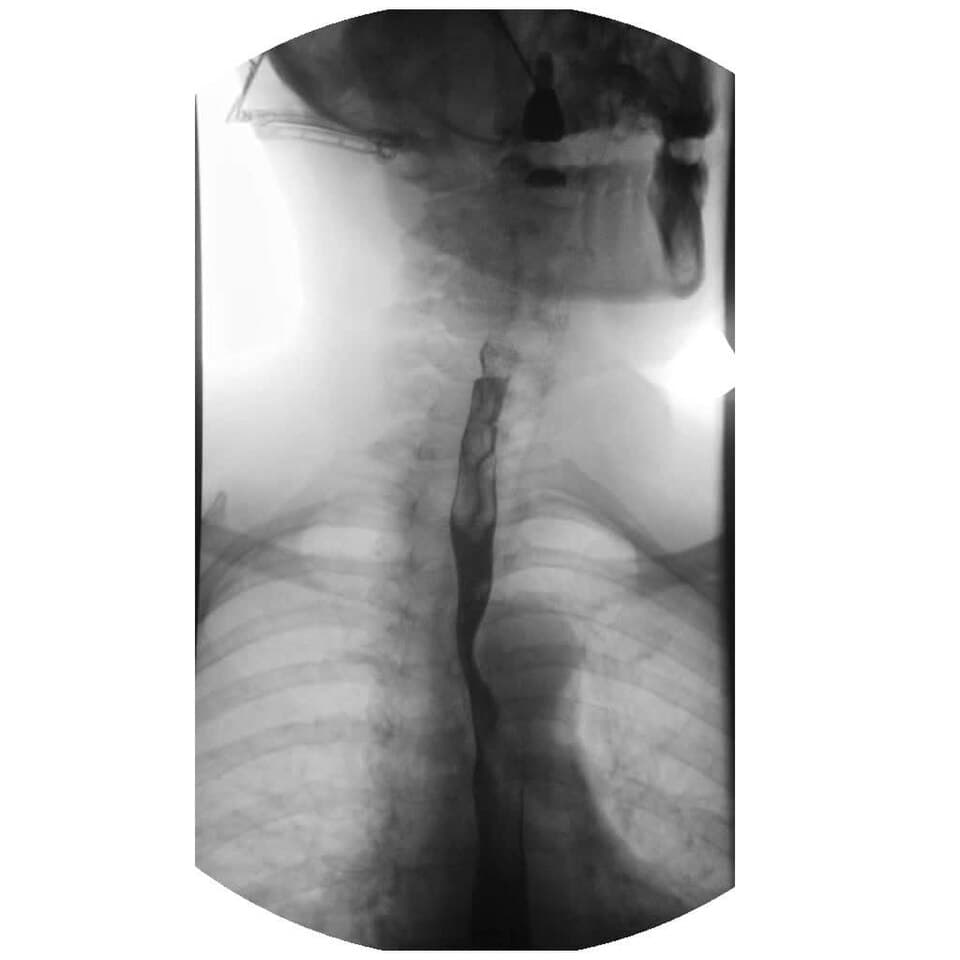
Upper gastrointestinal series
A barium sulfate drink makes the oesophagus and stomach visible on X-ray images.
Photo: Wikimedia Commons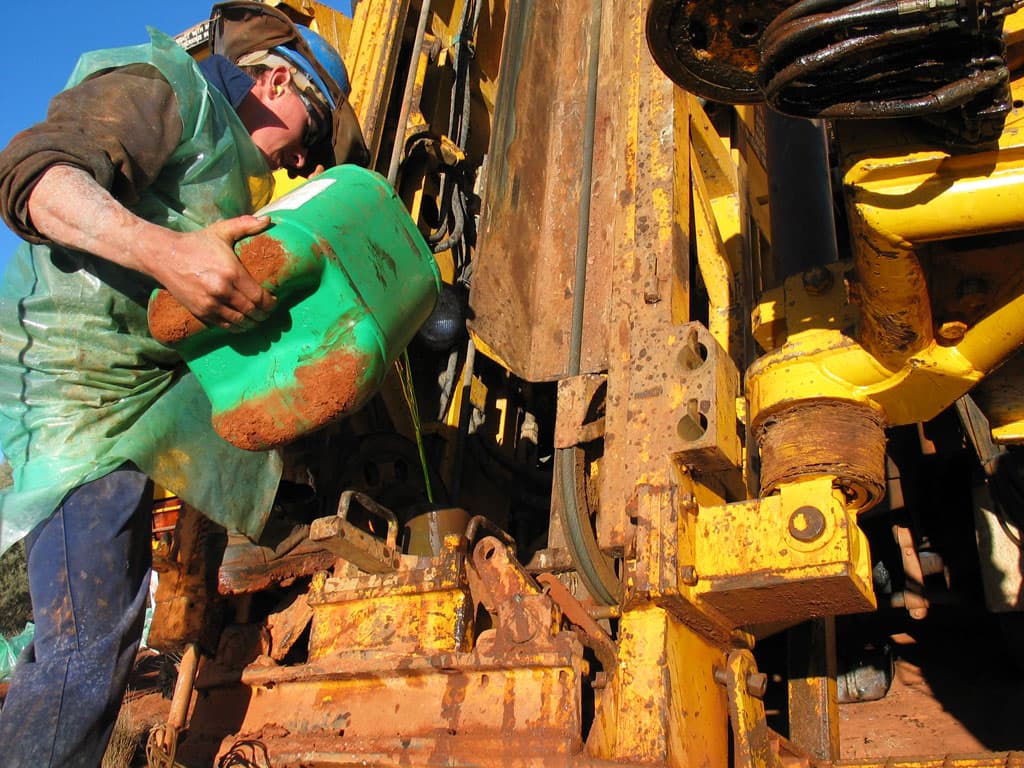
Drilling fluid
Most mined baryte is ground into drilling mud to control pressure in oil and gas wells.
Photo: Wikimedia Commons


Research
No research on Barium yet
When Bhavya publishes a project that studies Barium, it will be linked here.