Beryllium
Alkaline earth metal · Period 2 · Group 2 · s-block
Light, stiff and toxic: the metal of space mirrors
- Atomic mass
- 9.012 u
- State at 25 °C
- Solid
- Electronegativity
- 1.57
- Melting point
- 1,286.9 °C
- Boiling point
- 2,468.9 °C
- Configuration
- [He] 2s2
Beryllium, explained
Overview
Beryllium has the configuration [He]2s2, and its two valence electrons are held close to a small nucleus. Stripping both would create a tiny Be2+ ion with an enormous charge density, so beryllium compounds are largely covalent rather than ionic. Beryllium chloride forms polymeric chains, and beryllium hydroxide is amphoteric, dissolving in both acids and bases. In these ways beryllium resembles aluminium, the element diagonally below it, more than its own group-mates magnesium and calcium. A thin oxide film protects the metal from further attack by air.
As a metal, beryllium is unusual: with a density of 1.85 g/cm3 it is lighter than aluminium, yet about 40% stiffer than steel, and it holds its shape at very low temperatures. That is why the 18 hexagonal mirror segments of the James Webb Space Telescope are made of gold-coated beryllium. Its low atomic number makes it nearly transparent to X-rays, so it is used for windows in X-ray tubes, and it reflects neutrons in nuclear reactors. Beryllium is rare, at a few parts per million in the crust, and is mined mainly from bertrandite in Utah.
Discovery
In 1798 the French chemist Louis-Nicolas Vauquelin found a new oxide in beryl and emerald. Because its salts tasted sweet, it was first called glucinium, from the Greek glykys. In 1828 Friedrich Wöhler and Antoine Bussy independently isolated the metal by reducing beryllium chloride with potassium. The name beryllium, from the mineral beryl (Greek beryllos), eventually prevailed and was formally adopted by IUPAC in 1949.
- Where it’s found
- Beryllium occurs mainly in the minerals bertrandite and beryl; the United States, chiefly Spor Mountain in Utah, supplies most of the world's output.
- What it’s used for
- Space telescope mirrors
- X-ray tube windows
- Copper-beryllium springs
- Non-sparking tools
- Nuclear reactor reflectors
- In living things
- Beryllium has no biological role and is toxic. Inhaled dust can trigger chronic beryllium disease, an incurable immune reaction in the lungs, and beryllium is classified as a human carcinogen.
- Safety
- Solid beryllium parts are safe to handle, but dust, fumes and particles from machining are extremely hazardous to breathe. Work is done with strict ventilation and exposure limits.
How it compares
Where Beryllium sits among all 118 elements on the trends that shape the table.
- Electronegativity1.57Pauling
#52 of 100 elements with data
- Ionization energy900kJ/mol
#21 of 104 elements with data
- Atomic radius105pm
#84 of 95 elements with data
- Electron affinity-48kJ/mol
#95 of 109 elements with data
- Density1.85g/cm³
#95 of 114 elements with data
- Melting point1,560K
#39 of 110 elements with data
- Density
- 1.85 g/cm³
- Atomic radius
- 105 pm
- Covalent radius
- 102 pm
- Molar heat
- 16.443 J/(mol·K)
- Appearance
- white-gray metallic
- Discovered by
- Louis Nicolas Vauquelin
Inside the atom
4 electrons arranged in 2 shells: 2 · 2.
Orbital diagram
1s2 2s2 · shorthand [He] 2s2
- 1s2
- 2s2
Each box is an orbital holding up to two electrons of opposite spin. Highlighted subshells hold the valence electrons that decide how Beryllium bonds.
Ionization energies
Signature reactions
The chemistry Beryllium is known for.
Nuclear · Transmutation
Chadwick's neutron reaction
When alpha particles strike beryllium-9, the nucleus absorbs one and ejects a neutron, leaving carbon-12. In 1932 James Chadwick showed that this penetrating radiation consisted of uncharged particles with roughly the mass of a proton. Beryllium-based neutron sources still use this reaction today.
Conditions: alpha particles from polonium
Acid-base · Amphoteric
Beryllium hydroxide in base
Beryllium hydroxide dissolves in strong base to form the tetrahydroxoberyllate ion, just as it dissolves in acid to form Be2+ salts. This amphoteric behaviour reflects the strongly polarizing beryllium ion. Magnesium hydroxide, by contrast, dissolves only in acid.
Conditions: concentrated sodium hydroxide
Redox · Metallurgy
Magnesium reduction of beryllium fluoride
Industrial beryllium metal is made by heating beryllium fluoride with magnesium, which is the more reactive metal and takes the fluorine. The beryllium collects as pebbles that are then vacuum-melted and purified. The fluoride route is used because beryllium oxide is too stable to reduce easily.
Conditions: about 1300 °C
Where you’ll meet it

James Webb Space Telescope
JWST's 6.5-metre primary mirror is built from 18 gold-coated beryllium segments that keep their shape at about -233 °C.
Photo: Wikimedia Commons
Emerald
Emerald is beryl, a beryllium aluminium silicate, coloured green by traces of chromium or vanadium.
Photo: Wikimedia Commons
Aquamarine
The blue variety of beryl owes its colour to iron impurities in a beryllium-containing crystal.
Photo: Wikimedia Commons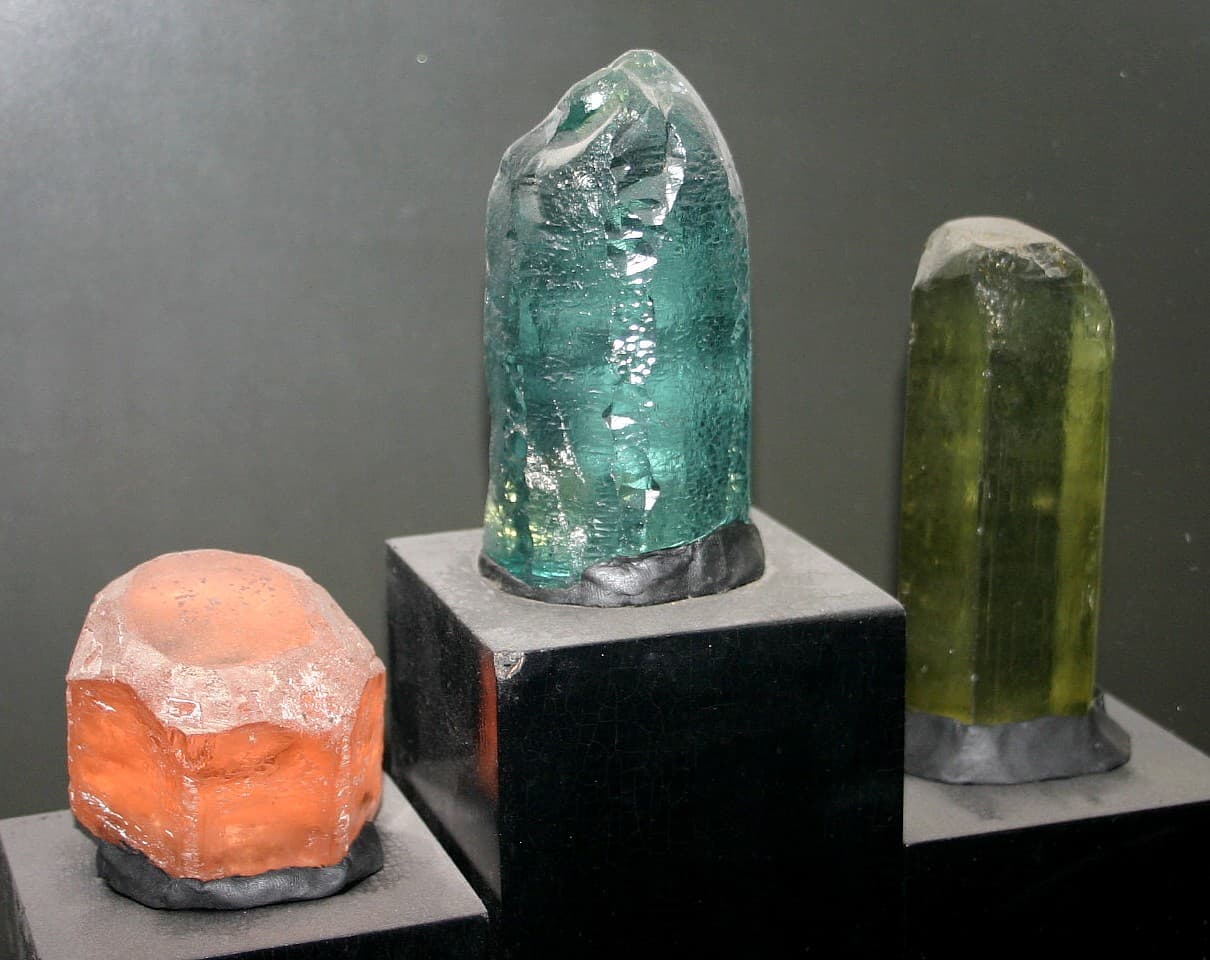
Beryl
The mineral beryl is both a gemstone family and a source of beryllium ore.
Photo: Wikimedia Commons


Research
No research on Beryllium yet
When Bhavya publishes a project that studies Beryllium, it will be linked here.