Actinium
Actinide · Period 7 · f-block
The ray-element that named a whole row of the periodic table
- Atomic mass
- 227 u
- State at 25 °C
- Solid
- Electronegativity
- 1.1
- Melting point
- 1,226.9 °C
- Boiling point
- 3,226.9 °C
- Configuration
- [Rn] 6d1 7s2
Nucleus drawn at reduced count for clarity. Drag to rotate.
Actinium, explained
Video lesson in production
Bhavya’s explainer for this element will play here.
Overview
Actinium is a soft, silvery radioactive metal and the first member of the actinide series, the row of 15 elements from actinium to lawrencium. It has the configuration 6d1 7s2, with no f electrons, and like lanthanum above it in group 3, it almost always forms the colourless Ac3+ ion. Its chemistry is so similar to lanthanum's that the two are hard to separate. Actinium glows with a pale blue light in the dark, because its intense radioactivity ionises the surrounding air.
All actinium isotopes are radioactive. Actinium-227, with a half-life of 21.8 years, occurs naturally in the uranium-235 decay chain, but only in tiny traces. Actinium-225, with a 10-day half-life, has become important in medicine: attached to molecules that seek out cancer cells, it releases four alpha particles as it decays through its short-lived daughters, destroying tumour cells while sparing more distant tissue. Supplying enough Ac-225 for clinical trials is now a major effort at national laboratories.
Discovery
André-Louis Debierne, a colleague of the Curies, reported actinium in 1899 from pitchblende residues and named it from the Greek aktis (aktinos), meaning 'ray' or 'beam'. In 1902 Friedrich Oskar Giesel independently found the same element, which he called emanium. Debierne's early samples were impure, and some historians credit Giesel with the first clear identification, but Debierne's name was kept.
- Where it’s found
- Actinium-227 occurs in trace amounts in uranium ores, and practical quantities are produced in reactors or accelerators from radium-226 or thorium targets.
- What it’s used for
- Targeted alpha cancer therapy
- Neutron sources
- Ocean circulation tracer
- Radiochemistry studies
- In living things
- Actinium has no biological role; if absorbed it deposits in the liver and bones, where its radiation is highly harmful.
- Safety
- Intensely radioactive; handled only in shielded hot cells or glove boxes. Its decay daughters add further alpha and gamma radiation.
How it compares
Where Actinium sits among all 118 elements on the trends that shape the table.
- Electronegativity1.1Pauling
#87 of 100 elements with data
- Ionization energy499kJ/mol
#98 of 104 elements with data
- Atomic radius195pm
#7 of 95 elements with data
- Electron affinity33.8kJ/mol
#67 of 109 elements with data
- Density10g/cm³
#40 of 114 elements with data
- Melting point1,500K
#41 of 110 elements with data
- Density
- 10 g/cm³
- Atomic radius
- 195 pm
- Covalent radius
- 186 pm
- Molar heat
- 27.2 J/(mol·K)
- Appearance
- —
- Discovered by
- Friedrich Oskar Giesel
Inside the atom
89 electrons arranged in 7 shells: 2 · 8 · 18 · 32 · 18 · 9 · 2.
Orbital diagram
1s2 2s2 2p6 3s2 3p6 4s2 3d10 4p6 5s2 4d10 5p6 6s2 4f14 5d10 6p6 7s2 6d1 · shorthand [Rn] 6d1 7s2
- 1s2
- 2s2
- 2p6
- 3s2
- 3p6
- 4s2
- 3d10
- 4p6
- 5s2
- 4d10
- 5p6
- 6s2
- 4f14
- 5d10
- 6p6
- 7s2
- 6d1
Each box is an orbital holding up to two electrons of opposite spin. Highlighted subshells hold the valence electrons that decide how Actinium bonds.
Ionization energies
Signature reactions
The chemistry Actinium is known for.
Nuclear · Proton bombardment
Producing actinium-225 with protons
A proton strikes radium-226, and the compound nucleus ejects two neutrons, leaving actinium-225. This route, alongside high-energy proton bombardment of thorium, is being developed to meet demand for cancer therapy.
Conditions: cyclotron proton beam on radium target
Nuclear · Alpha decay
Alpha decay of actinium-225
Actinium-225 emits an alpha particle and becomes francium-221, the first step of a chain that releases three more alpha particles within hours. The combined radiation is concentrated within a few cell diameters of the tumour.
Conditions: spontaneous; half-life 9.9 days
Precipitation
Precipitating actinium hydroxide
Adding base to an actinium solution precipitates white actinium hydroxide, just as lanthanum ions do. This similarity to lanthanum is why the actinides were placed as a series parallel to the lanthanides.
Conditions: adding ammonia or hydroxide
Where you’ll meet it
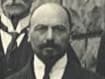
André-Louis Debierne
André-Louis Debierne discovered actinium in 1899 in Paris.
Photo: Wikimedia Commons
Actinium-225
A sample of actinium-225 nitrate prepared at Oak Ridge for cancer therapy research.
Photo: Wikimedia Commons
Oak Ridge National Laboratory
Oak Ridge supplies much of the world's actinium-225 by extracting it from a stockpile of thorium-229.
Photo: Wikimedia Commons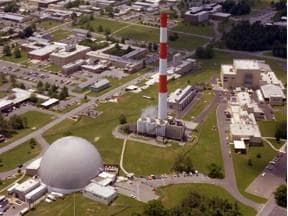
Brookhaven National Laboratory
Brookhaven makes actinium-225 by bombarding thorium targets with high-energy protons.
Photo: Wikimedia Commons


Research
No research on Actinium yet
When Bhavya publishes a project that studies Actinium, it will be linked here.