Uranium
Actinide · Period 7 · f-block
The heavy metal that powers reactors and once glowed in glassware
- Atomic mass
- 238.029 u
- State at 25 °C
- Solid
- Electronegativity
- 1.38
- Melting point
- 1,132.2 °C
- Boiling point
- 4,130.9 °C
- Configuration
- [Rn] 5f3 6d1 7s2
Nucleus drawn at reduced count for clarity. Drag to rotate.
Uranium, explained
Video lesson in production
Bhavya’s explainer for this element will play here.
Overview
Uranium is a dense (19.1 g/cm3), silvery actinide metal with the configuration 5f3 6d1 7s2. Its six outer electrons can be involved in bonding, so it shows oxidation states from +3 to +6. The +6 state is most stable in air and water, usually as the linear uranyl ion UO2^{2+}, which gives uranium minerals and salts their yellow-green colours and makes uranium glass glow green under ultraviolet light. Finely divided uranium metal is pyrophoric, and bulk metal slowly tarnishes in air.
Natural uranium is 99.3% uranium-238 and 0.7% uranium-235. Both are radioactive with very long half-lives (4.5 billion and 704 million years), which is why uranium is still present from Earth's formation. Uranium-235 matters because it can split, or fission, when it absorbs a slow neutron, releasing about 200 MeV and two or three new neutrons that can sustain a chain reaction. Reactor fuel is enriched to 3–5% U-235 by spinning uranium hexafluoride gas in centrifuges.
Discovery
Martin Heinrich Klaproth identified a new element in pitchblende in 1789 and named it after the planet Uranus, discovered eight years earlier. What he isolated was actually an oxide; Eugène-Melchior Péligot produced the metal in 1841. In 1896 Henri Becquerel found that uranium salts fogged photographic plates in the dark, the discovery of radioactivity. In 1938 Otto Hahn and Fritz Strassmann showed that uranium splits under neutron bombardment.
- Where it’s found
- Uranium averages about 2.7 parts per million in the crust and is mined mainly from uraninite (pitchblende) deposits in Kazakhstan, Canada, Namibia and Australia.
- What it’s used for
- Nuclear power fuel
- Nuclear weapons
- Armour-piercing projectiles
- Aircraft counterweights
- Radiometric dating
- Uranium glass (historical)
- In living things
- Uranium has no biological role; it is chemically toxic to the kidneys and radioactive, though natural uranium's radioactivity is weak.
- Safety
- Natural and depleted uranium are weakly radioactive but chemically toxic; avoid ingesting or inhaling dust. Enriched uranium carries criticality hazards and is tightly controlled.
How it compares
Where Uranium sits among all 118 elements on the trends that shape the table.
- Electronegativity1.38Pauling
#57 of 100 elements with data
- Ionization energy598kJ/mol
#68 of 104 elements with data
- Atomic radius175pm
#25 of 95 elements with data
- Electron affinity50.9kJ/mol
#51 of 109 elements with data
- Density19.1g/cm³
#17 of 114 elements with data
- Melting point1,410K
#43 of 110 elements with data
- Density
- 19.1 g/cm³
- Atomic radius
- 175 pm
- Covalent radius
- 170 pm
- Molar heat
- 27.665 J/(mol·K)
- Appearance
- —
- Discovered by
- Martin Heinrich Klaproth
Inside the atom
92 electrons arranged in 7 shells: 2 · 8 · 18 · 32 · 21 · 9 · 2.
Orbital diagram
1s2 2s2 2p6 3s2 3p6 4s2 3d10 4p6 5s2 4d10 5p6 6s2 4f14 5d10 6p6 7s2 5f3 6d1 · shorthand [Rn] 5f3 6d1 7s2
- 1s2
- 2s2
- 2p6
- 3s2
- 3p6
- 4s2
- 3d10
- 4p6
- 5s2
- 4d10
- 5p6
- 6s2
- 4f14
- 5d10
- 6p6
- 7s2
- 5f3
- 6d1
Each box is an orbital holding up to two electrons of opposite spin. Highlighted subshells hold the valence electrons that decide how Uranium bonds.
Ionization energies
Signature reactions
The chemistry Uranium is known for.
Nuclear · Fission
Fission of uranium-235
A uranium-235 nucleus absorbs a neutron, splits into two lighter nuclei and releases about 200 MeV plus three neutrons. Those neutrons can split more nuclei, the chain reaction behind nuclear power and the Little Boy bomb.
Conditions: slow (thermal) neutron; chain reaction in a reactor
Synthesis · Fluorination
Making uranium hexafluoride
Uranium tetrafluoride is fluorinated to uranium hexafluoride, a white solid that turns into a gas at 56.5 °C. As a gas it can be fed into centrifuges that separate U-235 from slightly heavier U-238.
Conditions: fluorine gas, about 350 °C
Nuclear · Alpha decay
Alpha decay of uranium-238
Uranium-238 emits an alpha particle to form thorium-234, the first step of a 14-step chain ending at stable lead-206. Measuring how much lead has built up lets geologists date ancient rocks and minerals.
Conditions: spontaneous; half-life 4.47 billion years
Where you’ll meet it

Uranium glass
Glass coloured with uranium fluoresces bright green under ultraviolet light.
Photo: Wikimedia Commons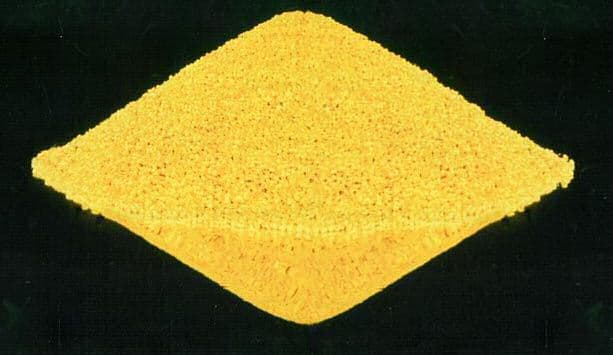
Yellowcake
Yellowcake is the uranium oxide concentrate produced at mines before enrichment.
Photo: Wikimedia Commons
Nuclear power plant
Most nuclear power plants generate electricity from the fission of uranium-235.
Photo: Wikimedia Commons
Little Boy
The Little Boy bomb dropped on Hiroshima in 1945 used about 64 kg of enriched uranium.
Photo: Wikimedia Commons


Research
No research on Uranium yet
When Bhavya publishes a project that studies Uranium, it will be linked here.