Thorium
Actinide · Period 7 · f-block
Named for the god of thunder, a possible fuel for future reactors
- Atomic mass
- 232.038 u
- State at 25 °C
- Solid
- Electronegativity
- 1.3
- Melting point
- 1,749.9 °C
- Boiling point
- 4,787.9 °C
- Configuration
- [Rn] 6d2 7s2
Nucleus drawn at reduced count for clarity. Drag to rotate.
Thorium, explained
Video lesson in production
Bhavya’s explainer for this element will play here.
Overview
Thorium is a silvery, weakly radioactive actinide metal that slowly tarnishes grey to black in air. Its configuration is 6d2 7s2, and it almost always loses all four outer electrons to form Th4+, so its chemistry resembles that of hafnium and zirconium more than that of later actinides. Thorium dioxide has the highest melting point of any oxide, about 3,350 °C, and glows brightly when heated, which made it the active ingredient in gas lantern mantles.
Natural thorium is almost entirely thorium-232, with a half-life of 14 billion years, roughly three times the age of Earth. Its slow decay, along with that of uranium and potassium-40, supplies much of the heat inside our planet. Thorium-232 cannot sustain a chain reaction itself, but it is 'fertile': absorbing a neutron turns it, after two beta decays, into uranium-233, which is fissile. This makes thorium a candidate fuel for reactors designed to breed their own fuel.
Discovery
In 1828 the Norwegian clergyman and mineralogist Morten Thrane Esmark found a black mineral on the island of Løvøya and sent it to Jöns Jacob Berzelius, who identified a new element in 1829. Berzelius named it after Thor, the Norse god of thunder, reusing a name he had given in 1815 to a supposed element that turned out to be yttrium phosphate. Gerhard Schmidt and Marie Curie independently found thorium to be radioactive in 1898.
- Where it’s found
- Thorium makes up about 10 parts per million of the crust and is obtained mainly from monazite, a rare-earth phosphate mineral found in beach sands in India, Brazil and Australia.
- What it’s used for
- Gas lantern mantles (historical)
- Welding electrodes
- High-temperature ceramics
- Nuclear fuel research
- Optical lens glass (historical)
- In living things
- Thorium has no biological role; inhaled or ingested thorium lodges in the lungs, liver and bones and raises cancer risk over time.
- Safety
- Weakly radioactive; solid thorium is safe to handle briefly, but its dust must not be inhaled. Finely divided thorium metal is pyrophoric and can ignite in air.
How it compares
Where Thorium sits among all 118 elements on the trends that shape the table.
- Electronegativity1.3Pauling
#62 of 100 elements with data
- Ionization energy587kJ/mol
#74 of 104 elements with data
- Atomic radius180pm
#17 of 95 elements with data
- Electron affinity113kJ/mol
#22 of 109 elements with data
- Density11.7g/cm³
#35 of 114 elements with data
- Melting point2,020K
#19 of 110 elements with data
- Density
- 11.7 g/cm³
- Atomic radius
- 180 pm
- Covalent radius
- 175 pm
- Molar heat
- 26.23 J/(mol·K)
- Appearance
- silvery, often with black tarnish
- Discovered by
- Jöns Jakob Berzelius
Inside the atom
90 electrons arranged in 7 shells: 2 · 8 · 18 · 32 · 18 · 10 · 2.
Orbital diagram
1s2 2s2 2p6 3s2 3p6 4s2 3d10 4p6 5s2 4d10 5p6 6s2 4f14 5d10 6p6 7s2 6d2 · shorthand [Rn] 6d2 7s2
- 1s2
- 2s2
- 2p6
- 3s2
- 3p6
- 4s2
- 3d10
- 4p6
- 5s2
- 4d10
- 5p6
- 6s2
- 4f14
- 5d10
- 6p6
- 7s2
- 6d2
Each box is an orbital holding up to two electrons of opposite spin. Highlighted subshells hold the valence electrons that decide how Thorium bonds.
Ionization energies
Signature reactions
The chemistry Thorium is known for.
Redox · Combustion
Burning thorium
Thorium burns with a brilliant white light to form thorium dioxide. The oxide's very high melting point and strong glow at high temperatures explain its use in lantern mantles and refractory ceramics.
Conditions: heating in air, or powder at room temperature
Nuclear · Neutron capture
Breeding fuel from thorium
Thorium-232 absorbs a neutron to form thorium-233, which beta-decays to protactinium-233 and then to fissile uranium-233. This is the first step of the thorium fuel cycle.
Conditions: neutron irradiation in a reactor
Nuclear · Alpha decay
Alpha decay of thorium-232
Thorium-232 emits an alpha particle to form radium-228, beginning the thorium decay series that ends at stable lead-208. Because the half-life is so long, natural thorium is only weakly radioactive.
Conditions: spontaneous; half-life 14 billion years
Where you’ll meet it
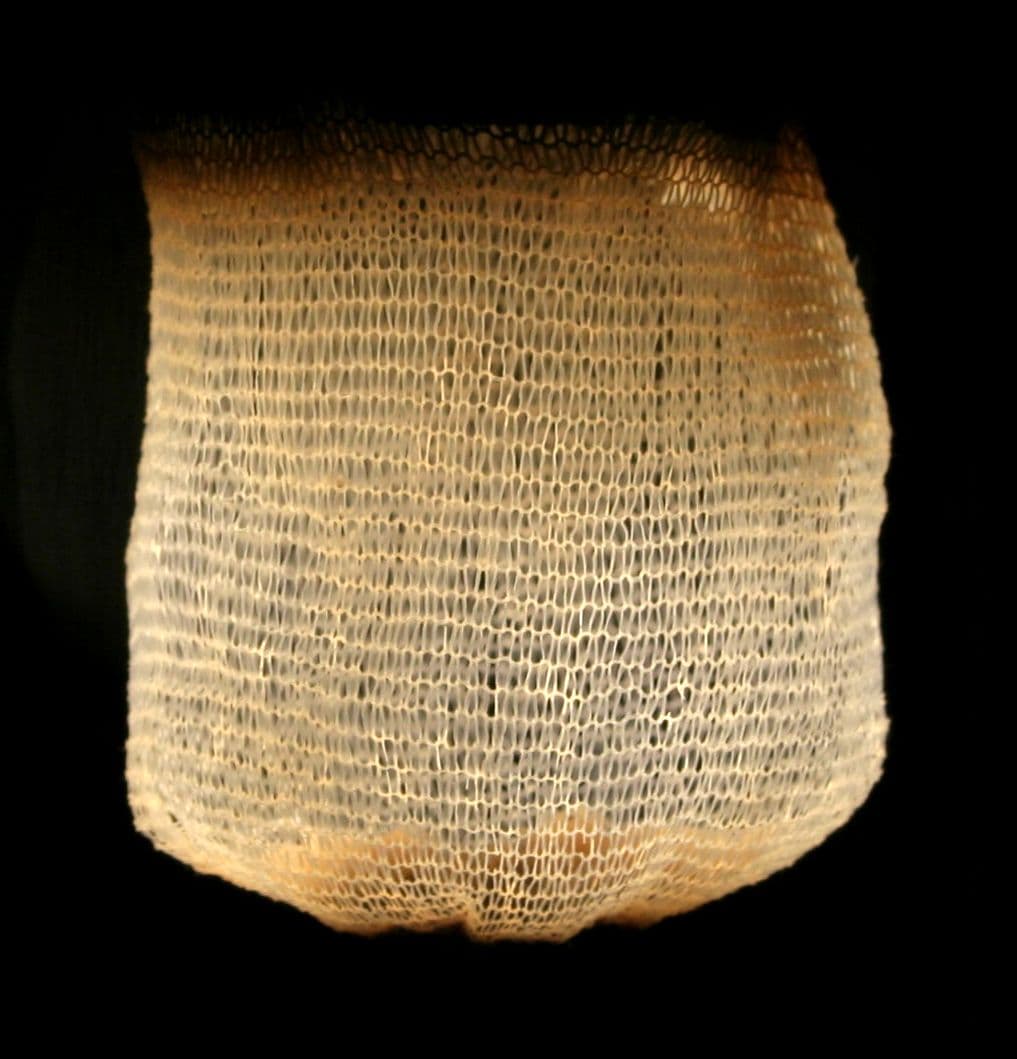
Gas mantle
Gas mantles glowed brightly because of thorium dioxide in their fabric mesh.
Photo: Wikimedia Commons
Monazite
Monazite, a phosphate of rare earths and thorium, is the main commercial source of thorium.
Photo: Wikimedia Commons

Thorite
Thorite, a thorium silicate, was the mineral in which Berzelius discovered the element.
Photo: Wikimedia Commons


Research
No research on Thorium yet
When Bhavya publishes a project that studies Thorium, it will be linked here.