Nobelium
Actinide · Period 7 · f-block
Named for Nobel, claimed by three labs, credited to Dubna
- Atomic mass
- 259 u
- State at 25 °C
- Solid
- Electronegativity
- 1.3
- Melting point
- 826.9 °Cpredicted
- Boiling point
- —
- Configuration
- [Rn] 5f14 7s2
Nucleus drawn at reduced count for clarity. Drag to rotate.
Nobelium, explained
Video lesson in production
Bhavya’s explainer for this element will play here.
Overview
Nobelium is the second-to-last actinide, with the electron configuration 5f14 7s2. That completely filled 5f subshell gives it the most unusual chemistry in its series: while nearly every other actinide prefers the +3 oxidation state in water, nobelium prefers +2. Removing a third electron would mean breaking into the stable, filled 5f14 shell, so No3+ is a strong oxidizing agent that readily grabs an electron back.
This makes nobelium behave in solution more like the alkaline-earth ions, such as Ca2+ and Sr2+, than like its actinide neighbors. Only atom-at-a-time experiments are possible: the longest-lived isotope, nobelium-259, has a half-life of about 58 minutes, and production rates are a few atoms per minute at best. Even so, laser spectroscopy at GSI, beginning in 2016, has measured its atomic energy levels and the size of its nucleus, the heaviest element studied this way at the time.
Discovery
Nobelium's discovery is one of the most disputed in chemistry. A team at the Nobel Institute in Stockholm claimed it in 1957 and proposed the name nobelium after Alfred Nobel; that result could not be reproduced. Berkeley reported it in 1958, but its isotope assignments were wrong. Careful work at Dubna by Georgy Flerov's group between 1963 and 1966 was later judged the conclusive discovery. IUPAC nevertheless kept the established name, nobelium, in 1997.
- Where it’s found
- Nobelium does not occur in nature; it is produced in accelerators by fusing light ions with curium, uranium or lead targets.
- What it’s used for
- Nuclear structure research
- Laser spectroscopy tests
- Relativistic chemistry studies
- Superheavy element calibration
- In living things
- Nobelium has no biological role. It is radioactive, and only a few atoms at a time have ever existed.
- Safety
- Radioactive and made only a few atoms at a time; no bulk sample has ever existed.
How it compares
Where Nobelium sits among all 118 elements on the trends that shape the table.
- Electronegativity1.3Pauling
#62 of 100 elements with data · predicted
- Ionization energy642kJ/mol
#57 of 104 elements with data · predicted
- Atomic radiusNo data
Not measured for this element
- Electron affinity-223kJ/mol
#109 of 109 elements with data · predicted
- DensityNo data
Not measured for this element
- Melting point1,100K
#58 of 110 elements with data · predicted
- Density
- —
- Atomic radius
- —
- Covalent radius
- —
- Molar heat
- —
- Appearance
- —
- Discovered by
- Joint Institute for Nuclear Research
Inside the atom
102 electrons arranged in 7 shells: 2 · 8 · 18 · 32 · 32 · 8 · 2.
Orbital diagram
1s2 2s2 2p6 3s2 3p6 4s2 3d10 4p6 5s2 4d10 5p6 6s2 4f14 5d10 6p6 7s2 5f14 · shorthand [Rn] 5f14 7s2
- 1s2
- 2s2
- 2p6
- 3s2
- 3p6
- 4s2
- 3d10
- 4p6
- 5s2
- 4d10
- 5p6
- 6s2
- 4f14
- 5d10
- 6p6
- 7s2
- 5f14
Each box is an orbital holding up to two electrons of opposite spin. Highlighted subshells hold the valence electrons that decide how Nobelium bonds.
Signature reactions
How the first atoms were made, and how they fall apart.
Nuclear · Fusion-evaporation
Dubna synthesis
A neon-22 nucleus fuses with uranium-238, and the hot compound nucleus cools by boiling off four neutrons. Dubna's identification of nobelium-256 and its decay products in this reaction underpinned the discovery credit.
Conditions: neon-22 beam on uranium target, Dubna, 1960s
Nuclear · Alpha decay
Alpha decay of nobelium-254
Nobelium-254 emits an alpha particle and becomes fermium-250. Matching such daughter nuclides to known isotopes is how an atom of a new element is identified.
Conditions: spontaneous, half-life about 51 seconds
Redox · Aqueous
Reduction of No(III)
Tracer experiments show the No3+/No2+ couple has a standard potential of roughly +1.4 V, so No3+ is easily reduced. This measured value confirms that the filled 5f14 shell stabilizes No2+, unlike any other actinide.
Conditions: tracer scale, aqueous solution
Where you’ll meet it
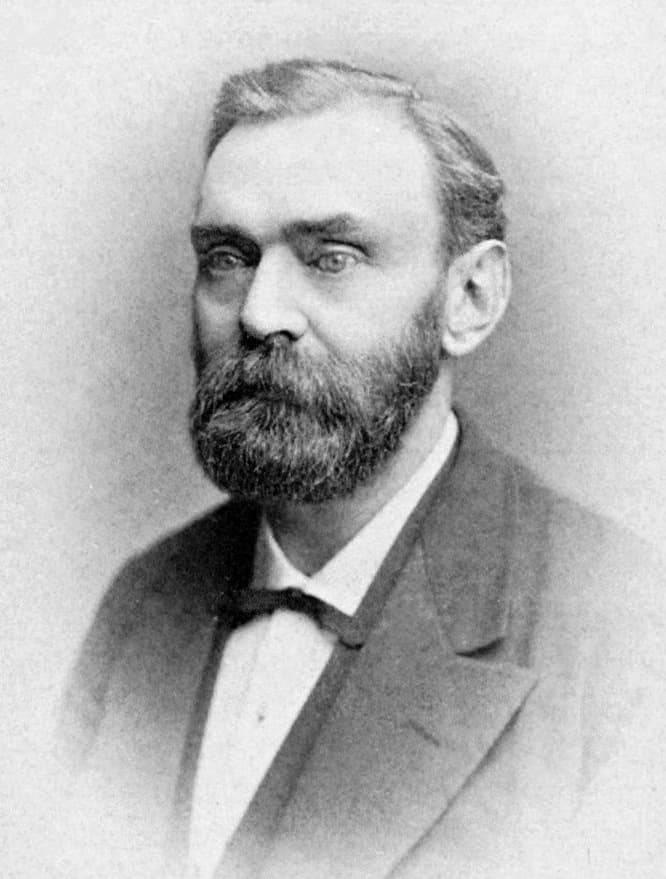
Alfred Nobel
The Swedish inventor of dynamite, whose fortune funds the Nobel Prizes, is honored by element 102.
Photo: Wikimedia Commons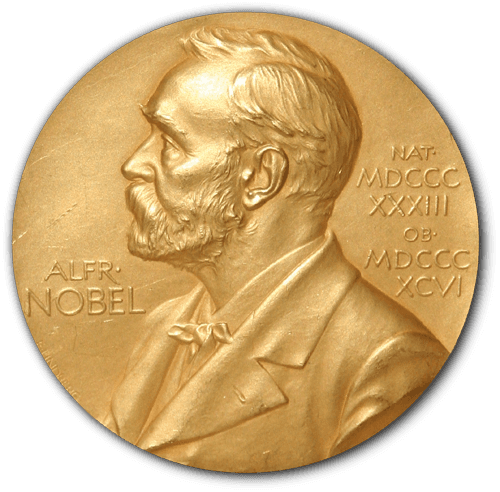
Nobel Prize
The prize that bears Nobel's name shares its origin with the element named after him.
Photo: Wikimedia Commons
Joint Institute for Nuclear Research
Dubna's experiments in the 1960s are credited with the conclusive discovery of nobelium.
Photo: Wikimedia Commons
Georgy Flerov
Flyorov led the Dubna group whose careful nobelium work settled the discovery dispute.
Photo: Wikimedia Commons


Research
No research on Nobelium yet
When Bhavya publishes a project that studies Nobelium, it will be linked here.