Carbon
Reactive nonmetal · Period 2 · Group 14 · p-block
The backbone of life, from pencil lead to diamond
- Atomic mass
- 12.011 u
- State at 25 °C
- Solid
- Electronegativity
- 2.55
- Melting point
- 4,326.9 °C
- Boiling point
- —
- Configuration
- [He] 2s2 2p2
Carbon, explained
Overview
Carbon has four valence electrons ([He]2s2 2p2), too many to lose easily and too few to gain, so it shares them, forming four covalent bonds. Carbon-carbon bonds are strong (about 346 kJ/mol for a single bond), and carbon can form single, double and triple bonds, so its atoms link into chains, branches and rings of almost unlimited variety. Tens of millions of carbon compounds are known, more than for all other elements combined, and this versatility is why an entire branch of chemistry, organic chemistry, is devoted to it.
The same bonding flexibility gives elemental carbon several very different forms. In diamond, every atom bonds to four neighbours in a rigid three-dimensional network, making it the hardest natural material and an electrical insulator. In graphite, atoms form flat hexagonal sheets with delocalized electrons that conduct electricity, while the sheets slide over one another. Carbon also forms hollow fullerene cages, nanotubes and single-atom-thick graphene. Through the carbon cycle, the element moves between the atmosphere (about 420 ppm CO2), oceans, rocks, fossil fuels and living things.
Discovery
Charcoal and soot have been used since prehistoric times, so carbon has no discoverer. In 1772 Antoine Lavoisier showed that diamond burns to give the same gas as charcoal, and in 1797 Smithson Tennant proved diamond is pure carbon. Lavoisier listed carbone among the elements in 1789, from the Latin carbo, charcoal. The name graphite was coined in 1789 by Abraham Gottlob Werner, from the Greek graphein, to write.
- Where it’s found
- Carbon is the fourth most abundant element in the universe; on Earth it occurs in carbonate rocks, coal, oil and gas, atmospheric CO2 and living matter, while diamonds are mined from kimberlite pipes.
- What it’s used for
- Steelmaking coke
- Fossil fuels
- Pencils and lubricants
- Industrial cutting tools
- Carbon-fibre composites
- Radiocarbon dating
- In living things
- Carbon is the structural basis of all known life, forming the skeletons of proteins, carbohydrates, fats and DNA, and makes up about 18% of human body mass. It enters the food web when plants and algae fix atmospheric CO2 by photosynthesis.
- Safety
- Elemental carbon is of low toxicity, though fine soot and carbon black dust damage the lungs. Incomplete combustion produces carbon monoxide, an odourless gas that blocks oxygen transport in the blood.
How it compares
Where Carbon sits among all 118 elements on the trends that shape the table.
- Electronegativity2.55Pauling
#10 of 100 elements with data
- Ionization energy1,090kJ/mol
#12 of 104 elements with data
- Atomic radius70pm
#91 of 95 elements with data
- Electron affinity122kJ/mol
#19 of 109 elements with data
- Density1.82g/cm³
#97 of 114 elements with data
- Melting point4,600K
#1 of 110 elements with data
- Density
- 1.82 g/cm³
- Atomic radius
- 70 pm
- Covalent radius
- 75 pm
- Molar heat
- 8.517 J/(mol·K)
- Appearance
- —
- Discovered by
- Ancient Egypt
Inside the atom
6 electrons arranged in 2 shells: 2 · 4.
Orbital diagram
1s2 2s2 2p2 · shorthand [He] 2s2 2p2
- 1s2
- 2s2
- 2p2
Each box is an orbital holding up to two electrons of opposite spin. Highlighted subshells hold the valence electrons that decide how Carbon bonds.
Ionization energies
Signature reactions
The chemistry Carbon is known for.
Redox · Combustion
Combustion of carbon
Carbon burns in plentiful oxygen to give carbon dioxide, releasing 394 kJ per mole. This reaction, in the form of burning coal, powered the Industrial Revolution. It is also the main source of the extra CO2 now warming the climate.
Conditions: ignition, excess oxygen
Redox · Biochemical
Photosynthesis
Plants, algae and cyanobacteria use light energy to reduce carbon dioxide to glucose, releasing oxygen from water. The overall equation hides dozens of steps in the light reactions and the Calvin cycle. Photosynthesis fixes on the order of 100 billion tonnes of carbon each year.
Conditions: sunlight, chlorophyll
Redox · Metallurgy
Reduction of iron ore
In a blast furnace, coke burns to carbon monoxide, which strips oxygen from iron ore and leaves molten iron. Carbon's ability to reduce metal oxides made iron and steel cheap enough to build the modern world. Steelmaking is now responsible for roughly 7% of global CO2 emissions.
Conditions: blast furnace, about 1500 °C
Watch Carbon react in 3D
In the kitchen
What happens in a gas stove flame
Combustion of methane
In the kitchen
Why baking soda and vinegar fizz
Acid–carbonate neutralization
In the kitchen
What makes bread dough rise
Alcoholic fermentation of glucose
In the kitchen
Where fruity smells come from
Fischer esterification
In your body
Where your body's energy comes from
Aerobic cellular respiration
In your body
How an antacid calms heartburn
Neutralization of stomach acid by calcium carbonate
Around the house
How lime mortar hardens
Carbonation of calcium hydroxide
Air, water and Earth
Why the oceans are becoming more acidic
Acid ionization of dissolved carbon dioxide
Air, water and Earth
What a car's catalytic converter does
Catalytic reduction of nitric oxide by carbon monoxide
Industry and technology
Why cement plants release so much CO2
Thermal decomposition of calcium carbonate
Industry and technology
How iron is made from rock
Reduction of iron ore by carbon monoxide
Fire, light and energy
What powers a backyard gas grill
Combustion of propane
Where you’ll meet it

Hope Diamond
This 45.52-carat blue diamond is pure carbon, coloured by trace boron atoms.
Photo: Wikimedia Commons
Graphite
Graphite's stacked sheets of carbon make it soft, slippery and electrically conductive.
Photo: Wikimedia Commons
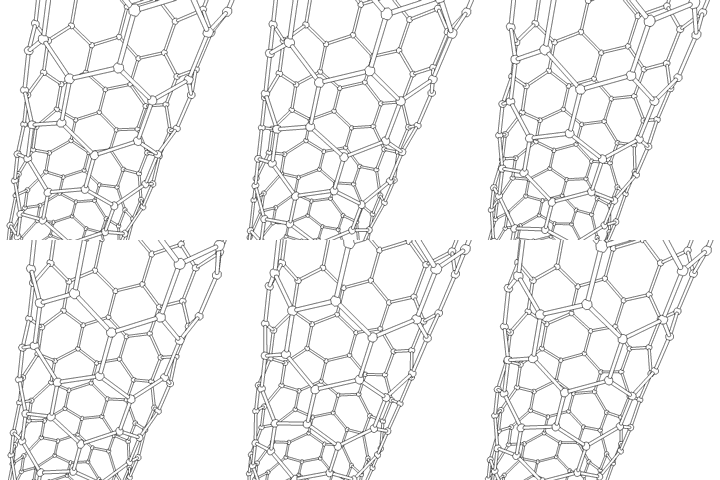
Carbon nanotube
Rolled-up sheets of carbon atoms form tubes with exceptional strength and conductivity.
Photo: Wikimedia Commons


Research
University laboratory research · 2023 – present
Frontally fabricated polymers
Three years of hands-on research in polymer and materials chemistry at the University of Utah, studying polymers made by frontal polymerization: a curing process that runs on the heat of its own reaction. Co-author of a paper published through the American Chemical Society, with a second manuscript in the publication process.
Health science research poster · HOSA · Junior year
Caffeine consumption and perceived alertness in high school students
A survey study of 78 high school students comparing self-reported alertness and cognition across groups with different levels of caffeine consumption. Presented as a research poster through HOSA – Future Health Professionals, placing in the top 10 in the state.