Nitrogen
Reactive nonmetal · Period 2 · Group 15 · p-block
Four-fifths of every breath, locked by a triple bond
- Atomic mass
- 14.007 u
- State at 25 °C
- Gas
- Electronegativity
- 3.04
- Melting point
- -210 °C
- Boiling point
- -195.8 °C
- Configuration
- [He] 2s2 2p3
Nitrogen, explained
Overview
Nitrogen atoms have five valence electrons ([He]2s2 2p3) and pair up into N2 molecules held together by a triple bond. At 945 kJ/mol, it is one of the strongest bonds in chemistry, which is why the nitrogen that makes up 78% of the atmosphere is so unreactive. In compounds, nitrogen shows a wide range of oxidation states, from -3 in ammonia to +5 in nitric acid and nitrates. Many nitrogen compounds are unstable relative to N2, so they release large amounts of energy when they decompose, which is the basis of most explosives.
Every living thing needs nitrogen for proteins and nucleic acids, but almost no organism can use N2 directly. Breaking the triple bond, called nitrogen fixation, happens through lightning, through bacteria with the enzyme nitrogenase, and through the industrial Haber-Bosch process, which now fixes about as much nitrogen as all natural processes on land combined. Synthetic fertilizer made this way supports roughly half of the world's population. Nitrogen gas is separated from liquefied air; as a liquid it boils at -196 °C, making it a cheap coolant.
Discovery
Daniel Rutherford, a student in Edinburgh, isolated nitrogen in 1772: after burning materials in a closed volume of air and absorbing the carbon dioxide, he found a residual 'noxious air' that could not support flame or life. Carl Scheele, Henry Cavendish and Joseph Priestley studied it around the same time. Lavoisier called it azote, meaning lifeless. In 1790 Jean-Antoine Chaptal named it nitrogène, from the Greek nitron (saltpetre) and genes (forming).
- Where it’s found
- Nitrogen makes up 78% of the atmosphere by volume and is obtained by fractional distillation of liquefied air or by membrane separation.
- What it’s used for
- Nitrogen fertilizers
- Food packaging gas
- Cryogenic freezing
- Explosives and propellants
- Nitric acid production
- Inert blanketing gas
- In living things
- Nitrogen is essential: it is part of every amino acid and of the bases of DNA and RNA, and makes up about 3% of body mass. Plants absorb it as nitrate or ammonium, and legumes host root bacteria that fix nitrogen from the air.
- Safety
- Nitrogen gas is non-toxic but can cause asphyxiation in confined spaces without any warning sensation. Liquid nitrogen causes severe frostbite and can burst sealed containers as it boils.
How it compares
Where Nitrogen sits among all 118 elements on the trends that shape the table.
- Electronegativity3.04Pauling
#4 of 100 elements with data
- Ionization energy1,400kJ/mol
#5 of 104 elements with data
- Atomic radius65pm
#92 of 95 elements with data
- Electron affinity-6.8kJ/mol
#91 of 109 elements with data
- Density0.001g/cm³
#111 of 114 elements with data
- Melting point63.1K
#105 of 110 elements with data
- Density
- 1.25 g/L
- Atomic radius
- 65 pm
- Covalent radius
- 71 pm
- Molar heat
- —
- Appearance
- colorless gas, liquid or solid
- Discovered by
- Daniel Rutherford
Inside the atom
7 electrons arranged in 2 shells: 2 · 5.
Orbital diagram
1s2 2s2 2p3 · shorthand [He] 2s2 2p3
- 1s2
- 2s2
- 2p3
Each box is an orbital holding up to two electrons of opposite spin. Highlighted subshells hold the valence electrons that decide how Nitrogen bonds.
Ionization energies
Signature reactions
The chemistry Nitrogen is known for.
Redox · Synthesis
Nitrogen fixation by lightning
Nitrogen and oxygen in air combine only at very high temperatures, such as inside a lightning bolt or a car engine. The nitric oxide formed is oxidized further and washed into soil as nitrate, a natural fertilizer. From engines, the same reaction produces NOx pollution and smog.
Conditions: lightning or engine temperatures above 1500 °C
Redox · Industrial
Ostwald process: ammonia oxidation
Ammonia is burned over a glowing platinum-rhodium catalyst to give nitric oxide, the first step in making nitric acid. Wilhelm Ostwald developed the process in 1902. Nitric acid is then used to make ammonium nitrate fertilizer and explosives.
Conditions: platinum-rhodium gauze, about 850 °C
Decomposition
Airbag inflation
A crash sensor ignites sodium azide, which decomposes almost instantly into sodium and a large volume of nitrogen gas. About 130 grams of azide yields roughly 67 litres of nitrogen at standard conditions, about the volume of a driver's airbag. Other chemicals in the charge convert the reactive sodium into harmless silicate glass.
Conditions: electrical ignition, about 300 °C
Watch Nitrogen react in 3D
In your body
How an instant cold pack gets cold
Dissolution of ammonium nitrate
Around the house
Why you must never mix bleach and ammonia
Formation of monochloramine
Air, water and Earth
What a car's catalytic converter does
Catalytic reduction of nitric oxide by carbon monoxide
Industry and technology
How we make fertilizer from air
Haber–Bosch ammonia synthesis
Fire, light and energy
How lightning fertilizes the soil
Nitrogen fixation by lightning
Where you’ll meet it

Liquid nitrogen
At -196 °C, liquid nitrogen is used to freeze biological samples, food and warts.
Photo: Wikimedia Commons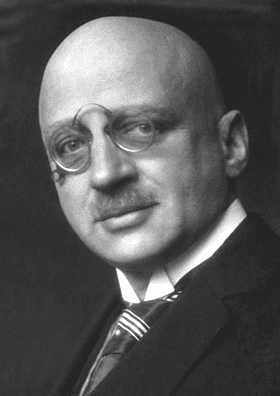
Haber process
Fritz Haber's method of making ammonia from atmospheric nitrogen transformed world agriculture.
Photo: Wikimedia Commons
Airbag
Airbags inflate with nitrogen generated by a rapid chemical decomposition.
Photo: Wikimedia Commons
Root nodule
Bacteria living in nodules on legume roots convert atmospheric nitrogen into ammonia the plant can use.
Photo: Wikimedia Commons


