Germanium
Metalloid · Period 4 · Group 14 · p-block
The semiconductor that launched the transistor age
- Atomic mass
- 72.631 u
- State at 25 °C
- Solid
- Electronegativity
- 2.01
- Melting point
- 938.3 °C
- Boiling point
- 2,832.9 °C
- Configuration
- [Ar] 3d10 4s2 4p2
Germanium, explained
Video lesson in production
Bhavya’s explainer for this element will play here.
Overview
Germanium is a metalloid in group 14, between silicon and tin, with four valence electrons ([Ar]3d10 4s2 4p2). Like silicon, each atom forms four covalent bonds in a diamond-like crystal, making it a brittle, lustrous gray-white solid. Its band gap, the energy needed to free an electron for conduction, is only 0.67 electronvolts, compared with 1.12 for silicon. That makes germanium an easier semiconductor to work with, but also more sensitive to heat. Its compounds are mainly in the +4 state, such as germanium dioxide and germanium tetrachloride.
The first transistor, built at Bell Labs in 1947, used germanium, and germanium dominated early electronics until silicon took over in the 1960s, because silicon works at higher temperatures and forms a stable insulating oxide. Today germanium has found new roles. Germanium dioxide raises the refractive index of the glass core in optical fibers. Germanium crystals are transparent to infrared light, so they serve as lenses in thermal cameras, and germanium wafers carry the multi-junction solar cells that power spacecraft.
Discovery
In 1871 Mendeleev predicted eka-silicon, a missing element below silicon with an atomic mass of about 72 and a density of about 5.5 g/cm3. In 1886 Clemens Winkler, analyzing the silver mineral argyrodite from Freiberg in Saxony, found an unexplained shortfall of about 7 percent in his results and tracked it down to a new element. Its properties closely matched the prediction. Winkler named it after his country, Germany (Latin Germania).
- Where it’s found
- Germanium is scarce, at about 1.5 ppm of the crust, and is recovered as a by-product of zinc ores and from coal fly ash, mostly in China.
- What it’s used for
- Optical-fiber cores
- Infrared camera lenses
- Space solar cells
- Gamma-ray detectors
- PET plastic catalyst
- Silicon–germanium chips
- In living things
- Germanium has no known biological role. Germanium dietary supplements have caused kidney failure and deaths and are not considered safe.
- Safety
- Germanium metal and its oxide have low acute toxicity, but germane gas (GeH4) is toxic and flammable. Long-term ingestion of germanium compounds can damage the kidneys.
How it compares
Where Germanium sits among all 118 elements on the trends that shape the table.
- Electronegativity2.01Pauling
#30 of 100 elements with data
- Ionization energy762kJ/mol
#36 of 104 elements with data
- Atomic radius125pm
#75 of 95 elements with data
- Electron affinity119kJ/mol
#21 of 109 elements with data
- Density5.32g/cm³
#78 of 114 elements with data
- Melting point1,210K
#52 of 110 elements with data
- Density
- 5.32 g/cm³
- Atomic radius
- 125 pm
- Covalent radius
- 121 pm
- Molar heat
- 23.222 J/(mol·K)
- Appearance
- grayish-white
- Discovered by
- Clemens Winkler
Inside the atom
32 electrons arranged in 4 shells: 2 · 8 · 18 · 4.
Orbital diagram
1s2 2s2 2p6 3s2 3p6 4s2 3d10 4p2 · shorthand [Ar] 3d10 4s2 4p2
- 1s2
- 2s2
- 2p6
- 3s2
- 3p6
- 4s2
- 3d10
- 4p2
Each box is an orbital holding up to two electrons of opposite spin. Highlighted subshells hold the valence electrons that decide how Germanium bonds.
Ionization energies
Signature reactions
The chemistry Germanium is known for.
Acid–base · Purification
Making germanium tetrachloride
Germanium concentrates are converted to germanium tetrachloride, a liquid that boils at about 86 °C. Repeated distillation removes impurities, the first step in producing semiconductor- and optical-grade germanium.
Conditions: concentrated hydrochloric acid, heating
Redox · Metal extraction
Hydrogen reduction to the metal
Purified germanium dioxide is reduced with hydrogen to germanium powder, which is melted and then zone-refined to extraordinary purity. Detector-grade germanium contains fewer than one impurity atom per trillion.
Conditions: about 650 °C
Redox · Vapor deposition
Doping optical-fiber glass
Germanium tetrachloride vapor is burned with oxygen alongside silicon tetrachloride, depositing germanium-doped glass on the inside of a silica tube. The germanium raises the core's refractive index so that light stays trapped in the fiber by total internal reflection.
Conditions: about 1600 °C inside a silica tube
Where you’ll meet it
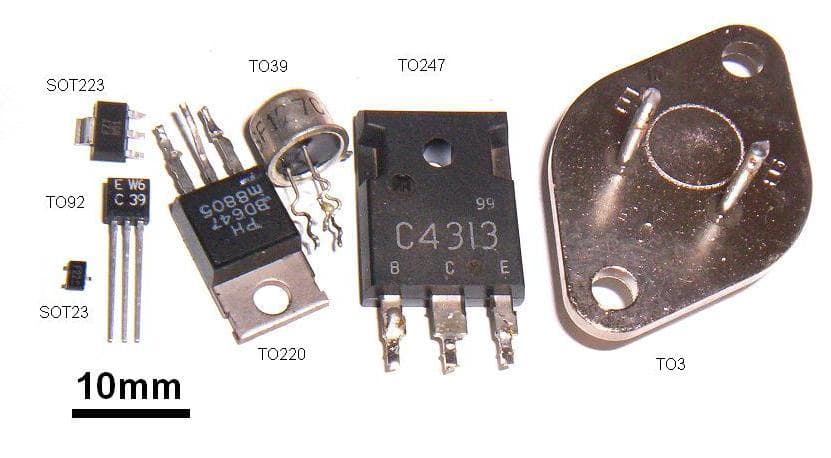
Transistor
The first transistors of the late 1940s and 1950s were made from germanium.
Photo: Wikimedia Commons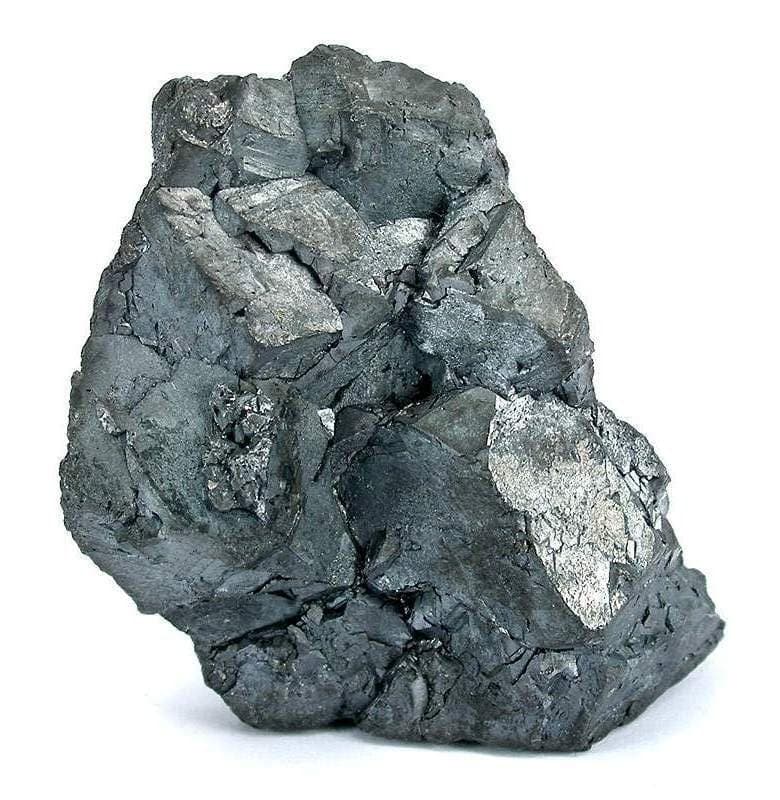
Argyrodite
Clemens Winkler discovered germanium in 1886 while analyzing this silver germanium sulfide mineral.
Photo: Wikimedia Commons
Optical fiber
Germanium dioxide in the core of telecommunications fibers keeps light guided over thousands of kilometers.
Photo: Wikimedia Commons
Thermography
Infrared images like this thermogram are often captured through germanium lenses, which are transparent to infrared.
Photo: Wikimedia Commons


Research
No research on Germanium yet
When Bhavya publishes a project that studies Germanium, it will be linked here.