Silver
Transition metal · Period 5 · Group 11 · d-block
The most conductive, most reflective metal of all
- Atomic mass
- 107.868 u
- State at 25 °C
- Solid
- Electronegativity
- 1.93
- Melting point
- 961.8 °C
- Boiling point
- 2,161.9 °C
- Configuration
- [Kr] 4d10 5s1
Nucleus drawn at reduced count for clarity. Drag to rotate.
Silver, explained
Video lesson in production
Bhavya’s explainer for this element will play here.
Overview
Silver is a soft, lustrous metal in group 11 with copper and gold. Its configuration is [Kr] 4d10 5s1: a full d subshell beneath a single, loosely held s electron. That lone electron moves freely through the metal, giving silver the highest electrical and thermal conductivity of any element. The same mobile electrons reflect about 95% of visible light, more than any other metal, which is why silver has backed the best mirrors since the 19th century. Silver almost always forms compounds in the +1 state, and it does not react with oxygen or water at ordinary temperatures.
Silver does react with sulfur. Traces of hydrogen sulfide in air turn it black with silver sulfide, the tarnish that coats old spoons. Silver halides are sensitive to light: a photon can free a silver atom from silver bromide, the basis of film photography for over a century. Today the largest industrial demand is for electrical contacts and the conductive paste printed on silicon solar cells. Silver ions are toxic to bacteria at very low concentrations, so silver is used in wound dressings and water filters. Mexico, China and Peru are the leading producers.
Discovery
Silver has been used since prehistory. By around 3000 BCE, people in Anatolia and Mesopotamia were extracting it from lead ores by cupellation, melting the ore and blowing air over it so that the lead oxidizes and silver remains. Laurion's mines financed Athens' navy, and from 1545 the Cerro Rico of Potosí in Bolivia poured silver into the Spanish empire. The English name comes from Old English seolfor; the symbol Ag is from Latin argentum, which also gave Argentina its name.
- Where it’s found
- Silver makes up about 0.075 parts per million of the crust and is mined mostly as a by-product of lead, zinc, copper and gold ores, with some native silver and silver sulfide (argentite) deposits.
- What it’s used for
- Solar cell contacts
- Electrical contacts and wiring
- Jewellery and silverware
- Mirrors and coatings
- Antibacterial dressings
- Brazing alloys
- In living things
- Silver has no biological role in humans. Silver ions are toxic to bacteria and fungi, which is why they are used as antimicrobials.
- Safety
- Metallic silver is not hazardous; soluble silver salts such as silver nitrate stain and burn skin, and long-term ingestion causes argyria.
How it compares
Where Silver sits among all 118 elements on the trends that shape the table.
- Electronegativity1.93Pauling
#34 of 100 elements with data
- Ionization energy731kJ/mol
#43 of 104 elements with data
- Atomic radius160pm
#36 of 95 elements with data
- Electron affinity126kJ/mol
#18 of 109 elements with data
- Density10.5g/cm³
#38 of 114 elements with data
- Melting point1,230K
#50 of 110 elements with data
- Density
- 10.5 g/cm³
- Atomic radius
- 160 pm
- Covalent radius
- 128 pm
- Molar heat
- 25.35 J/(mol·K)
- Appearance
- lustrous white metal
- Discovered by
- unknown, before 5000 BC
Inside the atom
47 electrons arranged in 5 shells: 2 · 8 · 18 · 18 · 1.
Orbital diagram
1s2 2s2 2p6 3s2 3p6 4s2 3d10 4p6 5s1 4d10 · shorthand [Kr] 4d10 5s1
- 1s2
- 2s2
- 2p6
- 3s2
- 3p6
- 4s2
- 3d10
- 4p6
- 5s1
- 4d10
Each box is an orbital holding up to two electrons of opposite spin. Highlighted subshells hold the valence electrons that decide how Silver bonds.
Ionization energies
Signature reactions
The chemistry Silver is known for.
Redox · Corrosion
Tarnishing
Hydrogen sulfide from eggs, rubber or polluted air reacts with silver and oxygen to form black silver sulfide. A thin film first looks yellow, then brown, then black.
Conditions: air containing traces of hydrogen sulfide
Redox · Organic test
Tollens' silver mirror
An aldehyde reduces silver-ammonia ions to metallic silver, which plates out as a shining mirror on the inside of the test tube. Chemists use it to tell aldehydes apart from ketones, and a similar reaction once silvered household mirrors.
Conditions: warm water bath
Precipitation
Silver chloride precipitation
Adding silver nitrate to a chloride solution produces a white, curdy precipitate of silver chloride. It darkens in sunlight as silver forms, the same chemistry used in photography.
Conditions: aqueous, room temperature
Watch Silver react in 3D
Where you’ll meet it
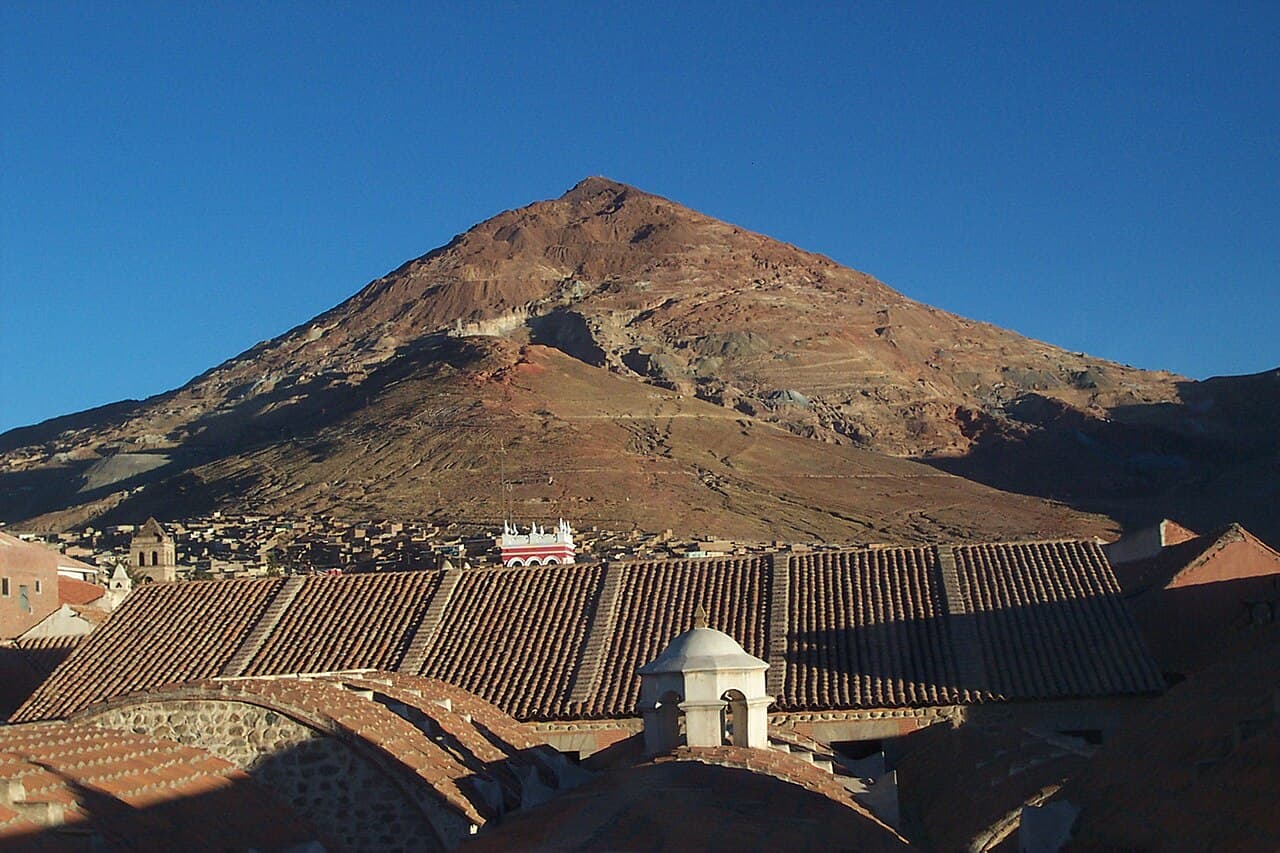
Cerro Rico
Bolivia's Cerro Rico, the 'rich mountain' of Potosí, produced a vast share of the world's silver in the 16th and 17th centuries.
Photo: Wikimedia Commons
Mirror
Silver reflects about 95% of visible light, and most high-quality mirrors are backed with it.
Photo: Wikimedia Commons
Cloud seeding
Silver iodide particles released into clouds act as seeds on which ice crystals form.
Photo: Wikimedia Commons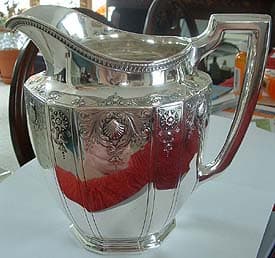
Sterling silver
Sterling silver, 92.5% silver alloyed with copper, is the classic material of fine tableware.
Photo: Wikimedia Commons


Research
No research on Silver yet
When Bhavya publishes a project that studies Silver, it will be linked here.