Gold
Transition metal · Period 6 · Group 11 · d-block
The metal that never tarnishes, coloured by relativity
- Atomic mass
- 196.967 u
- State at 25 °C
- Solid
- Electronegativity
- 2.54
- Melting point
- 1,064.2 °C
- Boiling point
- 2,969.9 °C
- Configuration
- [Xe] 4f14 5d10 6s1
Nucleus drawn at reduced count for clarity. Drag to rotate.
Gold, explained
Video lesson in production
Bhavya’s explainer for this element will play here.
Overview
Gold is the most malleable and among the least reactive of metals. Its configuration is [Xe]4f14 5d10 6s1, and its behaviour is shaped by Einstein's relativity. Gold's large nuclear charge makes inner electrons move at a substantial fraction of the speed of light, which contracts and stabilises the 6s orbital. The single 6s electron is therefore held unusually tightly, which helps explain why gold resists oxidation and why it can even form the auride ion, Au⁻, in compounds such as caesium auride.
The same effect narrows the energy gap between the filled 5d band and the 6s level, so gold absorbs blue light and reflects the yellow and red, giving it its colour. Silver, without such strong relativistic effects, absorbs only in the ultraviolet and looks white. Gold's resistance to corrosion and its excellent conductivity make it ideal for electrical contacts, while its inertness explains why it has been used for coins, jewellery and dental work for thousands of years.
Discovery
Gold has been known since prehistoric times because it occurs as native metal, in nuggets and river sands. The oldest worked gold yet found comes from the Varna Necropolis in Bulgaria, dated to about 4600–4200 BCE, and the kingdom of Lydia struck some of the first coins of gold alloy around 600 BCE. The English word comes from an old Germanic root meaning 'yellow', while the symbol Au comes from the Latin aurum.
- Where it’s found
- About 4 parts per billion of Earth's crust; it is mined as native gold in veins and placer deposits and extracted from low-grade ore by cyanide leaching.
- What it’s used for
- Jewellery
- Bullion and coins
- Electronic contacts
- Dentistry
- Spacecraft heat shielding
- Nanoparticle medical diagnostics
- In living things
- No biological role. Metallic gold is inert and even edible as leaf; some gold compounds have been used to treat rheumatoid arthritis.
- Safety
- Metallic gold is safe; cyanide solutions used to extract it are extremely toxic.
How it compares
Where Gold sits among all 118 elements on the trends that shape the table.
- Electronegativity2.54Pauling
#12 of 100 elements with data
- Ionization energy890kJ/mol
#23 of 104 elements with data
- Atomic radius135pm
#59 of 95 elements with data
- Electron affinity223kJ/mol
#6 of 109 elements with data
- Density19.3g/cm³
#15 of 114 elements with data
- Melting point1,340K
#46 of 110 elements with data
- Density
- 19.3 g/cm³
- Atomic radius
- 135 pm
- Covalent radius
- 124 pm
- Molar heat
- 25.418 J/(mol·K)
- Appearance
- metallic yellow
- Discovered by
- Middle East
Inside the atom
79 electrons arranged in 6 shells: 2 · 8 · 18 · 32 · 18 · 1.
Orbital diagram
1s2 2s2 2p6 3s2 3p6 4s2 3d10 4p6 5s2 4d10 5p6 6s1 4f14 5d10 · shorthand [Xe] 4f14 5d10 6s1
- 1s2
- 2s2
- 2p6
- 3s2
- 3p6
- 4s2
- 3d10
- 4p6
- 5s2
- 4d10
- 5p6
- 6s1
- 4f14
- 5d10
Each box is an orbital holding up to two electrons of opposite spin. Highlighted subshells hold the valence electrons that decide how Gold bonds.
Ionization energies
Signature reactions
The chemistry Gold is known for.
Redox · Complex formation
Cyanide leaching
Oxygen oxidises gold while cyanide ions bind the Au+ as the very stable dicyanoaurate complex, dissolving even microscopic gold particles from crushed ore. Most of the world's gold is extracted this way.
Conditions: dilute cyanide solution, air, pH above 10
Redox · Complex formation
Dissolving in aqua regia
Nitric acid alone cannot oxidise gold, but chloride ions capture the Au3+ as the tetrachloroaurate ion, pulling the reaction forward. The result is a yellow solution of chloroauric acid.
Conditions: concentrated HCl and HNO3, about 3:1
Redox · Single displacement
Recovery with zinc
Zinc, a more reactive metal, gives up electrons and takes over the cyanide ions, causing gold to precipitate as a fine dark powder. This Merrill–Crowe step recovers gold from leach solutions.
Conditions: zinc dust added to cyanide leach solution
Where you’ll meet it

Mask of Tutankhamun
This funerary mask contains about 10 kilograms of gold and still gleams after more than 3,300 years.
Photo: Wikimedia Commons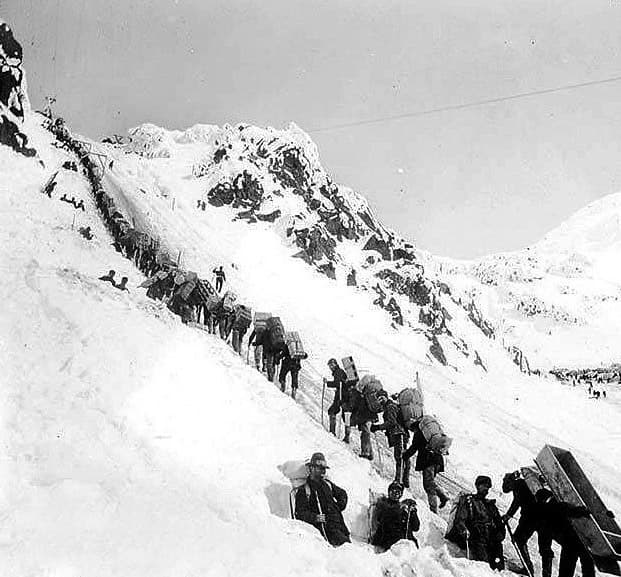
Klondike Gold Rush
Around 100,000 prospectors set out for Canada's Yukon after gold was found there in 1896.
Photo: Wikimedia Commons
Voyager Golden Record
Gold-plated copper records carry sounds and images of Earth on the Voyager spacecraft.
Photo: Wikimedia Commons
United States Bullion Depository
Fort Knox holds roughly 4,600 tonnes of the US government's gold reserves.
Photo: Wikimedia Commons


Research
No research on Gold yet
When Bhavya publishes a project that studies Gold, it will be linked here.