Copper
Transition metal · Period 4 · Group 11 · d-block
The red metal that wired the modern world
- Atomic mass
- 63.546 u
- State at 25 °C
- Solid
- Electronegativity
- 1.9
- Melting point
- 1,084.6 °C
- Boiling point
- 2,561.9 °C
- Configuration
- [Ar] 3d10 4s1
Copper, explained
Video lesson in production
Bhavya’s explainer for this element will play here.
Overview
Copper's atoms hold a full 3d subshell and a single 4s electron ([Ar]3d10 4s1). That lone, loosely held electron moves freely through the metal, so copper conducts electricity better than any metal except silver. Copper is also one of the few metals that is not silvery: electrons in its filled d band absorb blue and green light, leaving the reddish-orange reflection we see. Its common oxidation states are +1 and +2, and blue Cu2+ ions color many of its salts and minerals.
Copper sits below hydrogen in the reactivity series, so it does not react with dilute non-oxidizing acids and can occur as the native metal, which is one reason it was among the first metals people used. Today around 60 percent of copper goes into electrical wiring, motors, generators and electronics. Alloyed with tin it becomes bronze, and with zinc, brass. In air, copper slowly forms a green patina of basic copper salts that protects the metal beneath.
Discovery
People have used copper for more than 10,000 years: a copper pendant from northern Iraq dates to about 8700 BCE. Smelting copper from ore began around 5000 BCE, and mixing it with tin started the Bronze Age around 3300 BCE. Much of the Roman Empire's copper came from Cyprus, so the metal was called aes Cyprium, metal of Cyprus, later shortened to cuprum, the source of the symbol Cu and the English word copper.
- Where it’s found
- Copper is mined mostly from sulfide ores such as chalcopyrite (CuFeS2) in huge open-pit mines, with Chile the leading producer followed by Peru and the Democratic Republic of the Congo.
- What it’s used for
- Electrical wiring
- Plumbing pipes
- Motors and generators
- Brass and bronze
- Antimicrobial surfaces
- Fungicides
- In living things
- Copper is an essential trace element, needed by enzymes such as cytochrome c oxidase in respiration and superoxide dismutase. The genetic disorder Wilson's disease causes toxic copper build-up, and many invertebrates use copper to carry oxygen.
- Safety
- Copper metal is harmless to handle, but soluble copper salts are toxic if swallowed in quantity. Copper is highly toxic to fish and other aquatic life.
How it compares
Where Copper sits among all 118 elements on the trends that shape the table.
- Electronegativity1.9Pauling
#36 of 100 elements with data
- Ionization energy746kJ/mol
#40 of 104 elements with data
- Atomic radius135pm
#59 of 95 elements with data
- Electron affinity119kJ/mol
#20 of 109 elements with data
- Density8.96g/cm³
#46 of 114 elements with data
- Melting point1,360K
#44 of 110 elements with data
- Density
- 8.96 g/cm³
- Atomic radius
- 135 pm
- Covalent radius
- 112 pm
- Molar heat
- 24.44 J/(mol·K)
- Appearance
- red-orange metallic luster
- Discovered by
- Middle East
Inside the atom
29 electrons arranged in 4 shells: 2 · 8 · 18 · 1.
Orbital diagram
1s2 2s2 2p6 3s2 3p6 4s1 3d10 · shorthand [Ar] 3d10 4s1
- 1s2
- 2s2
- 2p6
- 3s2
- 3p6
- 4s1
- 3d10
Each box is an orbital holding up to two electrons of opposite spin. Highlighted subshells hold the valence electrons that decide how Copper bonds.
Ionization energies
Signature reactions
The chemistry Copper is known for.
Redox · Single displacement
Displacement of silver
A copper wire placed in silver nitrate solution grows glittering crystals of silver while the solution slowly turns blue with Cu2+ ions. It shows that copper is more reactive than silver.
Conditions: room temperature
Redox
Copper with concentrated nitric acid
Copper resists most acids, but nitric acid is a strong enough oxidizer to dissolve it. The reaction produces choking brown nitrogen dioxide gas and a green-blue solution of copper nitrate.
Conditions: concentrated acid, room temperature, fume hood
Redox · Corrosion
Formation of green patina
Copper roofs and statues slowly react with oxygen, moisture and carbon dioxide to form basic copper carbonate, the same compound as the mineral malachite. In polluted or coastal air, sulfate and chloride versions also form. The patina protects the metal underneath from further corrosion.
Conditions: outdoor air over years to decades
Where you’ll meet it

Statue of Liberty
The statue's green color is a patina that formed on its copper skin after it was erected in 1886.
Photo: Wikimedia Commons
Malachite
Malachite, a green copper carbonate hydroxide, has been used as a copper ore and ornamental stone for millennia.
Photo: Wikimedia Commons
Horseshoe crab
Horseshoe crab blood is blue because its oxygen carrier, hemocyanin, contains copper.
Photo: Wikimedia Commons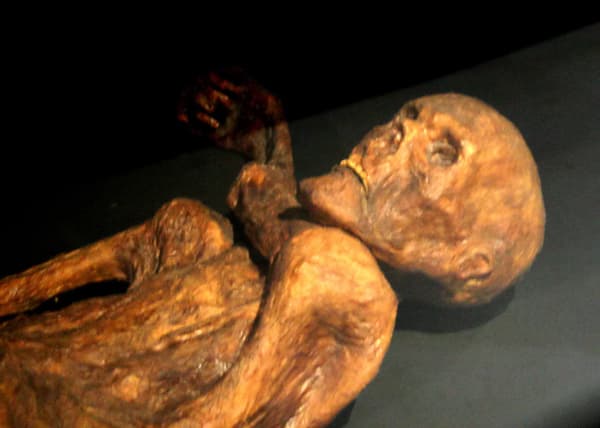
Ötzi
The 5,300-year-old Iceman was found with a copper-bladed axe, a sign of Copper Age metalworking.
Photo: Wikimedia Commons


Research
No research on Copper yet
When Bhavya publishes a project that studies Copper, it will be linked here.