Moscovium
Post-transition metal (predicted) · Period 7 · Group 15 · p-block
Named for the Moscow region, made from americium and calcium
- Atomic mass
- 289 u
- State at 25 °C
- Solid
- Electronegativity
- —
- Melting point
- 396.9 °Cpredicted
- Boiling point
- 1,126.9 °Cpredicted
- Configuration
- *[Rn] 5f14 6d10 7s2 7p3
Nucleus drawn at reduced count for clarity. Drag to rotate.
Moscovium, explained
Video lesson in production
Bhavya’s explainer for this element will play here.
Overview
Moscovium is the group 15 element below nitrogen, phosphorus, arsenic, antimony and bismuth. Of its three outer p electrons, two are predicted to fill the tightly held 7p1/2 sub-shell and one to sit alone in the higher-energy 7p3/2 orbital. That lone 7p3/2 electron should be easy to remove, so moscovium is predicted to form a stable +1 ion, Mc+, resembling the thallium(I) ion, unlike bismuth, which favors +3.
These predictions are largely untested. Moscovium-290, the longest-lived known isotope, has a half-life of under a second, and only around a hundred atoms have ever been detected. Gas-phase chemistry experiments have begun to probe its reactivity, but its chemical character is still mainly known from calculation. Its decay chains, running through nihonium and roentgenium down to dubnium, gave the first sightings of nihonium and of dubnium-268.
Discovery
A Dubna team led by Yuri Oganessian, in collaboration with Lawrence Livermore National Laboratory, bombarded americium-243 with calcium-48 in 2003 and reported four atoms of element 115 in 2004. The result was confirmed by later Dubna experiments and by GSI in 2012. IUPAC credited the collaboration in December 2015, and the name moscovium, after the Moscow Oblast region where Dubna lies, was approved in November 2016.
- Where it’s found
- Moscovium does not occur in nature; it is made by bombarding americium-243 with calcium-48 ions or as a decay product of tennessine.
- What it’s used for
- Superheavy chemistry studies
- Decay-chain identification
- Nuclear structure research
- Relativistic effects research
- In living things
- Moscovium has no biological role; it is radioactive and has only ever existed as individual atoms.
- Safety
- Radioactive and made only a few atoms at a time; it decays within a second.
How it compares
Where Moscovium sits among all 118 elements on the trends that shape the table.
- ElectronegativityNo data
Not measured for this element
- Ionization energyNo data
Not measured for this element
- Atomic radiusNo data
Not measured for this element
- Electron affinity35.3kJ/mol
#63 of 109 elements with data · predicted
- Density13.5g/cm³
#27 of 114 elements with data · predicted
- Melting point670K
#76 of 110 elements with data · predicted
- Density
- 13.5 g/cm³
- Atomic radius
- —
- Covalent radius
- —
- Molar heat
- —
- Appearance
- —
- Discovered by
- Joint Institute for Nuclear Research
Inside the atom
115 electrons arranged in 7 shells: 2 · 8 · 18 · 32 · 32 · 18 · 5.
Orbital diagram
1s2 2s2 2p6 3s2 3p6 4s2 3d10 4p6 5s2 4d10 5p6 6s2 4f14 5d10 6p6 7s2 5f14 6d10 7p3 · shorthand *[Rn] 5f14 6d10 7s2 7p3
- 1s2
- 2s2
- 2p6
- 3s2
- 3p6
- 4s2
- 3d10
- 4p6
- 5s2
- 4d10
- 5p6
- 6s2
- 4f14
- 5d10
- 6p6
- 7s2
- 5f14
- 6d10
- 7p3
Each box is an orbital holding up to two electrons of opposite spin. Highlighted subshells hold the valence electrons that decide how Moscovium bonds.
Signature reactions
How the first atoms were made, and how they fall apart.
Nuclear · Hot fusion
Dubna synthesis, 3n channel
Calcium-48 fuses with americium-243 and three neutrons evaporate to give moscovium-288. Three of the four atoms reported in 2004 came from this channel.
Conditions: calcium-48 beam on americium-243, Dubna U400 cyclotron, 2003
Nuclear · Hot fusion
Dubna synthesis, 4n channel
At higher beam energy the compound nucleus sheds four neutrons, giving moscovium-287. Seeing both isotopes at the expected energies strengthened the discovery claim.
Conditions: calcium-48 beam on americium-243, higher beam energy
Nuclear · Alpha decay
Alpha decay of moscovium-288
Moscovium-288 emits an alpha particle to become nihonium-284. The chain continues by alpha decay to dubnium-268, which ends in spontaneous fission.
Conditions: spontaneous, half-life about 0.2 seconds
Where you’ll meet it

Moscow Oblast
The region around Moscow, home to Dubna, gives element 115 its name.
Photo: Wikimedia Commons
Kremlin
The Moscow Kremlin is the best-known landmark of the region honored by moscovium.
Photo: Wikimedia Commons
Joint Institute for Nuclear Research
Moscovium was first made at the Joint Institute's Flerov Laboratory in Dubna.
Photo: Wikimedia Commons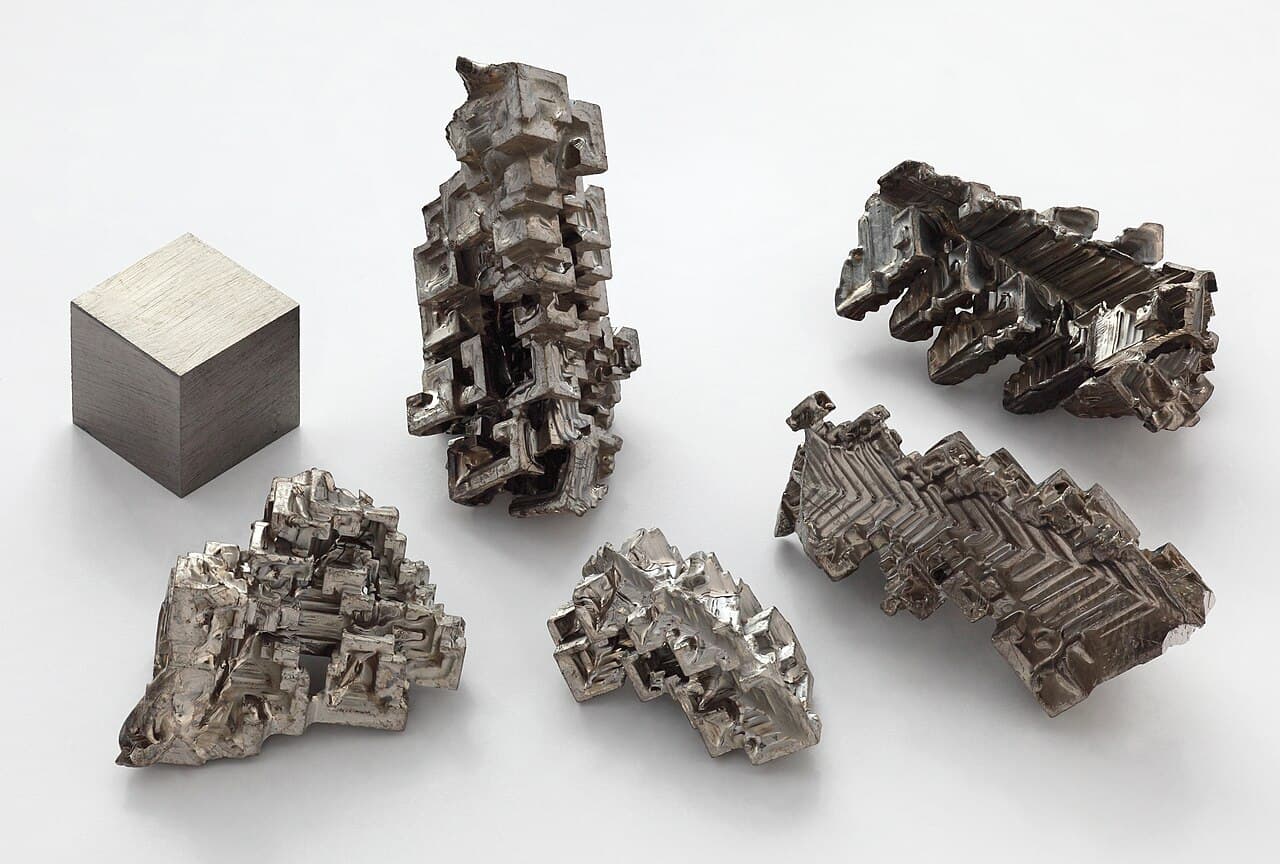
Bismuth
Bismuth, directly above moscovium in group 15, prefers +3, while moscovium is predicted to prefer +1.
Photo: Wikimedia Commons


Research
No research on Moscovium yet
When Bhavya publishes a project that studies Moscovium, it will be linked here.