Iodine
Reactive nonmetal · Period 5 · Group 17 · p-block
The violet halogen your thyroid cannot live without
- Atomic mass
- 126.904 u
- State at 25 °C
- Solid
- Electronegativity
- 2.66
- Melting point
- 113.7 °C
- Boiling point
- 184.3 °C
- Configuration
- [Kr] 4d10 5s2 5p5
Nucleus drawn at reduced count for clarity. Drag to rotate.
Iodine, explained
Video lesson in production
Bhavya’s explainer for this element will play here.
Overview
Iodine is the heaviest stable halogen in group 17, with configuration [Kr] 4d10 5s2 5p5. One electron short of a noble-gas configuration, it forms the iodide ion, I^−, and covalent I–I bonds in I2 molecules. Because its outer electrons are far from the nucleus, iodine is the least reactive stable halogen and the weakest oxidizing agent among them: chlorine and bromine displace it from iodide solutions. The large, easily distorted electron clouds of I2 molecules attract each other strongly enough that iodine is a solid at room temperature, forming lustrous blue-black crystals.
Heated gently, solid iodine sublimes directly into a violet vapour. Iodine dissolves poorly in water but readily in iodide solutions, where it forms the triiodide ion, I3^−, and it gives an intense blue-black colour with starch. In biology, iodine is essential: the thyroid gland incorporates it into the hormones thyroxine (T4) and triiodothyronine (T3), which regulate metabolism and brain development. Iodized salt, introduced in the 1920s, has prevented goitre and developmental disability in hundreds of millions of people. Iodine compounds also serve as X-ray contrast agents, disinfectants and industrial catalysts.
Discovery
In 1811 the French chemist Bernard Courtois was making saltpetre for Napoleon's gunpowder from seaweed ash. When he added sulfuric acid to the ash residue, a violet vapour rose and condensed into dark crystals. Charles-Bernard Desormes and Nicolas Clément announced the discovery in 1813, and Joseph Louis Gay-Lussac and Humphry Davy both studied the substance. Gay-Lussac named it iode, from the Greek iodes, meaning 'violet'.
- Where it’s found
- Iodine is scarce in rocks but concentrated in seawater, seaweed and brines; most is extracted from Chilean caliche (nitrate deposits) and from natural gas brines in Japan.
- What it’s used for
- Iodized salt
- X-ray contrast media
- Antiseptics
- LCD polarizing films
- Acetic acid catalysis
- Radioiodine thyroid therapy
- In living things
- Iodine is essential: it forms part of thyroid hormones T3 and T4, and deficiency causes goitre, hypothyroidism and, during pregnancy, impaired brain development in the child.
- Safety
- Solid iodine and its vapour irritate the skin, eyes and lungs, and large doses are toxic; radioactive iodine-131 released in nuclear accidents concentrates in the thyroid.
How it compares
Where Iodine sits among all 118 elements on the trends that shape the table.
- Electronegativity2.66Pauling
#7 of 100 elements with data
- Ionization energy1,010kJ/mol
#15 of 104 elements with data
- Atomic radius140pm
#52 of 95 elements with data
- Electron affinity295kJ/mol
#4 of 109 elements with data
- Density4.93g/cm³
#81 of 114 elements with data
- Melting point387K
#88 of 110 elements with data
- Density
- 4.93 g/cm³
- Atomic radius
- 140 pm
- Covalent radius
- 133 pm
- Molar heat
- —
- Appearance
- lustrous metallic gray, violet as a gas
- Discovered by
- Bernard Courtois
Inside the atom
53 electrons arranged in 5 shells: 2 · 8 · 18 · 18 · 7.
Orbital diagram
1s2 2s2 2p6 3s2 3p6 4s2 3d10 4p6 5s2 4d10 5p5 · shorthand [Kr] 4d10 5s2 5p5
- 1s2
- 2s2
- 2p6
- 3s2
- 3p6
- 4s2
- 3d10
- 4p6
- 5s2
- 4d10
- 5p5
Each box is an orbital holding up to two electrons of opposite spin. Highlighted subshells hold the valence electrons that decide how Iodine bonds.
Ionization energies
Signature reactions
The chemistry Iodine is known for.
Redox · Displacement
Halogen displacement
Chlorine is a stronger oxidizing agent than iodine, so it pulls electrons from iodide ions. The colourless solution turns brown as iodine forms, and this reaction is used to release iodine from brines.
Conditions: aqueous, room temperature
Redox · Analysis
Iodine–thiosulfate titration
Thiosulfate reduces iodine to colourless iodide, and the blue-black starch-iodine colour vanishes sharply at the endpoint. This titration is a standard way to measure oxidizing agents such as chlorine in bleach.
Conditions: aqueous, starch indicator
Redox
Laboratory preparation
Manganese dioxide in acid oxidizes iodide to iodine, which sublimes as a violet vapour and condenses as dark crystals on a cool surface. It echoes Courtois's original observation with seaweed ash.
Conditions: warmed with sulfuric acid
Where you’ll meet it

Iodised salt
Adding small amounts of iodide or iodate to table salt prevents iodine deficiency.
Photo: Wikimedia Commons
Povidone-iodine
The brown surgical antiseptic povidone-iodine slowly releases iodine to kill microbes.
Photo: Wikimedia Commons
Kelp forest
Kelp concentrates iodine from seawater, and iodine was first discovered in seaweed ash.
Photo: Wikimedia Commons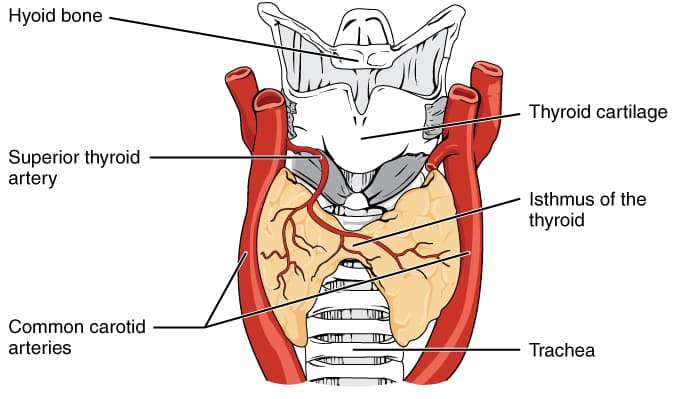
Thyroid
The thyroid gland uses iodine to make hormones that regulate metabolism.
Photo: Wikimedia Commons


Research
No research on Iodine yet
When Bhavya publishes a project that studies Iodine, it will be linked here.