Platinum
Transition metal · Period 6 · Group 10 · d-block
The noble metal that cleans car exhaust and fights cancer
- Atomic mass
- 195.085 u
- State at 25 °C
- Solid
- Electronegativity
- 2.28
- Melting point
- 1,768.3 °C
- Boiling point
- 3,824.9 °C
- Configuration
- [Xe] 4f14 5d9 6s1
Nucleus drawn at reduced count for clarity. Drag to rotate.
Platinum, explained
Video lesson in production
Bhavya’s explainer for this element will play here.
Overview
Platinum is a dense, silvery-white metal with the configuration [Xe]4f14 5d9 6s1. Like gold, it is noble: it does not tarnish in air and dissolves only in aqua regia or hot, concentrated oxidising mixtures. Yet its surface is chemically active in another way. Molecules such as hydrogen, oxygen and carbon monoxide stick to platinum atoms and their bonds weaken, which lets them react with each other far faster than in the gas phase. This makes platinum one of the most important catalysts in industry.
Catalytic converters use platinum, palladium and rhodium to oxidise carbon monoxide and unburnt fuel and to reduce nitrogen oxides. Platinum-rhodium gauze catalyses the oxidation of ammonia in the Ostwald process, the basis of nitric acid and fertiliser production. In medicine, cisplatin, a simple square-planar platinum(II) complex, binds to DNA in dividing cells and is a mainstay of chemotherapy for testicular, ovarian and other cancers.
Discovery
Pre-Columbian metalworkers in Ecuador and Colombia used platinum, sintered with gold, centuries before Europeans encountered it. Spanish officer Antonio de Ulloa described it in 1748 after an expedition to South America, where miners called it platina, 'little silver', and discarded it as a nuisance in gold workings. Samples reached England in the 1740s, and William Hyde Wollaston developed a powder method in the early 1800s to make workable platinum.
- Where it’s found
- About 5 parts per billion of Earth's crust, mined mainly from the Bushveld Complex in South Africa and from nickel-copper ores in Russia.
- What it’s used for
- Catalytic converters
- Nitric acid production
- Cancer drugs
- Jewellery
- Fuel-cell catalysts
- Laboratory electrodes and crucibles
- In living things
- No biological role. The metal is inert, but some platinum compounds are toxic, and platinum salts can trigger allergic reactions.
- Safety
- Bulk metal is safe; soluble platinum salts are sensitisers and can cause asthma-like reactions in workers.
How it compares
Where Platinum sits among all 118 elements on the trends that shape the table.
- Electronegativity2.28Pauling
#14 of 100 elements with data
- Ionization energy870kJ/mol
#25 of 104 elements with data
- Atomic radius135pm
#59 of 95 elements with data
- Electron affinity205kJ/mol
#7 of 109 elements with data
- Density21.4g/cm³
#11 of 114 elements with data
- Melting point2,040K
#18 of 110 elements with data
- Density
- 21.4 g/cm³
- Atomic radius
- 135 pm
- Covalent radius
- 123 pm
- Molar heat
- 25.86 J/(mol·K)
- Appearance
- silvery white
- Discovered by
- Antonio de Ulloa
Inside the atom
78 electrons arranged in 6 shells: 2 · 8 · 18 · 32 · 17 · 1.
Orbital diagram
1s2 2s2 2p6 3s2 3p6 4s2 3d10 4p6 5s2 4d10 5p6 6s1 4f14 5d9 · shorthand [Xe] 4f14 5d9 6s1
- 1s2
- 2s2
- 2p6
- 3s2
- 3p6
- 4s2
- 3d10
- 4p6
- 5s2
- 4d10
- 5p6
- 6s1
- 4f14
- 5d9
Each box is an orbital holding up to two electrons of opposite spin. Highlighted subshells hold the valence electrons that decide how Platinum bonds.
Ionization energies
Signature reactions
The chemistry Platinum is known for.
Redox · Complex formation
Dissolving in aqua regia
Nitric acid oxidises platinum while chloride ions trap the Pt4+ as the stable hexachloroplatinate ion, pulling the reaction forward. The orange-red solution of chloroplatinic acid is the starting material for most platinum compounds.
Conditions: hot aqua regia (HCl:HNO3 about 3:1)
Redox · Catalysis
Ostwald process
Ammonia and air pass through a glowing platinum gauze in a fraction of a second, forming nitric oxide. The NO is then oxidised and absorbed in water to make nitric acid for fertilisers and explosives.
Conditions: platinum-rhodium gauze, about 900 °C
Redox · Catalysis
Oxidising carbon monoxide
In a catalytic converter, CO and O2 adsorb on platinum and react to form carbon dioxide. Without the catalyst, this reaction is too slow at exhaust temperatures to remove poisonous CO.
Conditions: platinum catalyst, hot exhaust gas
Where you’ll meet it
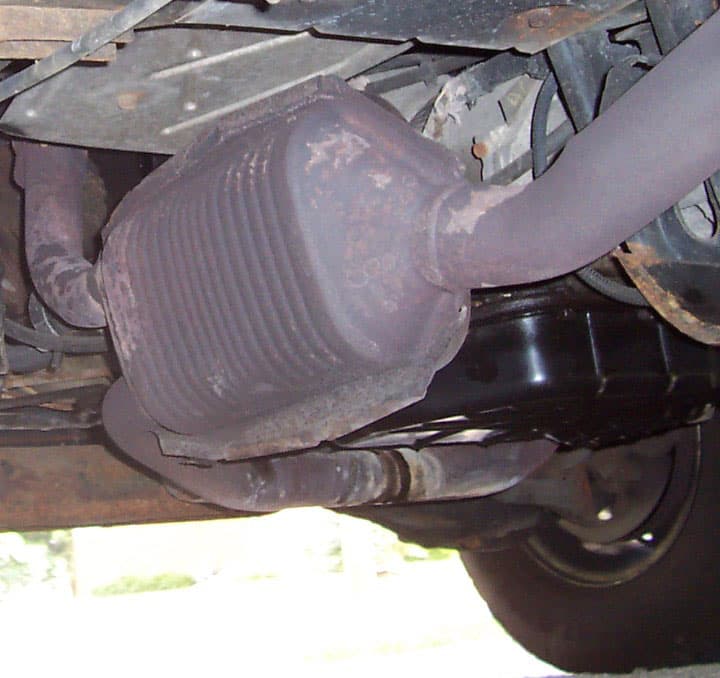
Catalytic converter
Platinum-group metals coated on a ceramic honeycomb clean the exhaust of most cars.
Photo: Wikimedia Commons
Bushveld Igneous Complex
This huge layered intrusion in South Africa holds most of the world's platinum reserves.
Photo: Wikimedia Commons
Cisplatin
A simple platinum compound that has been a key chemotherapy drug since 1978.
Photo: Wikimedia Commons
Fuel cell
Platinum catalysts split hydrogen and oxygen molecules at fuel-cell electrodes.
Photo: Wikimedia Commons


Research
No research on Platinum yet
When Bhavya publishes a project that studies Platinum, it will be linked here.