Gallium
Post-transition metal · Period 4 · Group 13 · p-block
The metal that melts in your hand and lights up your screens
- Atomic mass
- 69.723 u
- State at 25 °C
- Solid
- Electronegativity
- 1.81
- Melting point
- 29.8 °C
- Boiling point
- 2,399.9 °C
- Configuration
- [Ar] 3d10 4s2 4p1
Gallium, explained
Video lesson in production
Bhavya’s explainer for this element will play here.
Overview
Gallium sits below aluminium in group 13, with three outer electrons ([Ar]3d10 4s2 4p1), and nearly all its compounds are in the +3 state. The ten 3d electrons shield the nucleus poorly, so gallium's atom is no larger than aluminium's, and its electrons are held more tightly than the trend would suggest. Solid gallium has an unusual structure built from pairs of atoms, and it melts at just 29.76 °C, yet it does not boil until about 2,400 °C, one of the longest liquid ranges of any element. Like water, it expands when it freezes.
Gallium has no ores of its own and is recovered from the liquors used to refine bauxite into alumina, with China producing about 98 percent of the primary supply. Almost all of it ends up in semiconductors. Gallium arsenide handles the high-frequency signals in mobile phones and powers the solar panels on satellites. Gallium nitride makes blue and white LEDs and increasingly the compact fast chargers for laptops and phones.
Discovery
Dmitri Mendeleev predicted eka-aluminium in 1871, estimating its density and other properties. In 1875 the French chemist Paul-Émile Lecoq de Boisbaudran saw two new violet lines in the spectrum of zinc blende from the Pyrenees, and later that year isolated the metal by electrolysis. He named it after Gallia, the Latin name for France. Some suspected a pun on his own name, since gallus is Latin for coq, rooster, but he denied it.
- Where it’s found
- Present at about 19 ppm in the crust but never concentrated, gallium is extracted as a by-product of refining bauxite into alumina and, to a lesser extent, of zinc processing.
- What it’s used for
- LEDs and lasers (GaN)
- Mobile-phone RF chips
- Satellite solar cells
- Fast chargers
- Low-melting alloys
- Medical imaging isotopes
- In living things
- Gallium has no known biological role. Ga3+ can mimic Fe3+ in the body, which is exploited in some drugs and in gallium-67 and gallium-68 imaging.
- Safety
- Gallium metal has low toxicity but stains skin and corrodes aluminium and many other metals. Some compounds, especially gallium arsenide, are hazardous because of their other components.
How it compares
Where Gallium sits among all 118 elements on the trends that shape the table.
- Electronegativity1.81Pauling
#43 of 100 elements with data
- Ionization energy579kJ/mol
#79 of 104 elements with data
- Atomic radius130pm
#71 of 95 elements with data
- Electron affinity41kJ/mol
#60 of 109 elements with data
- Density5.91g/cm³
#75 of 114 elements with data
- Melting point303K
#94 of 110 elements with data
- Density
- 5.91 g/cm³
- Atomic radius
- 130 pm
- Covalent radius
- 124 pm
- Molar heat
- 25.86 J/(mol·K)
- Appearance
- silver-white
- Discovered by
- Lecoq de Boisbaudran
Inside the atom
31 electrons arranged in 4 shells: 2 · 8 · 18 · 3.
Orbital diagram
1s2 2s2 2p6 3s2 3p6 4s2 3d10 4p1 · shorthand [Ar] 3d10 4s2 4p1
- 1s2
- 2s2
- 2p6
- 3s2
- 3p6
- 4s2
- 3d10
- 4p1
Each box is an orbital holding up to two electrons of opposite spin. Highlighted subshells hold the valence electrons that decide how Gallium bonds.
Ionization energies
Signature reactions
The chemistry Gallium is known for.
Chemical vapor deposition
Growing gallium nitride
Trimethylgallium and ammonia react on a heated sapphire or silicon wafer, laying down gallium nitride crystal one atomic layer at a time. This is how the chips in blue and white LEDs are made.
Conditions: about 1000 °C, metal-organic vapor-phase epitaxy
Redox · Amphoteric
Gallium in sodium hydroxide
Like aluminium, gallium dissolves in strong bases, releasing hydrogen and forming the gallate ion. This amphoteric behavior is why gallium follows aluminium into the alkaline liquor of the Bayer process, where it is recovered.
Conditions: hot concentrated alkali
Redox · Single displacement
Gallium in hydrochloric acid
Gallium dissolves in acids to form Ga3+ ions and hydrogen gas, though more slowly than aluminium. The colorless solution reflects the filled d subshell of Ga3+.
Conditions: warm acid
Where you’ll meet it
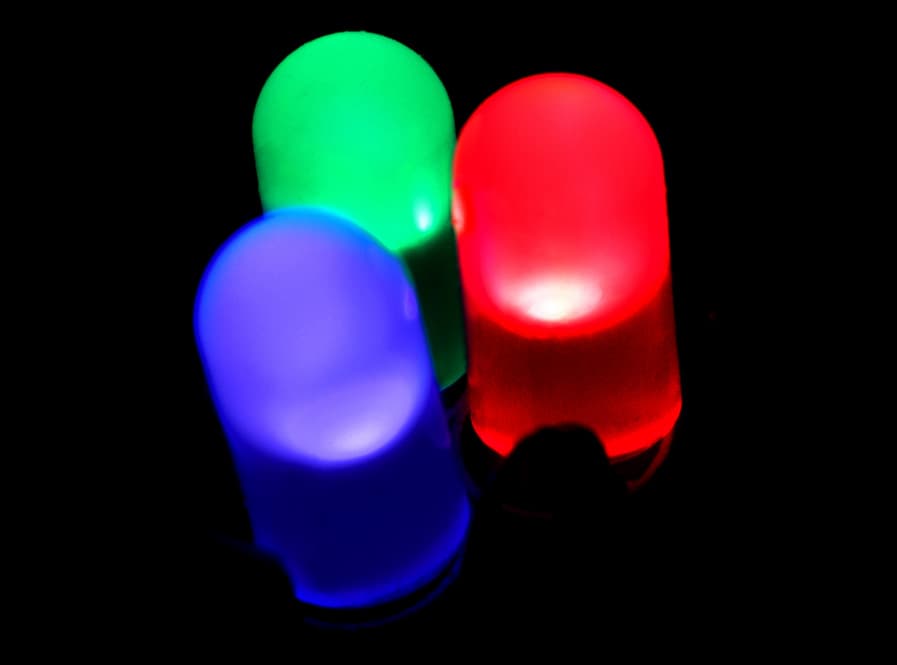
Light-emitting diode
Blue, green and white LEDs are built on gallium nitride; red ones often use gallium arsenide phosphide.
Photo: Wikimedia Commons
Gallium arsenide
Gallium arsenide wafers are used for high-speed electronics and highly efficient solar cells.
Photo: Wikimedia Commons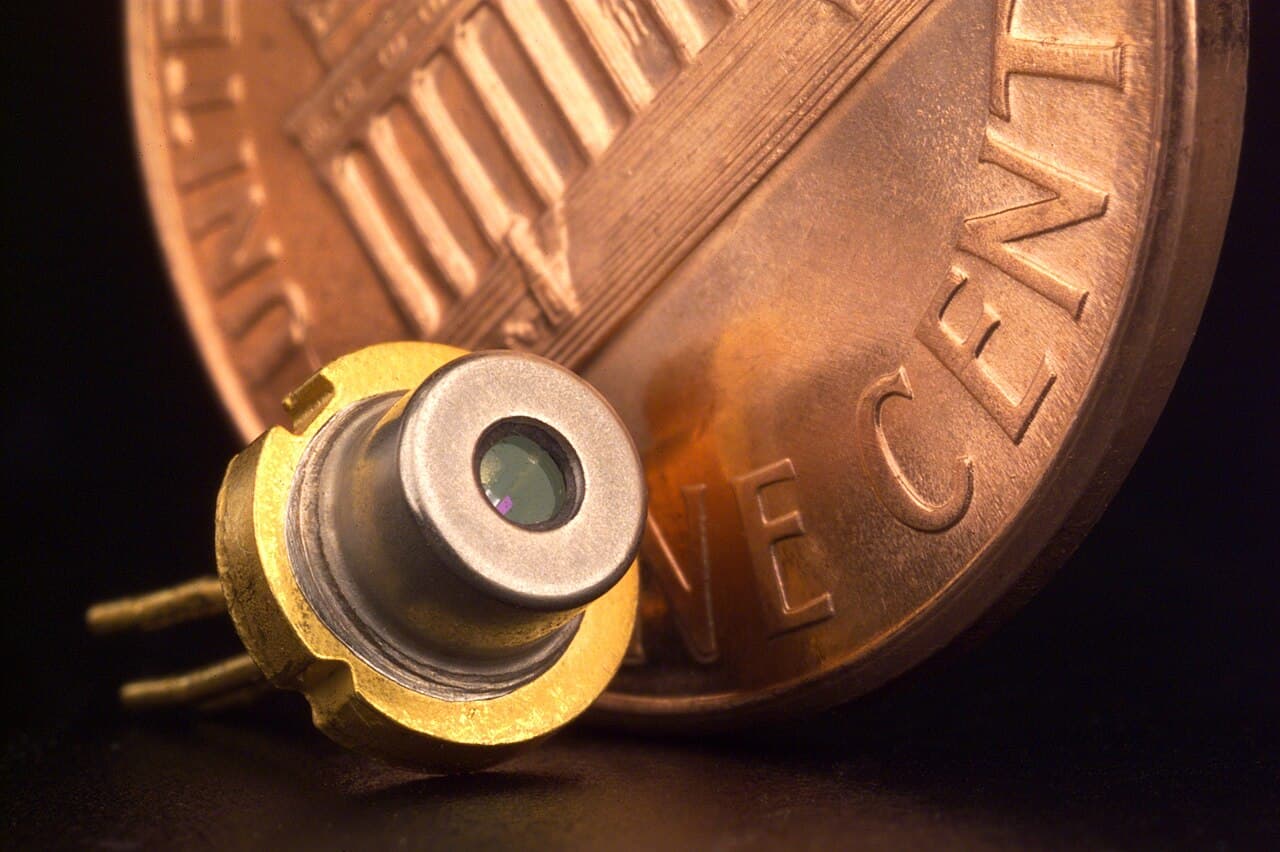
Laser diode
Laser diodes made from gallium arsenide and gallium nitride read optical discs and drive fiber-optic links.
Photo: Wikimedia Commons
Bauxite
Bauxite, the main aluminium ore, is also the world's main source of gallium.
Photo: Wikimedia Commons


Research
No research on Gallium yet
When Bhavya publishes a project that studies Gallium, it will be linked here.