Indium
Post-transition metal · Period 5 · Group 13 · p-block
The soft metal that makes touchscreens possible
- Atomic mass
- 114.818 u
- State at 25 °C
- Solid
- Electronegativity
- 1.78
- Melting point
- 156.6 °C
- Boiling point
- 2,071.9 °C
- Configuration
- [Kr] 4d10 5s2 5p1
Nucleus drawn at reduced count for clarity. Drag to rotate.
Indium, explained
Video lesson in production
Bhavya’s explainer for this element will play here.
Overview
Indium is a very soft, silvery metal in group 13, below gallium and above thallium. Its configuration is [Kr] 4d10 5s2 5p1, and it usually loses all three outer electrons to form In^3+, though the +1 state also exists. Indium melts at just 157 °C and is soft enough to scratch with a fingernail. A bar bent near the ear makes a faint crackling 'cry' as crystal twins form inside it, and the clean metal wets glass, sticking to it so well that it is used to make vacuum seals at cryogenic temperatures.
Most indium goes into indium tin oxide (ITO), a ceramic that is both transparent to visible light and electrically conducting. Those two properties rarely coexist: ITO's tin atoms donate free electrons, while its wide band gap lets visible light pass. Thin ITO films form the invisible electrodes in nearly every touchscreen, LCD and OLED panel. Indium also forms important semiconductors. Indium gallium nitride produces the blue light of white LEDs, and indium phosphide lasers drive fibre-optic links. Because indium is recovered only as a by-product of zinc refining, supply cannot easily expand with demand.
Discovery
In 1863 Ferdinand Reich and Hieronymous Theodor Richter at the Freiberg Mining Academy in Saxony were searching zinc ores for thallium. Because Reich was colour-blind, Richter examined the samples in a spectroscope and saw a brilliant indigo-blue line that matched no known element. They named it indium after the colour, from the Latin indicum, meaning indigo. Richter isolated the metal in 1864, and a sample was shown at the 1867 Paris Exposition.
- Where it’s found
- Indium makes up about 0.05 parts per million of the crust and is recovered mostly from residues of zinc refining, especially from sphalerite ores.
- What it’s used for
- Touchscreen electrodes (ITO)
- Flat-panel displays
- Blue and white LEDs
- Low-melting solders
- Cryogenic seals
- Fibre-optic lasers
- In living things
- Indium has no known biological role. Its compounds have moderate toxicity, and inhaling indium tin oxide dust in factories has been linked to serious lung disease.
- Safety
- Bulk indium is safe to handle, but indium compound dusts should not be inhaled, and indium-111 used in medicine is radioactive.
How it compares
Where Indium sits among all 118 elements on the trends that shape the table.
- Electronegativity1.78Pauling
#44 of 100 elements with data
- Ionization energy558kJ/mol
#85 of 104 elements with data
- Atomic radius155pm
#40 of 95 elements with data
- Electron affinity37kJ/mol
#61 of 109 elements with data
- Density7.31g/cm³
#59 of 114 elements with data
- Melting point430K
#86 of 110 elements with data
- Density
- 7.31 g/cm³
- Atomic radius
- 155 pm
- Covalent radius
- 142 pm
- Molar heat
- 26.74 J/(mol·K)
- Appearance
- silvery lustrous gray
- Discovered by
- Ferdinand Reich
Inside the atom
49 electrons arranged in 5 shells: 2 · 8 · 18 · 18 · 3.
Orbital diagram
1s2 2s2 2p6 3s2 3p6 4s2 3d10 4p6 5s2 4d10 5p1 · shorthand [Kr] 4d10 5s2 5p1
- 1s2
- 2s2
- 2p6
- 3s2
- 3p6
- 4s2
- 3d10
- 4p6
- 5s2
- 4d10
- 5p1
Each box is an orbital holding up to two electrons of opposite spin. Highlighted subshells hold the valence electrons that decide how Indium bonds.
Ionization energies
Signature reactions
The chemistry Indium is known for.
Redox · Combustion
Burning in air
Indium burns with a violet-blue flame to form yellow indium(III) oxide. Mixed with a little tin oxide, the same compound becomes the transparent conductor ITO.
Conditions: strong heating
Redox · Single displacement
Dissolving in hydrochloric acid
Indium sits above hydrogen in the activity series, so it slowly dissolves in acids and releases hydrogen. The resulting indium chloride solution is used to recover and purify the metal.
Conditions: warm dilute acid
Thermal decomposition · Thin-film growth
Growing indium phosphide
Vapours of trimethylindium and phosphine react on a hot wafer, laying down a crystalline indium phosphide film one atomic layer at a time. These films become the lasers and detectors of fibre-optic networks.
Conditions: metal-organic vapour-phase epitaxy, 500–650 °C
Where you’ll meet it

Touchscreen
Transparent indium tin oxide electrodes detect the position of your finger on most touchscreens.
Photo: Wikimedia Commons
Indium tin oxide
Transparent indium tin oxide films conduct electricity, and are used to heat aircraft cockpit windows as well as in display screens.
Photo: Wikimedia Commons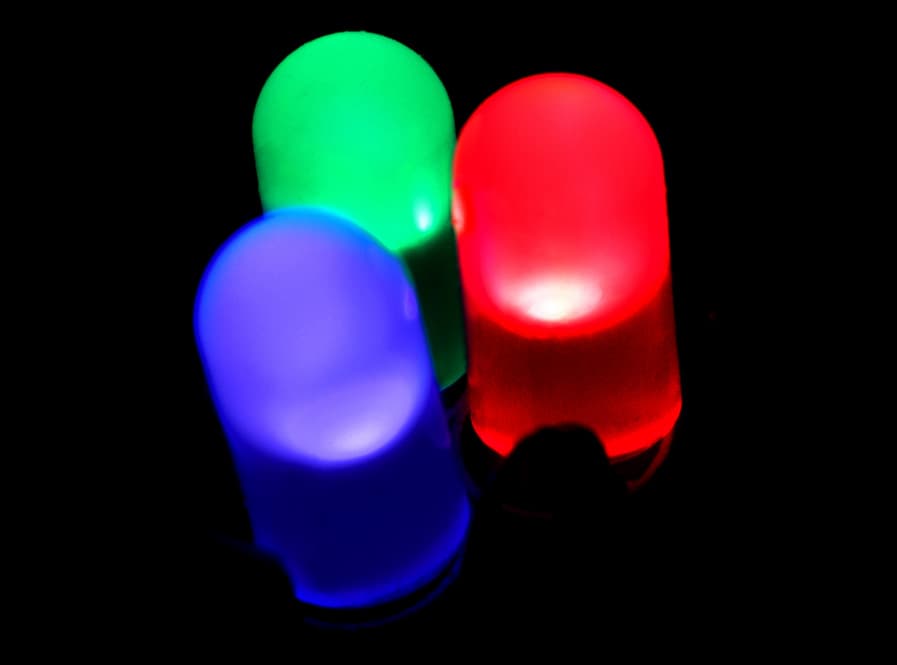
Light-emitting diode
Blue and white LEDs emit light from layers of indium gallium nitride.
Photo: Wikimedia Commons
Sphalerite
Indium is extracted as a by-product from zinc ores such as sphalerite.
Photo: Wikimedia Commons


Research
No research on Indium yet
When Bhavya publishes a project that studies Indium, it will be linked here.