Tungsten
Transition metal · Period 6 · Group 6 · d-block
The metal with the highest melting point of all
- Atomic mass
- 183.841 u
- State at 25 °C
- Solid
- Electronegativity
- 2.36
- Melting point
- 3,421.9 °C
- Boiling point
- 5,929.9 °C
- Configuration
- [Xe] 4f14 5d4 6s2
Nucleus drawn at reduced count for clarity. Drag to rotate.
Tungsten, explained
Video lesson in production
Bhavya’s explainer for this element will play here.
Overview
Tungsten has the highest melting point of any metal, 3422 °C, and the lowest vapour pressure. Its configuration is [Xe]4f14 5d4 6s2, and its six valence electrons fill all the bonding orbitals in its body-centred cubic crystal and none of the antibonding ones, producing extremely strong metallic bonds. It is also very dense, 19.3 g/cm3, almost exactly the same as gold.
These properties made tungsten the filament of incandescent light bulbs for a century; a filament glows at around 2500 °C without melting and evaporates only slowly. Today most tungsten goes into tungsten carbide, WC, a ceramic nearly as hard as diamond used in cutting tools, drill bits and mining equipment. Chemically, tungsten forms stable compounds in the +6 state, such as yellow WO3 and the tungstate ion, WO₄²⁻,, and resists most acids at room temperature.
Discovery
In 1781 Swedish chemist Carl Wilhelm Scheele showed that the mineral then called tungsten (Swedish for 'heavy stone', now named scheelite) contained a new acid. In 1783 the Spanish brothers Juan José and Fausto Elhuyar isolated the metal at Bergara by reducing an acid made from wolframite with charcoal. The symbol W comes from wolfram, the German name for wolframite, often explained as 'wolf's froth' because the ore lowered tin yields during smelting.
- Where it’s found
- About 1 part per million of Earth's crust, mined as wolframite and scheelite, with China producing most of the world's supply.
- What it’s used for
- Tungsten carbide cutting tools
- Light-bulb filaments
- TIG welding electrodes
- Radiation shielding
- X-ray tube targets
- Heavy alloys and counterweights
- In living things
- Some microbes, such as heat-loving archaea, use tungsten in essential enzymes; it has no known role in humans and is of low toxicity.
- Safety
- Bulk metal is safe; fine powder is flammable, and dust from grinding tungsten carbide with cobalt binder can harm the lungs.
How it compares
Where Tungsten sits among all 118 elements on the trends that shape the table.
- Electronegativity2.36Pauling
#13 of 100 elements with data
- Ionization energy770kJ/mol
#34 of 104 elements with data
- Atomic radius135pm
#59 of 95 elements with data
- Electron affinity78.8kJ/mol
#35 of 109 elements with data
- Density19.3g/cm³
#16 of 114 elements with data
- Melting point3,700K
#2 of 110 elements with data
- Density
- 19.3 g/cm³
- Atomic radius
- 135 pm
- Covalent radius
- 137 pm
- Molar heat
- 24.27 J/(mol·K)
- Appearance
- grayish white, lustrous
- Discovered by
- Carl Wilhelm Scheele
Inside the atom
74 electrons arranged in 6 shells: 2 · 8 · 18 · 32 · 12 · 2.
Orbital diagram
1s2 2s2 2p6 3s2 3p6 4s2 3d10 4p6 5s2 4d10 5p6 6s2 4f14 5d4 · shorthand [Xe] 4f14 5d4 6s2
- 1s2
- 2s2
- 2p6
- 3s2
- 3p6
- 4s2
- 3d10
- 4p6
- 5s2
- 4d10
- 5p6
- 6s2
- 4f14
- 5d4
Each box is an orbital holding up to two electrons of opposite spin. Highlighted subshells hold the valence electrons that decide how Tungsten bonds.
Ionization energies
Signature reactions
The chemistry Tungsten is known for.
Redox · Metal extraction
Hydrogen reduction of tungsten oxide
Hydrogen strips oxygen from yellow tungsten trioxide, leaving grey tungsten powder. Because tungsten's melting point is so high, the powder is then pressed and sintered rather than cast.
Conditions: about 700–1000 °C in flowing hydrogen
Redox · Combustion
Oxidation in air
Heated tungsten oxidises to yellow WO3. This is why bulb filaments must sit in a vacuum or inert gas: in air, a white-hot filament would burn out almost instantly.
Conditions: red heat, above about 400 °C
Synthesis · Carburisation
Forming tungsten carbide
Tungsten powder heated with carbon black forms tungsten carbide. Bonded with cobalt, it becomes the hard metal used in drill bits and machine tools.
Conditions: about 1400–2000 °C
Where you’ll meet it

Incandescent light bulb
The glowing coil in a classic bulb is a tungsten filament.
Photo: Wikimedia Commons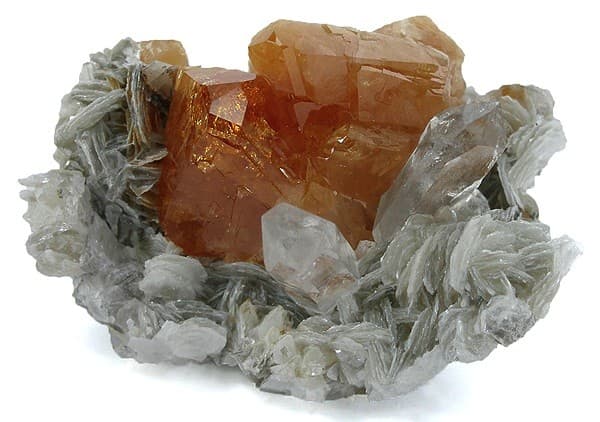
Scheelite
Calcium tungstate, the mineral in which Scheele found tungsten, glows blue under UV light.
Photo: Wikimedia Commons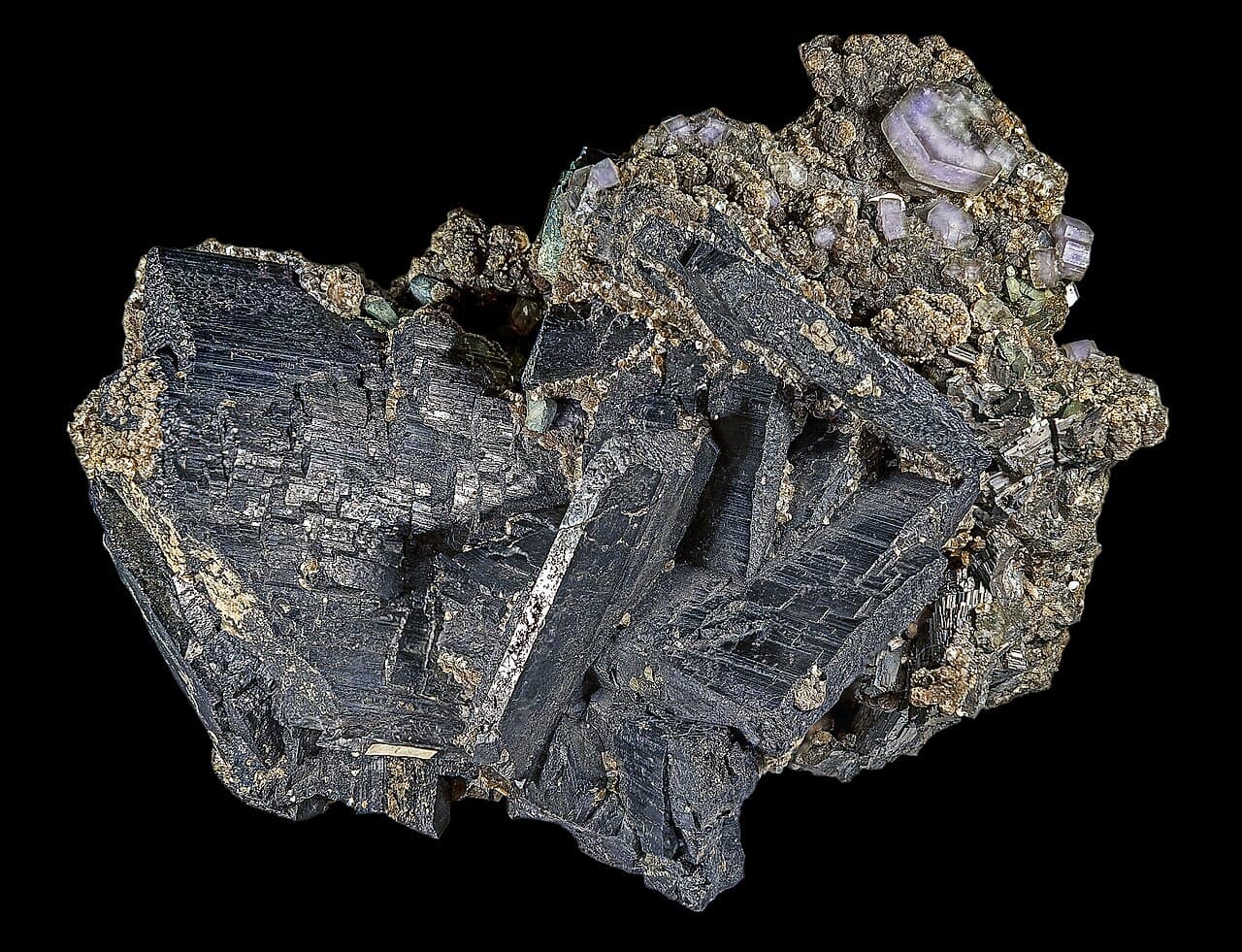

Gas tungsten arc welding
TIG welding uses a tungsten electrode that carries the arc without melting.
Photo: Wikimedia Commons


Research
No research on Tungsten yet
When Bhavya publishes a project that studies Tungsten, it will be linked here.