Technetium
Transition metal · Period 5 · Group 7 · d-block
The first human-made element, now behind millions of medical scans
- Atomic mass
- 98 u
- State at 25 °C
- Solid
- Electronegativity
- 1.9
- Melting point
- 2,156.9 °C
- Boiling point
- 4,264.9 °C
- Configuration
- [Kr] 4d5 5s2
Nucleus drawn at reduced count for clarity. Drag to rotate.
Technetium, explained
Video lesson in production
Bhavya’s explainer for this element will play here.
Overview
Technetium is the lightest element with no stable isotopes. It sits in group 7 between manganese and rhenium, and its chemistry resembles rhenium's: its most stable form in water is the pertechnetate ion, TcO4^−, with technetium in the +7 state. The reason it is entirely radioactive comes from nuclear rather than chemical structure. Technetium has an odd number of protons (43), and its neighbours molybdenum and ruthenium already have stable isotopes at nearly every mass number where a technetium nucleus might sit, so any technetium isotope can lower its energy by beta decay.
Its longest-lived isotopes, technetium-97 and technetium-98, have half-lives of about four million years, far shorter than Earth's age, so primordial technetium is gone. Trace amounts form in uranium ores by spontaneous fission. Nuclear reactors produce technetium-99 in large amounts as a fission product, a long-lived waste that is mobile in groundwater as pertechnetate. The metastable isomer technetium-99m is a workhorse of nuclear medicine: its six-hour half-life and clean 140 keV gamma emission let gamma cameras image bones, heart and organs while giving patients a low radiation dose.
Discovery
Dmitri Mendeleev left a gap below manganese in 1871 and called the missing element eka-manganese. Several claimed discoveries, including 'masurium' in 1925, could not be reproduced. In 1937 Emilio Segrè received a molybdenum foil that had been bombarded with deuterons in Ernest Lawrence's cyclotron at Berkeley. Working in Palermo with Carlo Perrier, he isolated radioactive isotopes of element 43, the first element produced artificially. They named it technetium, from the Greek technetos, meaning 'artificial'.
- Where it’s found
- Technetium is essentially absent from nature apart from tiny traces in uranium ores; it is obtained from spent nuclear fuel (Tc-99) or from molybdenum-99 generators (Tc-99m).
- What it’s used for
- Bone scans
- Heart perfusion imaging
- Thyroid and kidney imaging
- Sentinel lymph node mapping
- Corrosion inhibitor research
- In living things
- Technetium has no biological role. In medicine, pertechnetate behaves like iodide in the body, collecting in the thyroid and stomach, and it can be attached to carrier molecules that target specific organs.
- Safety
- All technetium isotopes are radioactive. Technetium-99 is a weak beta emitter that is handled in a glove box, while medical technetium-99m doses are small and decay to low levels within a day.
How it compares
Where Technetium sits among all 118 elements on the trends that shape the table.
- Electronegativity1.9Pauling
#36 of 100 elements with data
- Ionization energy702kJ/mol
#50 of 104 elements with data
- Atomic radius135pm
#59 of 95 elements with data
- Electron affinity53kJ/mol
#48 of 109 elements with data
- Density11g/cm³
#37 of 114 elements with data
- Melting point2,430K
#11 of 110 elements with data
- Density
- 11 g/cm³
- Atomic radius
- 135 pm
- Covalent radius
- 128 pm
- Molar heat
- 24.27 J/(mol·K)
- Appearance
- shiny gray metal
- Discovered by
- Emilio Segrè
Inside the atom
43 electrons arranged in 5 shells: 2 · 8 · 18 · 13 · 2.
Orbital diagram
1s2 2s2 2p6 3s2 3p6 4s2 3d10 4p6 5s2 4d5 · shorthand [Kr] 4d5 5s2
- 1s2
- 2s2
- 2p6
- 3s2
- 3p6
- 4s2
- 3d10
- 4p6
- 5s2
- 4d5
Each box is an orbital holding up to two electrons of opposite spin. Highlighted subshells hold the valence electrons that decide how Technetium bonds.
Ionization energies
Signature reactions
The chemistry Technetium is known for.
Nuclear · Deuteron bombardment
Discovery synthesis
A molybdenum nucleus absorbs a deuteron and ejects a neutron, raising the proton count to 43. Reactions like this in Lawrence's cyclotron produced the samples in which technetium was first identified.
Conditions: deuteron beam from a cyclotron
Nuclear · Beta decay
Medical generator decay
Molybdenum-99 emits a beta particle (and an antineutrino) to become metastable technetium-99m. The technetium is washed out of the generator as sodium pertechnetate and then emits a 140 keV gamma ray that a gamma camera detects.
Conditions: spontaneous, half-life 66 hours
Redox · Combustion
Burning in oxygen
Technetium metal burns to give pale yellow, volatile technetium(VII) oxide. In water this oxide forms pertechnic acid, the source of the pertechnetate ion.
Conditions: heated in oxygen, about 500 °C
Where you’ll meet it

Gamma camera
Gamma cameras detect the 140 keV photons from technetium-99m to map organs inside the body.
Photo: Wikimedia Commons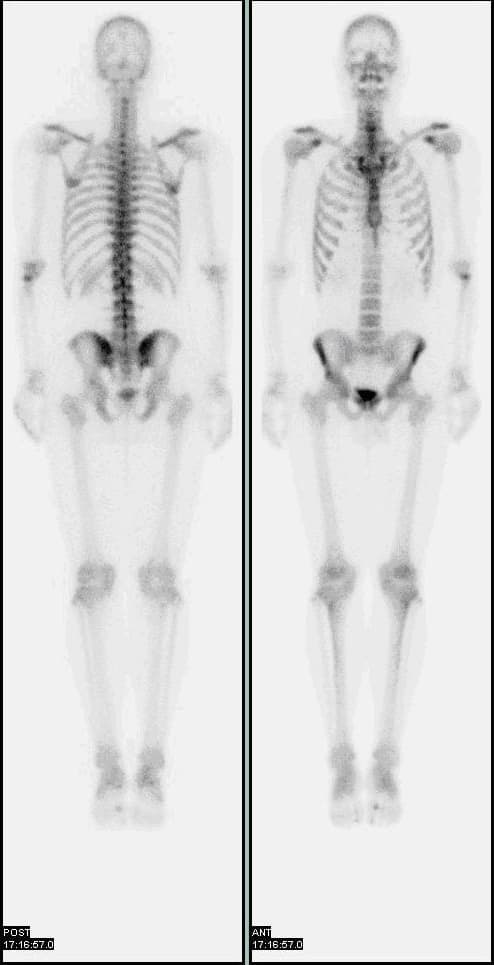
Bone scintigraphy
A whole-body bone scan shows where a technetium-labelled phosphate tracer has concentrated in the skeleton.
Photo: Wikimedia Commons
S-type star
Technetium in the spectra of S-type giants showed that stars forge heavy elements.
Photo: Wikimedia Commons
Emilio Segrè
Emilio Segrè co-discovered technetium in 1937 and later shared a Nobel Prize for discovering the antiproton.
Photo: Wikimedia Commons


Research
No research on Technetium yet
When Bhavya publishes a project that studies Technetium, it will be linked here.