Selenium
Reactive nonmetal · Period 4 · Group 16 · p-block
The moon element that turns light into electricity
- Atomic mass
- 78.972 u
- State at 25 °C
- Solid
- Electronegativity
- 2.55
- Melting point
- 220.9 °C
- Boiling point
- 684.9 °C
- Configuration
- [Ar] 3d10 4s2 4p4
Selenium, explained
Video lesson in production
Bhavya’s explainer for this element will play here.
Overview
Selenium is a nonmetal in group 16, directly below sulfur, with six valence electrons ([Ar]3d10 4s2 4p4). It forms selenides (−2) and compounds in the +4 and +6 states, much as sulfur does. Selenium has several allotropes: red amorphous powder, black glassy selenium, and the stable gray form made of spiral chains of atoms. Gray selenium is a semiconductor whose electrical conductivity rises sharply in light, a property discovered in 1873 that led to early light meters, the first solid-state solar cell and the photocopier.
Selenium is both essential and poisonous, with a narrow window between the two. Adults need about 55 micrograms a day, while regular intakes above about 400 micrograms risk poisoning. The body builds selenium into the amino acid selenocysteine, found in antioxidant enzymes and in the enzymes that activate thyroid hormone. Industrially, selenium is used in glassmaking, in the electrolytic production of manganese, and in thin-film copper indium gallium selenide solar cells.
Discovery
In 1817 the Swedish chemists Jöns Jacob Berzelius and Johan Gottlieb Gahn noticed a reddish sludge in the lead chambers of a sulfuric acid works that used pyrite from the Falun copper mine. At first they thought it contained tellurium, but Berzelius showed it was a new element. Because tellurium had been named after the Earth (Latin tellus), he named its chemical cousin after the Moon, from the Greek selēnē.
- Where it’s found
- Selenium is rare, at about 0.05 ppm of the crust, and is recovered mainly from the anode slimes left over from electrolytic copper refining.
- What it’s used for
- Glass coloring and decolorizing
- Manganese production
- Thin-film solar cells
- Dietary supplements
- Anti-dandruff shampoo
- Rubber vulcanization
- In living things
- Selenium is an essential trace element, built into about 25 human selenoproteins, including glutathione peroxidases and the deiodinases that activate thyroid hormone. Too much causes selenosis, with hair and nail loss and garlic-smelling breath.
- Safety
- Hydrogen selenide and selenium dioxide are highly toxic and irritating. Chronic overexposure to selenium compounds causes selenosis.
How it compares
Where Selenium sits among all 118 elements on the trends that shape the table.
- Electronegativity2.55Pauling
#10 of 100 elements with data
- Ionization energy941kJ/mol
#19 of 104 elements with data
- Atomic radius115pm
#79 of 95 elements with data
- Electron affinity195kJ/mol
#9 of 109 elements with data
- Density4.81g/cm³
#82 of 114 elements with data
- Melting point494K
#84 of 110 elements with data
- Density
- 4.81 g/cm³
- Atomic radius
- 115 pm
- Covalent radius
- 116 pm
- Molar heat
- 25.363 J/(mol·K)
- Appearance
- black, red, and gray (not pictured) allotropes
- Discovered by
- Jöns Jakob Berzelius
Inside the atom
34 electrons arranged in 4 shells: 2 · 8 · 18 · 6.
Orbital diagram
1s2 2s2 2p6 3s2 3p6 4s2 3d10 4p4 · shorthand [Ar] 3d10 4s2 4p4
- 1s2
- 2s2
- 2p6
- 3s2
- 3p6
- 4s2
- 3d10
- 4p4
Each box is an orbital holding up to two electrons of opposite spin. Highlighted subshells hold the valence electrons that decide how Selenium bonds.
Ionization energies
Signature reactions
The chemistry Selenium is known for.
Redox · Combustion
Burning selenium
Selenium burns with a blue flame to form white selenium dioxide, giving off a smell often compared to rotten horseradish. The dioxide is used as an oxidizing agent in organic chemistry.
Conditions: heating in air
Redox · Precipitation
Recovering selenium with sulfur dioxide
Sulfur dioxide reduces dissolved selenous acid, and red elemental selenium precipitates from the solution. This step is used to recover selenium from copper refinery residues.
Conditions: acidic solution, room temperature
Hydrolysis
Hydrolysis of aluminium selenide
Aluminium selenide reacts with water to release hydrogen selenide, a foul-smelling gas even more toxic than hydrogen sulfide. The reaction mirrors the behavior of aluminium sulfide, reflecting the close relationship between sulfur and selenium.
Conditions: contact with water, fume hood essential
Where you’ll meet it


Photocopier
Early xerographic copiers relied on photoconductive selenium drums to form the image.
Photo: Wikimedia Commons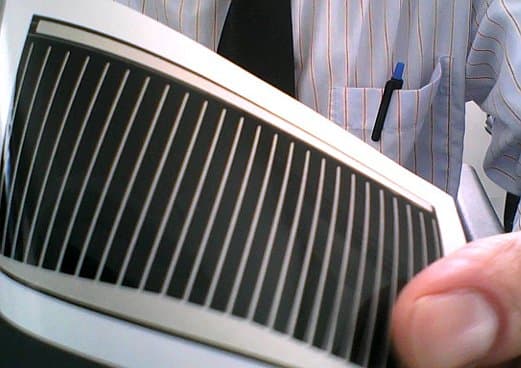
CIGS solar cell
Flexible thin-film CIGS solar cells use a light-absorbing layer of copper indium gallium selenide.
Photo: Wikimedia Commons
Kremlin stars
The ruby-red glass of the Moscow Kremlin's stars gets its color from selenium.
Photo: Wikimedia Commons


Research
No research on Selenium yet
When Bhavya publishes a project that studies Selenium, it will be linked here.