Yttrium
Transition metal · Period 5 · Group 3 · d-block
The rare earth behind white LEDs, lasers and superconductors
- Atomic mass
- 88.906 u
- State at 25 °C
- Solid
- Electronegativity
- 1.22
- Melting point
- 1,525.9 °C
- Boiling point
- 2,929.9 °C
- Configuration
- [Kr] 4d1 5s2
Yttrium, explained
Video lesson in production
Bhavya’s explainer for this element will play here.
Overview
Yttrium is the first element of the second transition series ([Kr]4d1 5s2), and like scandium above it, it gives up all three valence electrons to form Y3+. The ion has no d electrons, so yttrium compounds are colorless. Because of the lanthanide contraction, the Y3+ ion is almost exactly the same size as the ions of holmium and dysprosium, so yttrium is always found with the heavy rare earth elements, is extracted with them and is counted among the rare earths.
The metal is silvery and fairly stable in air thanks to a protective oxide film. Yttrium's value lies in its compounds. Yttrium aluminium garnet (YAG) crystals host neodymium in powerful industrial lasers, and cerium-doped YAG is the yellow phosphor that turns blue LED light white. Yttrium oxide stabilizes zirconia ceramics, and yttrium barium copper oxide (YBCO), discovered in 1987, was the first material to superconduct above the boiling point of liquid nitrogen.
Discovery
In 1787 Carl Axel Arrhenius, a Swedish army officer, found a heavy black mineral in a feldspar quarry at Ytterby near Stockholm. In 1794 the Finnish chemist Johan Gadolin showed that it contained a new earth, which was named yttria after the village. Yttria later turned out to be a mixture of several rare-earth oxides. Friedrich Wöhler prepared impure yttrium metal in 1828 by reducing its chloride with potassium.
- Where it’s found
- Yttrium is present at about 33 ppm in the crust and is extracted from xenotime, monazite and especially the ion-adsorption clays of southern China.
- What it’s used for
- White-LED phosphors
- YAG lasers
- Superconductors (YBCO)
- Stabilized zirconia ceramics
- Y-90 cancer therapy
- Turbine-blade coatings
- In living things
- Yttrium has no known biological role. Its compounds are of low to moderate toxicity, and radioactive yttrium-90 is used in medicine.
- Safety
- Fine yttrium powder or turnings are flammable. Soluble compounds are mildly toxic, and inhaled dust may damage the lungs.
How it compares
Where Yttrium sits among all 118 elements on the trends that shape the table.
- Electronegativity1.22Pauling
#77 of 100 elements with data
- Ionization energy600kJ/mol
#67 of 104 elements with data
- Atomic radius180pm
#17 of 95 elements with data
- Electron affinity29.6kJ/mol
#72 of 109 elements with data
- Density4.47g/cm³
#84 of 114 elements with data
- Melting point1,800K
#30 of 110 elements with data
- Density
- 4.47 g/cm³
- Atomic radius
- 180 pm
- Covalent radius
- 163 pm
- Molar heat
- 26.53 J/(mol·K)
- Appearance
- silvery white
- Discovered by
- Johan Gadolin
Inside the atom
39 electrons arranged in 5 shells: 2 · 8 · 18 · 9 · 2.
Orbital diagram
1s2 2s2 2p6 3s2 3p6 4s2 3d10 4p6 5s2 4d1 · shorthand [Kr] 4d1 5s2
- 1s2
- 2s2
- 2p6
- 3s2
- 3p6
- 4s2
- 3d10
- 4p6
- 5s2
- 4d1
Each box is an orbital holding up to two electrons of opposite spin. Highlighted subshells hold the valence electrons that decide how Yttrium bonds.
Ionization energies
Signature reactions
The chemistry Yttrium is known for.
Redox · Combustion
Burning in oxygen
Yttrium burns to form yttrium oxide (yttria), a white, very stable ceramic material with a melting point above 2400 °C. Yttria is the starting material for phosphors, lasers and stabilized zirconia.
Conditions: heating above about 400 °C
Solid-state synthesis
Synthesis of YBCO superconductor
Powdered oxides and barium carbonate are ground together and heated, releasing carbon dioxide and forming black yttrium barium copper oxide. The final oxygen anneal is critical: only material close to the YBa2Cu3O7 composition superconducts, at about 93 K.
Conditions: about 950 °C, then slow cooling in oxygen
Nuclear · Beta decay
Beta decay of yttrium-90
Yttrium-90 emits high-energy electrons that travel only a few millimeters in tissue. Tiny Y-90 microspheres injected into the liver's blood supply deliver concentrated radiation to tumors while sparing distant organs.
Conditions: half-life 64 hours
Where you’ll meet it

Ytterby
The Ytterby quarry on Resarö, Sweden, is the namesake of four elements, including yttrium.
Photo: Wikimedia Commons
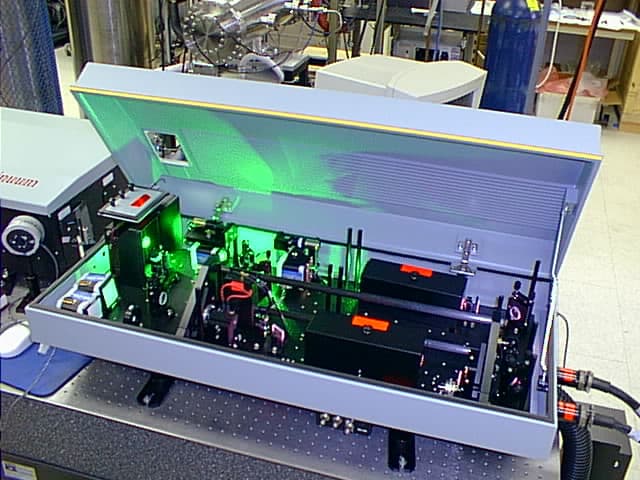
Nd:YAG laser
Neodymium-doped yttrium aluminium garnet lasers are used for cutting, welding and eye surgery.
Photo: Wikimedia Commons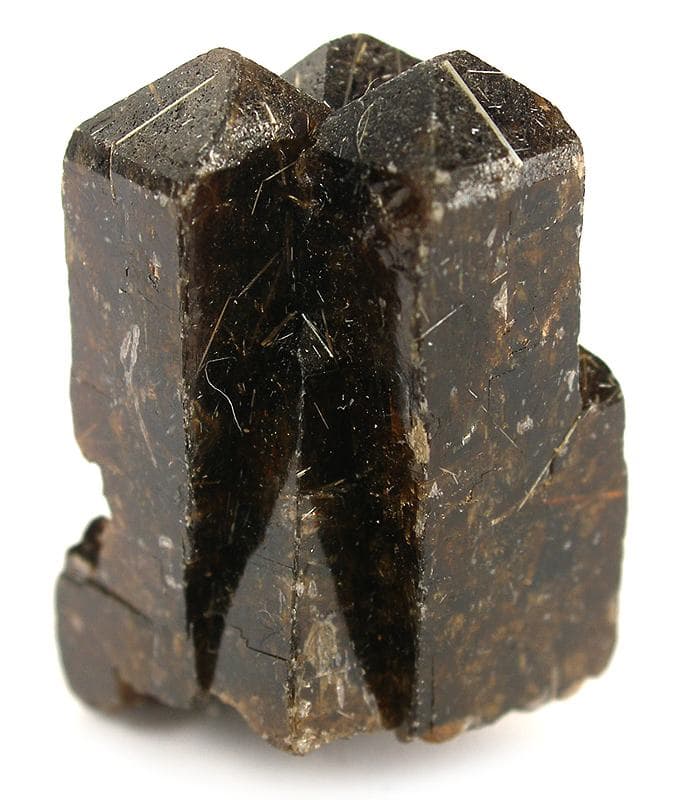
Xenotime
Xenotime, yttrium phosphate, is one of the main yttrium ore minerals.
Photo: Wikimedia Commons


Research
No research on Yttrium yet
When Bhavya publishes a project that studies Yttrium, it will be linked here.