Titanium
Transition metal · Period 4 · Group 4 · d-block
As strong as many steels, at little more than half the weight
- Atomic mass
- 47.867 u
- State at 25 °C
- Solid
- Electronegativity
- 1.54
- Melting point
- 1,667.9 °C
- Boiling point
- 3,286.9 °C
- Configuration
- [Ar] 3d2 4s2
Titanium, explained
Overview
Titanium has four valence electrons ([Ar]3d2 4s2), and its most stable compounds use all of them, as in titanium dioxide (TiO2) and titanium tetrachloride (TiCl4). On paper titanium is a reactive metal that should corrode easily. In reality it is one of the most corrosion-resistant metals known, because its surface instantly forms a dense, tightly bonded oxide film only a few nanometers thick. If the surface is scratched, the film re-forms in milliseconds, which is why titanium survives seawater, chlorine and body fluids.
Titanium is the ninth most abundant element in Earth's crust, yet the metal is expensive. Its affinity for oxygen and nitrogen means it cannot be smelted with carbon like iron; instead it is made by the slow, batch-wise Kroll process. With a density of 4.5 g/cm3, about 57 percent that of steel, and strength comparable to many steels, it is prized in aircraft, implants and chemical plants. Even so, about 95 percent of mined titanium never becomes metal: it is turned into TiO2, the brilliant white pigment in paint, paper, plastics and toothpaste.
Discovery
In 1791 William Gregor, a clergyman and amateur mineralogist in Cornwall, found an unknown metal oxide in black sand from the Manaccan valley. In 1795 the German chemist Martin Heinrich Klaproth independently found the same element in rutile and named it after the Titans of Greek mythology. Pure titanium metal was not made until 1910, when Matthew Hunter reduced TiCl4 with sodium; William Kroll's magnesium process of the 1940s made it commercially practical.
- Where it’s found
- Making up about 0.6 percent of the crust, titanium is mined mainly as ilmenite (FeTiO3) and rutile (TiO2), largely from beach and mineral sands.
- What it’s used for
- White pigment (TiO2)
- Aircraft and jet engines
- Medical and dental implants
- Chemical plant equipment
- Sunscreen UV filter
- Architectural cladding
- In living things
- Titanium has no known biological role. The metal and its dioxide are largely inert in the body, which is why titanium is used for implants.
- Safety
- Solid titanium is harmless, but fine powder and machining chips are flammable, and burning titanium cannot be put out with water or carbon dioxide. Titanium tetrachloride fumes in moist air, releasing corrosive hydrogen chloride.
How it compares
Where Titanium sits among all 118 elements on the trends that shape the table.
- Electronegativity1.54Pauling
#54 of 100 elements with data
- Ionization energy659kJ/mol
#52 of 104 elements with data
- Atomic radius140pm
#52 of 95 elements with data
- Electron affinity7.29kJ/mol
#85 of 109 elements with data
- Density4.51g/cm³
#83 of 114 elements with data
- Melting point1,940K
#20 of 110 elements with data
- Density
- 4.51 g/cm³
- Atomic radius
- 140 pm
- Covalent radius
- 136 pm
- Molar heat
- 25.06 J/(mol·K)
- Appearance
- silvery grey-white metallic
- Discovered by
- William Gregor
Inside the atom
22 electrons arranged in 4 shells: 2 · 8 · 10 · 2.
Orbital diagram
1s2 2s2 2p6 3s2 3p6 4s2 3d2 · shorthand [Ar] 3d2 4s2
- 1s2
- 2s2
- 2p6
- 3s2
- 3p6
- 4s2
- 3d2
Each box is an orbital holding up to two electrons of opposite spin. Highlighted subshells hold the valence electrons that decide how Titanium bonds.
Ionization energies
Signature reactions
The chemistry Titanium is known for.
Redox · Kroll process step 1
Chlorination of rutile
Titanium dioxide is heated with coke and chlorine to make volatile titanium tetrachloride. The TiCl4 can be distilled to very high purity, removing iron and other impurities before the metal is produced.
Conditions: about 1000 °C, fluidized bed
Redox · Metal extraction
Magnesium reduction (Kroll process)
Titanium tetrachloride vapor is fed onto molten magnesium inside a sealed steel vessel, producing porous titanium sponge. The argon blanket is essential because hot titanium would otherwise absorb oxygen and nitrogen and become brittle.
Conditions: 800–850 °C, argon atmosphere
Hydrolysis
Hydrolysis of titanium tetrachloride
Liquid TiCl4 reacts at once with water vapor, producing dense white clouds of titanium dioxide particles and hydrogen chloride. The reaction has been used in naval smoke screens and in skywriting.
Conditions: contact with moist air
Where you’ll meet it

Guggenheim Museum Bilbao
Frank Gehry's museum is clad in about 33,000 thin titanium panels that ripple in the light.
Photo: Wikimedia Commons
SR-71 Blackbird
The Blackbird's titanium skin withstood temperatures above 300 °C caused by air friction at Mach 3.
Photo: Wikimedia Commons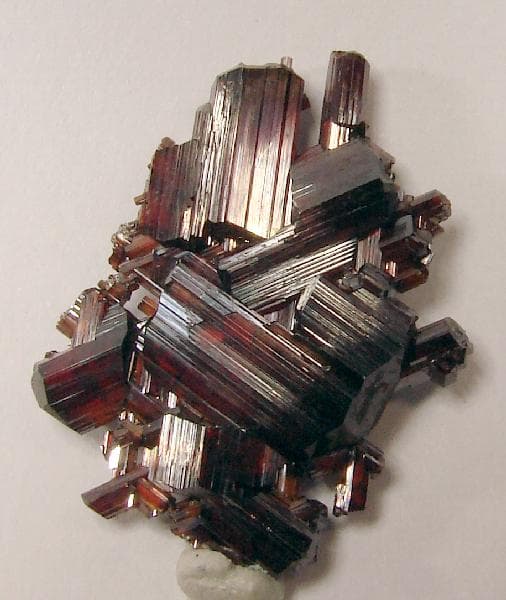
Rutile
Rutile is a natural crystalline form of titanium dioxide and one of the two main titanium ores.
Photo: Wikimedia Commons
Sunscreen
Nanoscale titanium dioxide in mineral sunscreens scatters and absorbs ultraviolet light.
Photo: Wikimedia Commons


Research
No research on Titanium yet
When Bhavya publishes a project that studies Titanium, it will be linked here.