Osmium
Transition metal · Period 6 · Group 8 · d-block
The densest natural element, with a toxic, smelly oxide
- Atomic mass
- 190.233 u
- State at 25 °C
- Solid
- Electronegativity
- 2.2
- Melting point
- 3,032.9 °C
- Boiling point
- 5,011.9 °C
- Configuration
- [Xe] 4f14 5d6 6s2
Nucleus drawn at reduced count for clarity. Drag to rotate.
Osmium, explained
Video lesson in production
Bhavya’s explainer for this element will play here.
Overview
Osmium is the densest naturally occurring element, at about 22.59 g/cm3, just ahead of iridium. Its configuration is [Xe]4f14 5d6 6s2. The lanthanide contraction makes its atoms barely larger than those of ruthenium above it, while its atomic mass is nearly twice as great, so a great deal of mass is packed into a small volume. The bluish-white metal is extremely hard and brittle, so it is used mainly in alloys where wear resistance matters.
Osmium can use all eight of its valence electrons, reaching the +8 oxidation state in osmium tetroxide, OsO4. This volatile, pale yellow solid gives off a sharp, chlorine-like smell, which is the origin of the element's name. OsO4 adds cleanly across carbon–carbon double bonds to make diols, a reaction central to the asymmetric synthesis that earned K. Barry Sharpless part of the 2001 Nobel Prize in Chemistry. It is also a stain in electron microscopy, where it binds to fats in cell membranes.
Discovery
English chemist Smithson Tennant discovered osmium in 1803 in London, along with iridium. When crude platinum was dissolved in aqua regia, a black insoluble residue remained, which most chemists assumed was graphite. Tennant showed that it contained two new metals. He named one osmium, from the Greek osme, 'smell', because of the pungent odour of its volatile oxide.
- Where it’s found
- One of the rarest stable elements in Earth's crust, it is recovered as a by-product of nickel and platinum refining, often from natural osmium-iridium alloys.
- What it’s used for
- Fountain-pen nib tips
- Electron-microscopy stains
- Fingerprint development
- Organic synthesis catalysts
- Hard-wearing alloys and pivots
- In living things
- No biological role. Osmium tetroxide is highly toxic, damaging the eyes, lungs and skin even at low concentrations.
- Safety
- Bulk metal is harmless, but finely divided osmium slowly forms OsO4 in air; this volatile oxide is highly toxic and must be handled in a fume hood.
How it compares
Where Osmium sits among all 118 elements on the trends that shape the table.
- Electronegativity2.2Pauling
#16 of 100 elements with data
- Ionization energy840kJ/mol
#28 of 104 elements with data
- Atomic radius130pm
#71 of 95 elements with data
- Electron affinity104kJ/mol
#27 of 109 elements with data
- Density22.6g/cm³
#9 of 114 elements with data
- Melting point3,310K
#4 of 110 elements with data
- Density
- 22.6 g/cm³
- Atomic radius
- 130 pm
- Covalent radius
- 129 pm
- Molar heat
- 24.7 J/(mol·K)
- Appearance
- silvery, blue cast
- Discovered by
- Smithson Tennant
Inside the atom
76 electrons arranged in 6 shells: 2 · 8 · 18 · 32 · 14 · 2.
Orbital diagram
1s2 2s2 2p6 3s2 3p6 4s2 3d10 4p6 5s2 4d10 5p6 6s2 4f14 5d6 · shorthand [Xe] 4f14 5d6 6s2
- 1s2
- 2s2
- 2p6
- 3s2
- 3p6
- 4s2
- 3d10
- 4p6
- 5s2
- 4d10
- 5p6
- 6s2
- 4f14
- 5d6
Each box is an orbital holding up to two electrons of opposite spin. Highlighted subshells hold the valence electrons that decide how Osmium bonds.
Ionization energies
Signature reactions
The chemistry Osmium is known for.
Redox · Oxidation
Formation of osmium tetroxide
Powdered osmium burns to form volatile OsO4, which escapes as a pungent vapour. This reaction is how osmium is separated from other platinum metals during refining.
Conditions: heating powdered osmium in air, about 400 °C
Acid–base · Complex formation
Dissolving OsO4 in alkali
Osmium tetroxide accepts two hydroxide ions to form a deep red-brown osmate(VIII) complex. Trapping the vapour in alkali this way is used both to collect osmium and to neutralise spills.
Conditions: aqueous sodium or potassium hydroxide
Redox · Synthesis
Fluorination
Osmium reacts with fluorine to give osmium hexafluoride, a volatile yellow compound. Only the most powerful oxidisers, fluorine and oxygen, can push osmium to its highest oxidation states.
Conditions: heating with fluorine, about 300 °C
Where you’ll meet it

Fountain pen
The hard tip on many gold pen nibs was traditionally an osmium-iridium alloy, called osmiridium.
Photo: Wikimedia Commons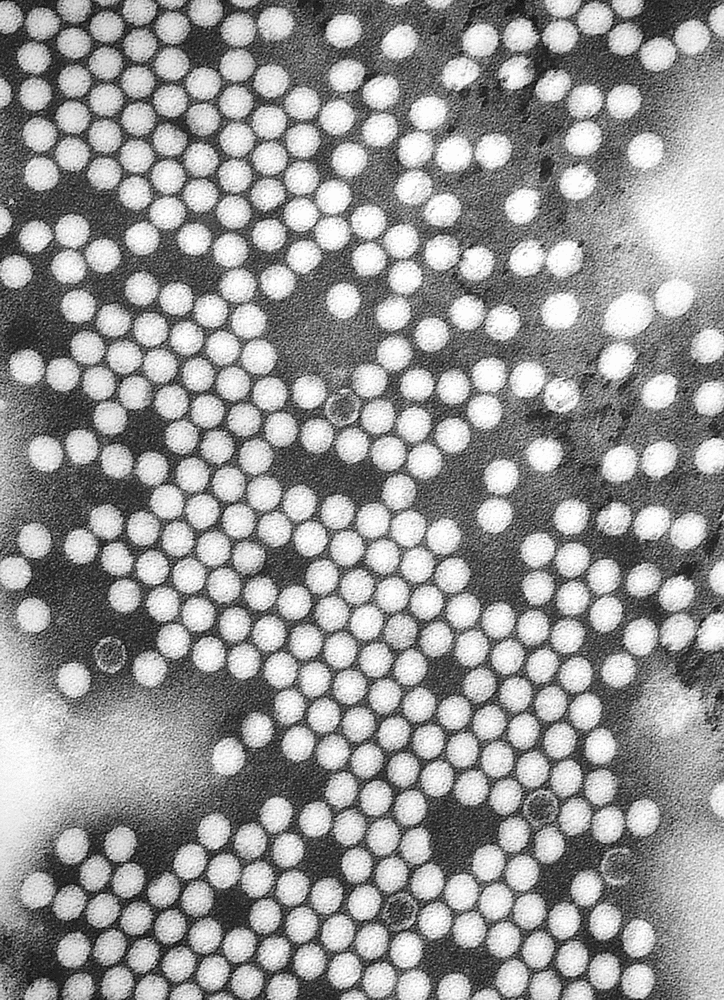
Transmission electron microscopy
Osmium tetroxide stains cell membranes so they show up dark in electron micrographs.
Photo: Wikimedia Commons
Fingerprint
Osmium tetroxide vapour reacts with fats in fingerprint residue, revealing latent prints.
Photo: Wikimedia Commons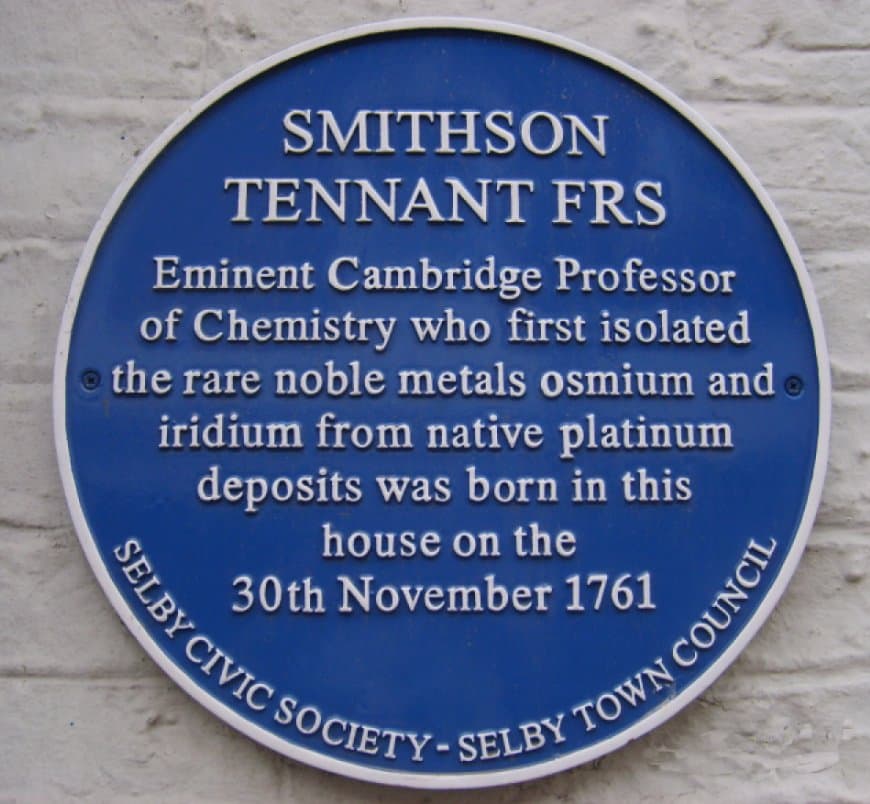
Smithson Tennant
The English chemist who discovered osmium and iridium in 1803.
Photo: Wikimedia Commons


Research
No research on Osmium yet
When Bhavya publishes a project that studies Osmium, it will be linked here.