Copernicium
Transition metal · Period 7 · Group 12 · d-block
A volatile heavy metal named for the man who moved the Sun
- Atomic mass
- 285 u
- State at 25 °C
- Liquid
- Electronegativity
- —
- Melting point
- 9.9 °Cpredicted
- Boiling point
- 66.9 °Cpredicted
- Configuration
- *[Rn] 5f14 6d10 7s2
Nucleus drawn at reduced count for clarity. Drag to rotate.
Copernicium, explained
Video lesson in production
Bhavya’s explainer for this element will play here.
Overview
Copernicium is the group 12 element below zinc, cadmium and mercury, with a 6d10 7s2 configuration. Its closed shells and strongly relativistically stabilized 7s electrons make it reluctant to form bonds, so it is expected to be even more volatile and less reactive than mercury. Some early predictions, notably by Kenneth Pitzer in 1975, suggested it might even behave almost like a noble gas, making it a sharp test of how far relativity can rewrite periodic trends.
Experiments in 2006 and 2007 by a PSI-Dubna collaboration tested this with copernicium-283 atoms flowing over gold-coated detectors cooled along a temperature gradient. Copernicium adsorbed on gold only at temperatures well below where mercury sticks, showing it is a volatile metal with a weak bond to gold, weaker than mercury's. Later calculations suggest that bulk copernicium would be a liquid near room temperature, a prediction that cannot yet be tested.
Discovery
Sigurd Hofmann's team at GSI made copernicium on 9 February 1996 by bombarding lead-208 with zinc-70, observing copernicium-277. Its discovery was confirmed by GSI in 2000 and by RIKEN in 2004, and IUPAC credited GSI in 2009. The name honors Nicolaus Copernicus, who placed the Sun at the center of the solar system, and was announced on 19 February 2010, his 537th birthday. The proposed symbol Cp was changed to Cn.
- Where it’s found
- Copernicium does not occur in nature; it is made in accelerators or as a decay product of flerovium.
- What it’s used for
- Superheavy volatility studies
- Relativistic effects research
- Gold-adsorption chemistry
- Nuclear structure research
- In living things
- Copernicium has no biological role; it is radioactive and has only ever existed as individual atoms.
- Safety
- Radioactive and made only a few atoms at a time; it decays within seconds to minutes.
How it compares
Where Copernicium sits among all 118 elements on the trends that shape the table.
- ElectronegativityNo data
Not measured for this element
- Ionization energyNo data
Not measured for this element
- Atomic radiusNo data
Not measured for this element
- Electron affinityNo data
Not measured for this element
- Density14g/cm³
#23 of 114 elements with data · predicted
- Melting point283K
#97 of 110 elements with data · predicted
- Density
- 14 g/cm³
- Atomic radius
- —
- Covalent radius
- —
- Molar heat
- —
- Appearance
- —
- Discovered by
- Gesellschaft für Schwerionenforschung
Inside the atom
112 electrons arranged in 7 shells: 2 · 8 · 18 · 32 · 32 · 18 · 2.
Orbital diagram
1s2 2s2 2p6 3s2 3p6 4s2 3d10 4p6 5s2 4d10 5p6 6s2 4f14 5d10 6p6 7s2 5f14 6d10 · shorthand *[Rn] 5f14 6d10 7s2
- 1s2
- 2s2
- 2p6
- 3s2
- 3p6
- 4s2
- 3d10
- 4p6
- 5s2
- 4d10
- 5p6
- 6s2
- 4f14
- 5d10
- 6p6
- 7s2
- 5f14
- 6d10
Each box is an orbital holding up to two electrons of opposite spin. Highlighted subshells hold the valence electrons that decide how Copernicium bonds.
Signature reactions
How the first atoms were made, and how they fall apart.
Nuclear · Cold fusion
GSI cold-fusion synthesis
Zinc-70 fuses with lead-208 and the compound nucleus emits one neutron. The cross-section was about a picobarn, meaning roughly one atom per week of bombardment.
Conditions: zinc-70 beam on lead-208, GSI UNILAC, 1996
Nuclear · Hot fusion
Hot-fusion route to flerovium
Calcium-48, with 20 protons and 28 neutrons, fuses with plutonium-242 to make flerovium-287 after three neutrons evaporate. This was the source of copernicium atoms for the first chemistry experiments.
Conditions: calcium-48 beam on plutonium-242, Dubna
Nuclear · Alpha decay
Alpha decay to copernicium-283
Flerovium-287 emits an alpha particle to form copernicium-283, which lives about 4 seconds, long enough to be swept onto gold-coated detectors. The measured adsorption showed copernicium is more volatile than mercury.
Conditions: spontaneous, half-life about 0.5 seconds
Where you’ll meet it

Nicolaus Copernicus
The Renaissance astronomer who put the Sun at the center of the solar system is honored by element 112.
Photo: Wikimedia Commons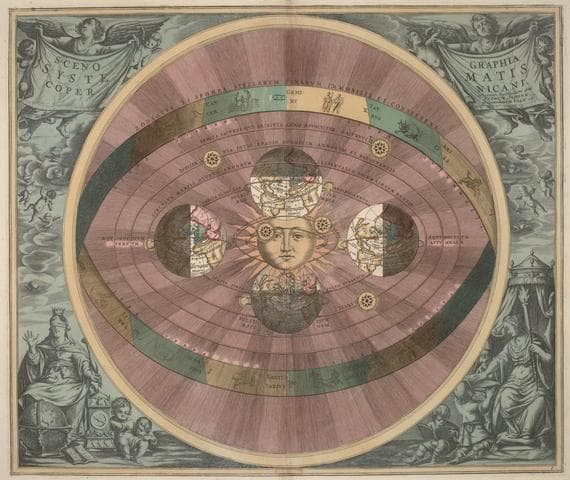
Heliocentrism
Copernicus's Sun-centered model, published in 1543, is commemorated in element 112's name.
Photo: Wikimedia Commons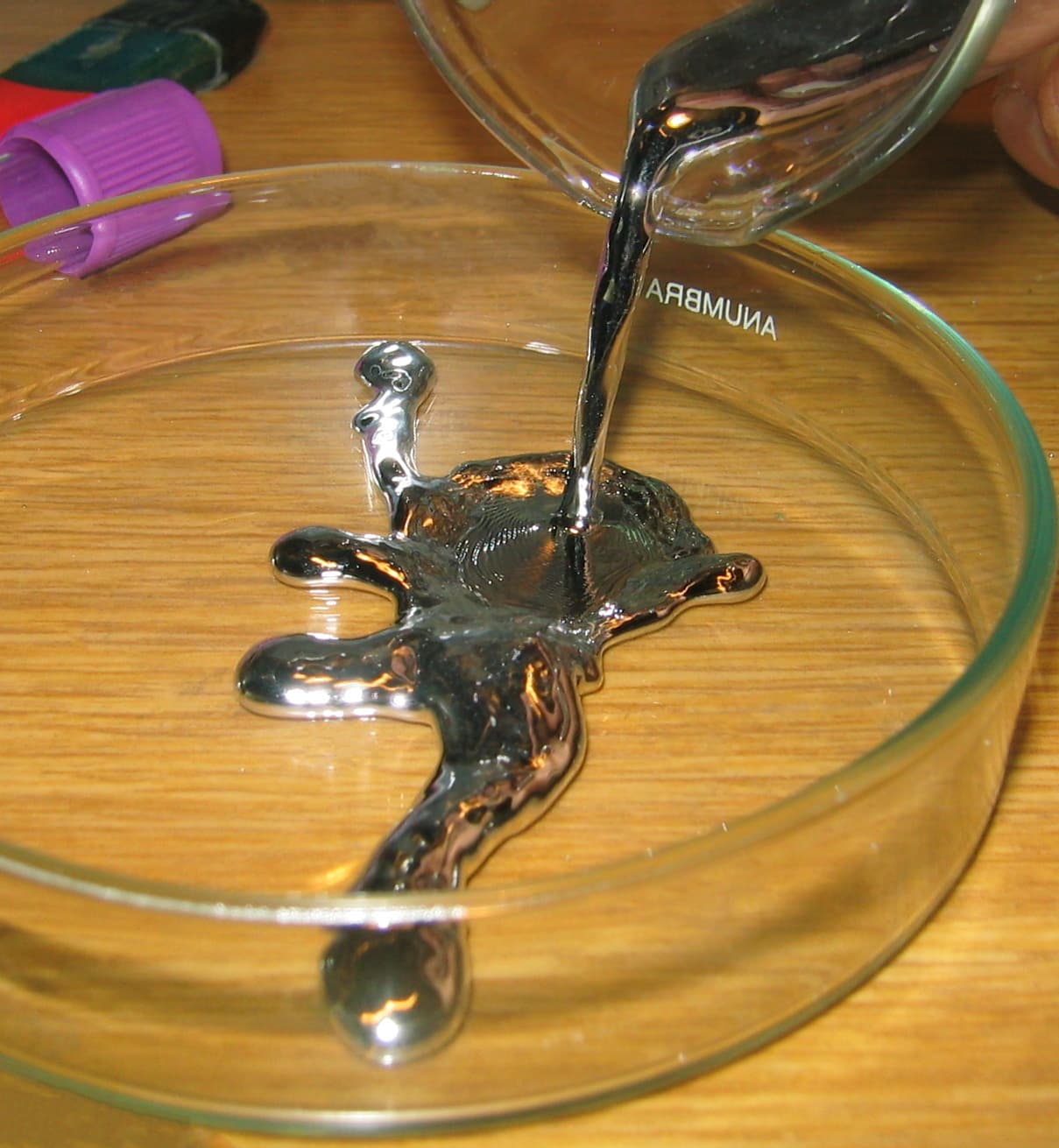
Mercury (element)
Mercury, directly above copernicium in group 12, is a liquid metal, and copernicium may be even more volatile.
Photo: Wikimedia Commons
Gold
Copernicium's chemistry was tested by measuring how weakly its atoms stick to gold surfaces.
Photo: Wikimedia Commons


Research
No research on Copernicium yet
When Bhavya publishes a project that studies Copernicium, it will be linked here.