Cobalt
Transition metal · Period 4 · Group 9 · d-block
The blue of Ming porcelain and the heart of vitamin B12
- Atomic mass
- 58.933 u
- State at 25 °C
- Solid
- Electronegativity
- 1.88
- Melting point
- 1,494.9 °C
- Boiling point
- 2,926.9 °C
- Configuration
- [Ar] 3d7 4s2
Cobalt, explained
Video lesson in production
Bhavya’s explainer for this element will play here.
Overview
Cobalt ([Ar]3d7 4s2) forms compounds mainly in the +2 and +3 oxidation states. Cobalt(II) salts are pink in water, where each ion is surrounded by six water molecules, but turn deep blue when four chloride ions crowd around instead; the change in geometry alters how the d orbitals split and which light is absorbed. Cobalt(III) forms exceptionally stable, slow-reacting complexes, which is why Alfred Werner chose cobalt ammines to work out the theory of coordination compounds that won him the 1913 Nobel Prize.
Cobalt is a hard, silvery, ferromagnetic metal, and it stays magnetic to about 1,115 °C, higher than any other element. Those properties suit it to jet-engine superalloys and powerful samarium–cobalt magnets. Its biggest market today is lithium-ion batteries, where cobalt stabilizes the layered oxide cathodes of phones and many electric cars. About 70 percent of the world's supply comes from the Democratic Republic of the Congo, raising serious concerns about working conditions in small-scale mines.
Discovery
Cobalt compounds colored Egyptian glass and Chinese porcelain blue for thousands of years before anyone knew the element existed. Around 1735 the Swedish chemist Georg Brandt showed that the blue came from a previously unknown metal, not from bismuth as had been assumed. The name comes from the German Kobold, a goblin: miners blamed goblins for ores that looked valuable but gave off poisonous arsenic fumes when smelted and yielded no copper or silver.
- Where it’s found
- Cobalt is produced mostly as a by-product of copper and nickel mining, above all in the Democratic Republic of the Congo, from minerals such as carrollite, heterogenite and cobaltite.
- What it’s used for
- Lithium-ion battery cathodes
- Jet-engine superalloys
- Samarium–cobalt magnets
- Blue glass and ceramics
- Cobalt-60 radiotherapy
- Industrial catalysts
- In living things
- Humans need cobalt only as part of vitamin B12, which is essential for making red blood cells and maintaining nerves. Ruminants such as sheep need dietary cobalt so that their gut microbes can make B12 for them.
- Safety
- Inhaled cobalt dust can cause asthma and lung disease, and cobalt metal is classified by IARC as probably carcinogenic to humans. Cobalt-60 is an intense gamma-ray source that must be heavily shielded.
How it compares
Where Cobalt sits among all 118 elements on the trends that shape the table.
- Electronegativity1.88Pauling
#40 of 100 elements with data
- Ionization energy760kJ/mol
#38 of 104 elements with data
- Atomic radius135pm
#59 of 95 elements with data
- Electron affinity63.9kJ/mol
#43 of 109 elements with data
- Density8.9g/cm³
#48 of 114 elements with data
- Melting point1,770K
#31 of 110 elements with data
- Density
- 8.9 g/cm³
- Atomic radius
- 135 pm
- Covalent radius
- 111 pm
- Molar heat
- 24.81 J/(mol·K)
- Appearance
- hard lustrous gray metal
- Discovered by
- Georg Brandt
Inside the atom
27 electrons arranged in 4 shells: 2 · 8 · 15 · 2.
Orbital diagram
1s2 2s2 2p6 3s2 3p6 4s2 3d7 · shorthand [Ar] 3d7 4s2
- 1s2
- 2s2
- 2p6
- 3s2
- 3p6
- 4s2
- 3d7
Each box is an orbital holding up to two electrons of opposite spin. Highlighted subshells hold the valence electrons that decide how Cobalt bonds.
Ionization energies
Signature reactions
The chemistry Cobalt is known for.
Complex formation · Equilibrium
Chloride complex color change
Adding chloride turns pink octahedral hexaaquacobalt(II) into the blue tetrahedral tetrachlorocobaltate(II) ion. Because the forward reaction is endothermic, heating the solution turns it blue and cooling turns it pink again, a vivid Le Chatelier demonstration.
Conditions: concentrated HCl; warming favors the blue form
Decomposition · Hydrate
Dehydration of cobalt chloride
Pink cobalt chloride hexahydrate loses its water of crystallization and turns blue. The change reverses in damp air, which is the principle behind cobalt chloride moisture-test paper.
Conditions: gentle heating
Nuclear · Neutron activation
Making cobalt-60
Natural cobalt, which is entirely cobalt-59, captures a neutron to become radioactive cobalt-60, with a half-life of 5.27 years. Its gamma rays sterilize medical equipment and food and treat cancer.
Conditions: neutron irradiation in a nuclear reactor
Where you’ll meet it

Blue and white porcelain
Chinese blue-and-white porcelain, including Ming ware, is painted with cobalt oxide under the glaze.
Photo: Wikimedia Commons
Erythrite
Erythrite, a hydrated cobalt arsenate, forms crimson to pink crystals called cobalt bloom.
Photo: Wikimedia Commons
Lithium-ion battery
Many lithium-ion cells use cathodes of lithium cobalt oxide or nickel–manganese–cobalt oxide.
Photo: Wikimedia Commons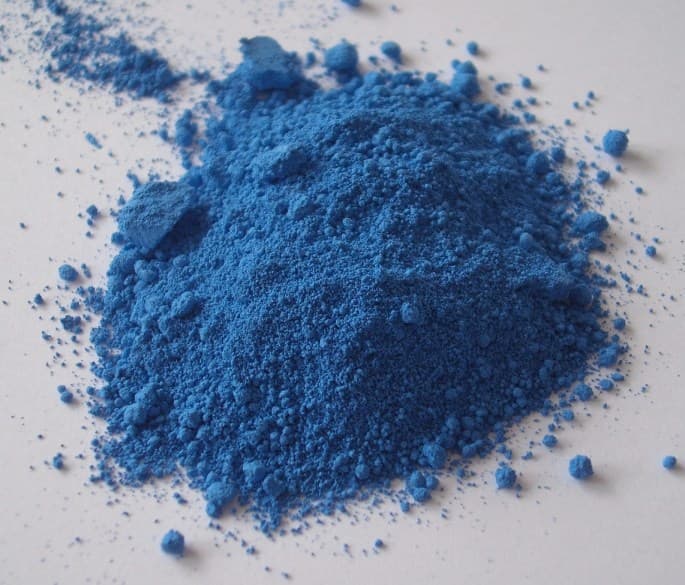
Cobalt blue
Cobalt blue, cobalt(II) aluminate, is a stable, intense pigment prized by painters since the 19th century.
Photo: Wikimedia Commons


Research
No research on Cobalt yet
When Bhavya publishes a project that studies Cobalt, it will be linked here.